The Ultimate Guide to Privacy-Compliant Commercial Data Providers
Privacy-Compliant Commercial Data Providers are among the most important and least understood players in modern healthcare marketing.
Published on December 22, 2025
These vendors power everything from programmatic activation to patient acquisition modeling, yet their offerings, privacy claims, and actual utility vary wildly.
In healthcare, where compliance risk is ever-present and digital targeting is tightly regulated, these providers are often misunderstood. Some are seen as magic bullets that can unlock compliant audience expansion. Others are dismissed entirely out of caution or confusion. The reality, as always, is more nuanced.
This guide exists to bring clarity to that nuance. Built for healthcare marketers, digital strategists, compliance officers, and IT stakeholders, it answers four essential questions:
- What are commercial data providers, and what makes them compliant?
- What role do they play in a HIPAA-aligned marketing stack?
- How can you evaluate vendors for safety, interoperability, and utility?
- Who are the leaders in this space, and what sets them apart?
Privacy-compliant data is not a shortcut. It’s infrastructure. The right provider can help you build a more secure, scalable, and legally defensible marketing strategy. The wrong provider can compromise trust, expose risk, or waste budget on poorly matched audiences.
This guide helps you make the right call.






Wheelhouse POV
What Are Privacy-Compliant Commercial Data Providers?
Privacy-Compliant Commercial Data Providers are third-party vendors that supply enriched, de-identified, and privacy-safe data to support audience targeting, segmentation, and measurement in healthcare marketing.
Unlike platforms that rely on first-party data from your CRM or website, these providers bring in external intelligence. Their value lies in expanding the audience you can reach and understand, without compromising compliance.
What They Provide
These vendors typically offer:
- Demographic and behavioral data linked to health-related interests or content engagement
- Professional datasets for reaching healthcare providers, decision-makers, or influencers
- Modeled indicators based on claims, prescriptions, or consumer behaviors
- Propensity scores that estimate likelihood of certain conditions, treatments, or actions
- Opt-in or survey-based data where individuals have explicitly shared health interests or intent signals
All data is delivered in a HIPAA-aligned format. It is either de-identified, pseudonymized, or tokenized. Vendors use methods like hashed IDs, clean rooms, and audience suppression to ensure that PHI is never exposed or activated improperly.
Where the Data Comes From
Most vendors in this category start from the same foundational inputs:
- Public data like the National Provider Identifier (NPI) registry
- Licensed claims and prescription datasets from clearinghouses or partners
- Consumer data from aggregators, modeled or inferred through non-PHI signals
- Opt-in survey panels where individuals disclose conditions, preferences, or behaviors
- Digital engagement data gathered from publisher networks or data partnerships
The difference lies in what happens next.
Why It Matters
What separates one vendor from another is not usually the data source, it’s the methodology:
- How datasets are cleaned, deduplicated, and refreshed
- What models are used to infer likely health interests or intent
- How privacy is enforced throughout the enrichment and delivery process
- Whether opt-in data is blended or kept separate from modeled data
- How the output is structured for activation through clean rooms, hashed IDs, or suppression logic
This post-processing is what defines a vendor’s utility, performance, and risk profile.
Why This Matters In Healthcare Marketing
In most industries, digital marketers can build lookalike audiences, retarget users, and enrich segments with little concern for regulatory risk. Healthcare is different. Privacy is not a guideline; it is law.
Healthcare marketers operate under the constraints of HIPAA, state-level laws like CPRA and My Health My Data, and increasing scrutiny from the FTC and OCR. Even when data is technically de-identified, using it improperly can trigger compliance violations.
Despite these risks, marketing teams still need to reach new patients, promote services, and demonstrate ROI. That is where privacy-compliant commercial data providers come in.
These vendors make it possible to:
- Expand targeting beyond your existing patient base
- Reach health-interested audiences without revealing PHI
- Conduct cross-channel campaigns using hashed IDs or clean rooms
- Measure performance using privacy-safe signals
Without these partners, your options narrow to contextual targeting or generic awareness campaigns. Worse, you risk leaning on non-compliant tactics such as remarketing based on site engagement or identity-based audience uploads.
Wheelhouse POV
The Role of Data Providers In The Healthcare Marketing Stack
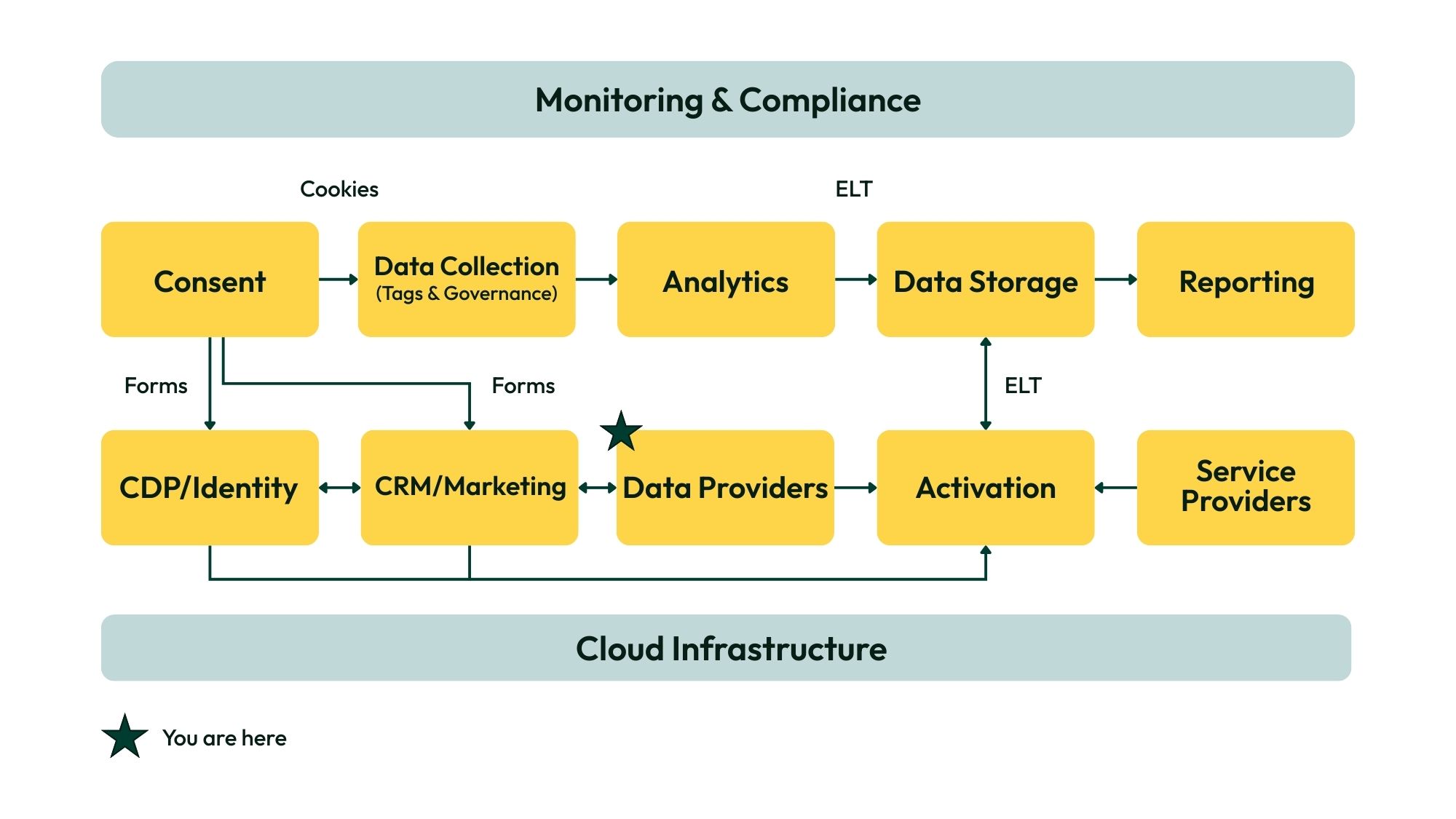
Data providers are not standalone solutions. They represent one layer within a broader, privacy-aligned MarTech ecosystem. Their role is to enrich targeting and audience strategy by supplying compliant data into the platforms that execute campaigns or measure results.
They do not replace your CDP, CRM, consent platform, or analytics tools. Instead, they integrate with those systems and expand their capabilities without introducing compliance risk.
Where They Fit
These providers typically support three core functions within the marketing workflow:
Audience Strategy and Segmentation
Offering data that helps define who you want to reach, based on demographics, behaviors, or modeled health interests.
Activation Readiness
Delivering audiences in formats that can be used in clean rooms, DSPs, or social platforms through hashed IDs or secure APIs.
Measurement and Matchback
Supporting privacy-safe performance evaluation through cohort-level insights instead of individual-level tracking.
How They Interact with Other Tools
Customer Data Platforms (CDPs)
Data providers can enrich audience definitions and suppression logic when integrated into CDPs, especially when clean room capabilities are involved.
Demand-Side Platforms (DSPs)
Many providers offer ready-to-activate audience segments for programmatic campaigns, either directly or through identity infrastructure partners.
Consent Management Platforms (CMPs)
While there is no direct integration, alignment is critical. Any third-party data activation must respect the consent policies governing your first-party environment.
Analytics Platforms
The de-identified signals from data providers can be used to inform attribution, segment-level performance, and high-level campaign insights without exposing PHI.
Wheelhouse POV
Core Qualities Of A Privacy-Compliant Data Provider
Not all data providers operating in healthcare are truly privacy-compliant. Many market themselves as HIPAA-safe, but only a subset can back that claim with defensible methods, audit-ready documentation, and activation models that hold up under scrutiny.
To separate qualified partners from high-risk vendors, focus on the following attributes:
1. Privacy Enforcement Built Into the Product
The provider should apply privacy controls at the data level, not just through contracts. Look for:
- Proven methodologies that align with HHS de-ID standards
- De-identification or pseudonymization at the source
- Suppression of sensitive attributes

Wheelhouse Caution
2. Support for HIPAA-Safe Activation
Data is only as compliant as the way it is used. Vendors should offer activation methods that prevent PHI exposure and identity leakage. Strong indicators include:
- Delivery through hashed IDs or tokenized formats
- Clean room compatibility
- Preconfigured segments that suppress high-risk behaviors
3. Clear Consent or Opt-In Logic
For consumer-level datasets, especially those tied to health-related behaviors, consent matters. Trustworthy vendors can show:
- How they collect and manage opt-in signals
- What disclosures are made to individuals
- How they manage consent revocation or suppression
4. Source Transparency and Refresh Rates
You should know where the data comes from, how it was processed, and how often it is updated. This protects both compliance and performance. Ask:
- What are the core data sources?
- How often is the data refreshed?
- What happens when records are outdated or invalid?
5. Audit-Ready Documentation
Any provider you work with should be able to produce compliance documentation on demand. This includes:
- A documented de-ID methodology
- Sample data dictionaries or output specs
- BAA templates (if applicable) or equivalent legal scaffolding
Wheelhouse POV
The Data Provider Vendor Landscape
The healthcare data market is crowded with vendors claiming privacy compliance, unique insights, or proprietary models. In reality, many of these providers work with overlapping datasets and offer similar services on the surface. The key differences come down to what type of data they specialize in, how they model and package it, and whether their compliance claims can hold up under legal review.
Below are the three primary categories of vendors, along with representative examples and their core use cases.
1. HCP Data Providers
These vendors focus on professional data for targeting licensed healthcare providers and decision-makers. They are most often used for B2B campaigns, CRM enrichment, or specialty-specific outreach.
Representative Vendors:
- IQVIA (OneKey): Offers broad, detailed HCP profiles with extensive NPI-level segmentation. Strong in life sciences use cases.
- Veeva OpenData: Known for CRM integration and robust provider data hygiene.
- HealthLink Dimensions: Focused on deliverable email addresses and HCP contact data, with consistent privacy positioning.
Typical Uses:
- HCP list creation and targeting
- License or specialty filtering
- B2B or referral campaigns
2. Consumer Health Data Providers
These vendors focus on consumer-level data enriched with health-related attributes, behaviors, or modeled interest. They power campaigns aimed at patients or caregivers while maintaining privacy standards.
Representative Vendors:
- Swoop: Specializes in condition-specific audience modeling and tokenized activation, often used for digital campaigns.
- Acxiom: Offers deep demographic and behavioral data with clean room integration.
- LexisNexis (Enclarity): Known for identity resolution and risk scoring, with healthcare applications across both provider and consumer targeting.
Typical Uses:
- Condition-based prospecting
- Lookalike audience modeling
- Activation through DSPs and social platforms
3. Hybrid Platforms
These vendors blend HCP and consumer data or provide infrastructure to support audience building and analysis across segments. They are often used by systems or agencies managing large-scale campaigns across multiple audience types.
Representative Vendors:
- Definitive Healthcare: Combines provider and facility data with intelligence on referral patterns and affiliations. Strong B2B and cross-segment capabilities.
- LiveRamp (via partners): Not a data originator, but often plays a role in onboarding, ID resolution, and clean room facilitation for both HCP and consumer audiences.
Typical Uses:
- Cross-channel segmentation and activation
- Audience measurement and matchback
- Market analysis or territory planning
Wheelhouse POV
Evaluation Framework
To evaluate commercial data providers with privacy and compliance in mind, we use a five-part framework tailored to the demands of HIPAA-regulated healthcare marketing. Each category is weighted based on its importance to compliance, performance, and operational readiness.
1. HIPAA & Privacy Compliance (30%)
This is the foundational category. If a vendor cannot demonstrate clear privacy practices, the rest does not matter. Providers must show:
- HIPAA-compliant de-identification and consent governance
- Willingness and ability to sign a Business Associate Agreement (BAA)
- Transparent sourcing, documentation, and audit readiness
- Built-in safeguards to reduce re-identification risk
2. Digital Activation Capability (25%)
It is not enough to have compliant data. You must be able to activate it safely, across real-world channels. This category assesses:
- Ability to activate audiences in DSPs, CDPs, or clean rooms
- Support for hashed ID graphs or tokenized audience delivery
- Coverage across channels like programmatic, social, CTV, and email
3. Healthcare Market Fit (20%)
Not every data provider is built for healthcare. This category evaluates how well the vendor serves the specific needs of regulated healthcare organizations.
- Use cases tailored to provider, payer, or life sciences marketing
- Proven adoption by HIPAA-covered entities
- Audiences modeled specifically for regulated campaigns
4. Technical Interoperability (15%)
A provider’s utility depends on how easily their data connects with your existing systems. This category covers:
- API access and real-time integration support
- Compatibility with clean rooms, DSPs, CDPs, and analytics platforms
- Automated refresh cycles and minimal manual lift
5. Support & Transparency (10%)
Vendors should offer more than just data. They should be accessible, responsive, and open about how they work.
- Availability of onboarding guides, technical documentation, and compliance support
- Clear explanations of data sourcing, refresh rates, and privacy controls
- Willingness to engage with marketing, compliance, and legal teams
Vendor Scorecard: Privacy-Compliant Commercial Data Providers
This table evaluates leading Commercial Data Providers against the needs of privacy-first healthcare organizations. Each vendor is assessed on two key dimensions, compliance utility and marketing enablement, alongside a holistic score that reflects overall performance, flexibility, and fit for HIPAA-regulated environments.
Dual Utility: Compliance vs. Performance
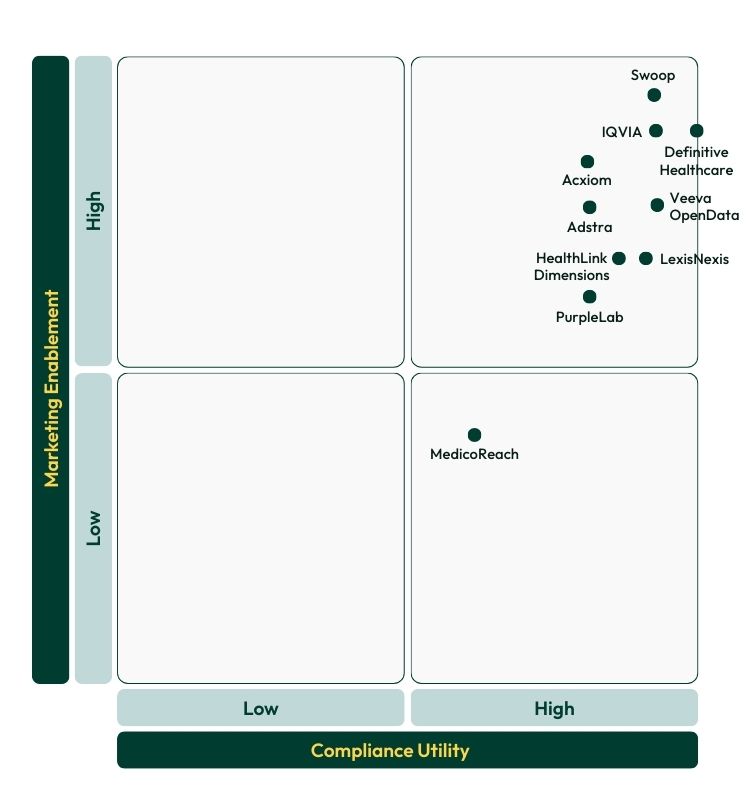
Selecting a commercial data provider in healthcare is not just a matter of choosing the vendor with the most segments or best tech stack. It is a strategic trade-off between two core imperatives:
Compliance Utility – How well the provider supports HIPAA-aligned use, including de-identification, consent governance, suppression logic, and auditability.
Marketing Enablement – How effectively the provider delivers usable, privacy-safe data for audience segmentation, activation, and performance measurement.
The Dual Utility Framework scores each vendor on these two dimensions (each out of 8) and maps them into a quadrant to help healthcare marketers and compliance teams quickly assess alignment. This visualization is not a substitute for due diligence. It is a starting point for prioritizing conversations, shortlisting vendors, and identifying best-fit partners based on your goals, risk posture, and internal capabilities.
Interpreting the Quadrants
Strategic Leaders (Top Right)
Vendors with high compliance and enablement scores. These partners combine strong privacy architecture with meaningful marketing impact. Ideal for long-term integration into a privacy-first stack.
Specialized Performers (Top Left or Bottom Right)
Vendors that excel in either compliance or marketing utility, but not both. Useful for targeted use cases or as part of a broader mix of partners.
High Risk / Low Yield (Bottom Left)
Vendors with weak compliance structures and limited marketing enablement. Typically list-based or underdeveloped platforms. Should be approached with caution or avoided in HIPAA-scoped environments.
This framework is designed to support smarter vendor selection in a category filled with marketing claims and inconsistent privacy practices. Real utility comes from partners that can do both—protect data and unlock performance.
Future Outlook: What’s Next for Privacy-Compliant Data Providers?
The commercial data landscape is changing quickly. New regulations, platform shifts, and technologies are reshaping how healthcare organizations can acquire and use third-party data. Over the next two years, we expect meaningful changes in what qualifies as privacy-compliant data and who is equipped to provide it.
1. State-Level Privacy Laws Will Fragment the Market
HIPAA remains essential, but it is no longer the highest standard. Laws like CPRA, Colorado’s Privacy Act, and Washington’s My Health My Data law are redefining what counts as health data and how it must be handled. Some vendors will evolve to meet these requirements. Others will fall behind.
Implication: National compliance will require vendors to document and adjust their privacy logic on a state-by-state basis, particularly for campaigns that cross regional boundaries.
2. Clean Room Infrastructure Will Become Essential
As cookies and device IDs fade, clean rooms are becoming the default for privacy-safe activation and measurement. Data providers that cannot support tokenized or hashed ID delivery into secure environments will lose relevance.
Implication: Future-ready vendors will need to support clean room workflows, cohort-level matchbacks, and minimize reliance on outdated identity graphs.
3. AI Will Reshape Health Interest Modeling
AI and machine learning are driving new methods for predicting health interests, treatment behavior, and audience affinity, often without accessing PHI. This enables more precise targeting but introduces concerns around transparency, fairness, and regulatory scrutiny.
Implication: Healthcare marketers must ask how models are trained, validated, and governed, especially when they influence care-related messaging.
4. Composable Data Ecosystems Will Overtake All-in-One Vendors
Organizations are moving away from relying on a single provider. Instead, they are assembling modular stacks of data partners connected through APIs and clean rooms. This mix-and-match approach offers greater flexibility and control.
Implication: The most valuable vendors will be those that are open, interoperable, and transparent about how their data can work alongside others.
About This Guide
This guide was created through a collaborative process that blended the speed and structure of AI with decades of real-world healthcare marketing experience.
We used AI tools to help us gather, synthesize, and organize foundational information about this category and the vendors included. These tools supported brainstorming, research structuring, and drafting early content sections. We also used AI to transcribe and analyze hours of interviews with our internal experts, vendor partners, and healthcare industry leaders, transforming those conversations into the practical insights shared throughout.
Every section was manually reviewed, edited, and enriched by our team to ensure accuracy, nuance, and relevance to healthcare marketers navigating complex privacy challenges. We refined the structure iteratively, using both AI suggestions and human judgment to create a guide that is clear, credible, and actionable.
While AI helped us work more efficiently, it’s the combination of technology and lived experience that gives this guide its depth and utility.
Created by Wheelhouse DMG

Legal Disclaimer: The information contained in this communication should not be construed as legal advice on any matter. Wheelhouse DMG is not providing any legal opinions regarding the compliance of any solution with HIPAA or other laws and regulations. Any determination as to whether a particular solution meets applicable compliance requirements is the sole responsibility of the client and should be made after consulting with their own legal counsel.
More Ultimate Guides
Explore our other Ultimate Guides to help you navigate your privacy-compliant MarTech needs.