CAPABILITIES
Healthcare Digital Advertising: Getting the Most Out of Every Paid Media Dollar with Search, Social, and Programmatic
We run paid search, paid social, and programmatic campaigns for medical device, healthcare, and privacy-first brands. We deliver performance others can’t because we built the data infrastructure that enables it: a HIPAA-compliant foundation that unifies your first-party data, CRM, digital advertising, and web analytics into a single, coherent view of your customer journey. That means our strategists are making decisions based on the totality of what’s driving performance, not the partial picture advertising platforms offer. Our campaigns and the technology that powers them are built from the ground up for the compliance requirements tightening around this space. Compliance is not an afterthought here.
Agency EXPERTISE
Paid Advertising Strategy
Digital advertising for medical practices and MedTech organizations is most effective when it’s part of a larger, integrated strategy. That’s why we take the time to understand your organization, its mission, challenges, and goals. Whether you’re aiming to reach patients, providers, or decision-makers, we translate this knowledge into actionable, compliant advertising strategies.
The result is a clear, data-driven roadmap that connects your campaigns to measurable outcomes, ensuring consistent performance and meaningful impact for your brand in the healthcare space.
Paid Search Advertising
Our agency designs paid search campaigns that deliver measurable outcomes, from increasing patient appointments to driving adoption of innovative medical devices. As a specialized medical device advertising agency, we’ve helped generate tens of millions in revenue for our clients, achieving ROI levels that exceed expectations.
By combining custom-built paid search strategies with cutting-edge advertising tools and technologies, and continuously optimizing for conversions, we ensure your campaigns reach the right audience, meet compliance standards, and deliver exceptional performance in the competitive healthcare and medical device landscape.
Paid Social Advertising
In the healthcare and medical device sectors, paid social offers a powerful way to reach highly targeted audiences, from patients researching treatment options to providers exploring new medical technologies. We leverage the expansive capabilities of paid social platforms to engage these custom audiences efficiently, often using paid social as a cost-effective channel to attract new prospects.
Our strategies maximize the synergy between paid social and paid search, seamlessly retargeting and converting newly identified audiences into patients or customers. With our team’s deep expertise, we frequently achieve ROAS for paid social that rivals, and sometimes surpasses, that of paid search, driving measurable results for your healthcare brand. Our expertise also extends to digital advertising for pharmaceutical companies, where compliance and audience precision are paramount.
Display & Programmatic Advertising
As a healthcare-focused digital advertising agency, we know that effective advertising requires data-driven strategies that resonate with diverse audiences, from patients and caregivers to providers and decision-makers. We leverage first-party data insights to create unified advertising strategies tailored to your unique goals and compliance needs.
Through strategic partnerships with leading implementation partners, we deliver customized solutions that align with your organization’s objectives. Whether it’s Display, DOOH, OTT, or other media, our meticulous approach ensures your campaigns engage the right audience at the right time, seamlessly integrating into your broader marketing mix and driving measurable impact.
Creative Testing & Campaign Variation
Our creative testing services leverage data-driven insights to optimize your creative performance. Through systematic A/B testing, multivariate analysis, and iterative refinement, we continuously improve your ad creative, landing pages, and user experiences to maximize engagement, conversions, and ROI.
Building on these proven insights, our comprehensive ad campaign services transform data into compelling brand experiences. We offer strategic creative concept development, social media campaigns, interactive experiences, and dedicated campaign landing pages that work together to elevate your brand’s presence and drive meaningful engagement.
Real-Time Propensity Modeling
Most healthcare and medical device advertising programs optimize against a single, blunt signal. A lead comes in, and ad platforms respond by finding more leads, whether or not those leads ever become patients or customers. Real-Time Propensity Modeling changes the signal. It scores the likely value of every lead at the moment of form submission and passes that score directly to Meta, Google, and other platforms, shifting optimization from raw volume to genuine quality.
Because the entire process runs on a server-side, HIPAA-compliant architecture, platforms get a sharper quality signal without ever touching protected patient data. The result is a program that grows more efficient as it scales. Better signals drive better targeting, higher-converting leads, and a cost per acquisition that keeps falling as the model learns.
Frequently Asked Questions
How can healthcare and medical device brands run digital advertising without third-party cookies?
Healthcare and medical device brands can run digital advertising without third-party cookies by basing targeting and measurement on first-party data, the information collected directly from your own audience, rather than on cookies that track people across other sites. Done well, this is more durable than cookie-based tracking, since it doesn't degrade as browsers and regulations tighten. At Wheelhouse, we build campaigns on exactly this kind of HIPAA-compliant first-party foundation.
How do healthcare and medical device brands improve lead quality, not just lead volume?
Healthcare and medical device brands can improve lead quality by changing the signal sent back to ad platforms. When the conversion event is simply "a lead came in," algorithms optimize for whatever produces the most leads, regardless of value. Improving quality means feeding platforms a better signal, such as a predicted value or conversion-likelihood score for each lead, so platforms learn to find people who actually convert. At Wheelhouse, we accomplish this through Real-Time Propensity Modeling, generating a lead score at the moment of form submission and passing it to Meta, Google, and others to shift optimization from volume to value.
Which digital advertising channels are most effective for healthcare and medical device marketing?
There is no single best digital advertising channel for healthcare and MedTech marketing. Effectiveness depends on intent and audience. Paid search captures patients and providers already looking, paid social builds awareness and reaches specific segments, and programmatic extends scale. The harder question is how channels work together, and that's why measurement matters more than channel selection. Methods like Media Mix Modeling, which Wheelhouse uses to isolate each channel's true contribution, are worth more than a ranked list of tactics.
How can paid social advertising help healthcare and medical device organizations reach patients and providers?
Paid social advertising helps healthcare and medical device organizations reach patients and providers through granular audience targeting and strong creative formats. In regulated categories, the constraint is doing this without relying on restricted data or risking exposure on patient-facing journeys. The answer is to optimize against first-party signals rather than platform pixels, which keeps targeting both effective and compliant.
How can you track conversions and campaign ROI without putting patient privacy at risk?
You can track conversions and campaign ROI without putting patient privacy at risk by ensuring two things are true: the data feeding your measurement is compliant, and your ROI method doesn't depend on tracking individuals. Pixels on patient-facing pages are a common exposure point, so compliant measurement starts with a first-party data foundation and server-side collection. For ROI specifically, aggregate methods like Media Mix Modeling work without individual identifiers, making them both privacy-safe and resistant to signal loss.
featured case studies





Compass
The Intelligence Layer That Makes Privacy-First Performance Possible
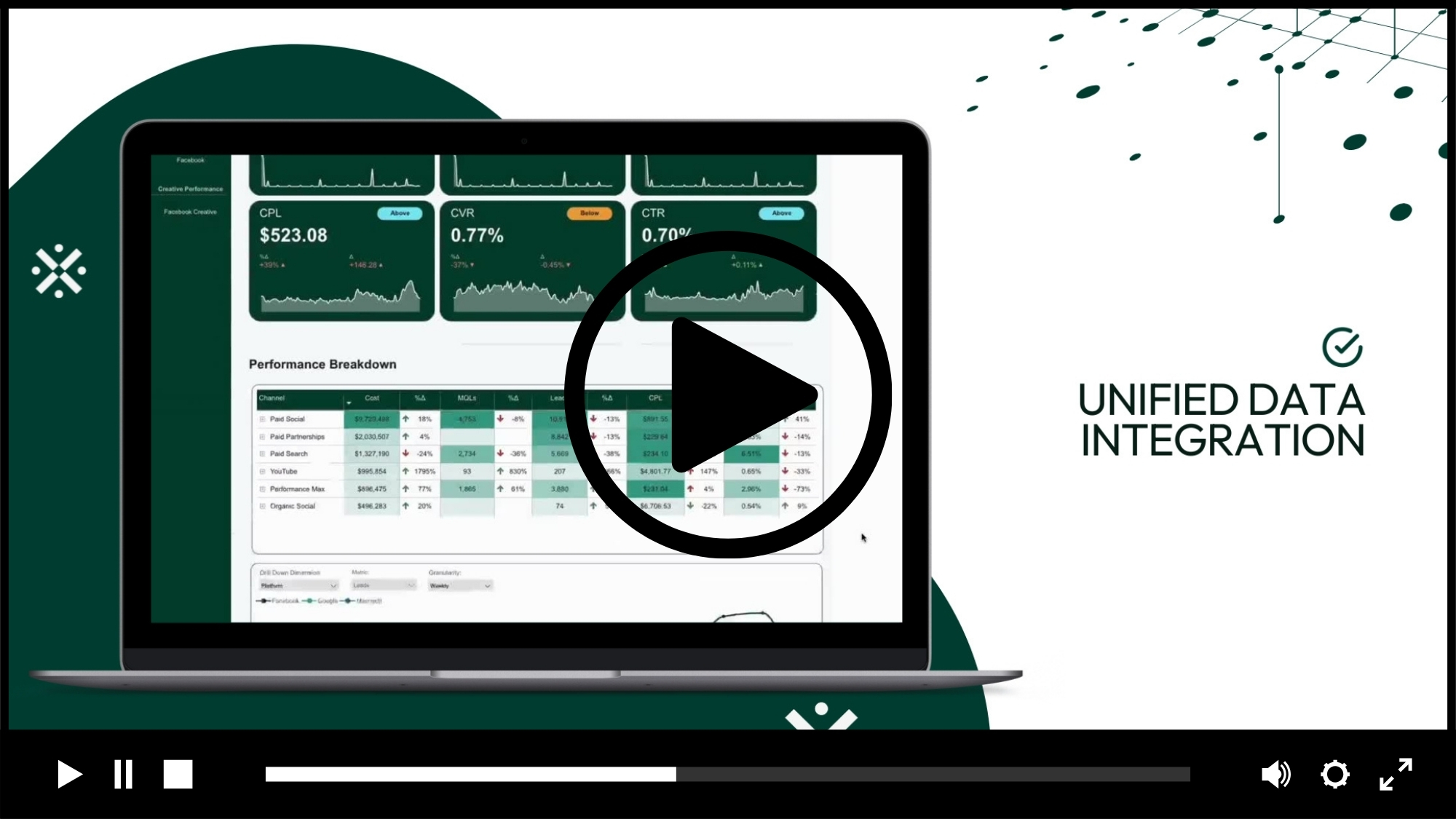
Compass is Wheelhouse’s HIPAA-compliant marketing data warehouse. It integrates and harmonizes first-party data, CRM, digital advertising, web analytics, and offline marketing data into a single, coherent view of the customer journey – built specifically for the compliance requirements and data complexity that healthcare and medical device organizations face. For brands where third-party tracking is restricted, platform data is incomplete, and measurement gaps threaten leadership confidence in marketing spend, Compass is the infrastructure that solves the problem.
What Compass does:
- Integrates first-party data, CRM, digital advertising, web analytics, and offline marketing data into a unified HIPAA-compliant warehouse
- Delivers a complete view of the customer journey across all channels and touchpoints
- Enables accurate attribution, channel optimization, and budget allocation decisions
- Powers Media Mix Modeling and advanced analytics with clean, harmonized data inputs
- Surfaces insights through customizable dashboards, flexible reporting, and AI-enabled business intelligence
With Compass, our strategists make decisions grounded in a complete and compliant picture of what is actually driving performance. That means better targeting, more defensible attribution, accurate cross-channel reporting, and the clean, unified data foundation that advanced capabilities like Media Mix Modeling require. It is the difference between trusting platform-reported numbers and knowing the truth.

Lighthouse
Search Intelligence At Scale
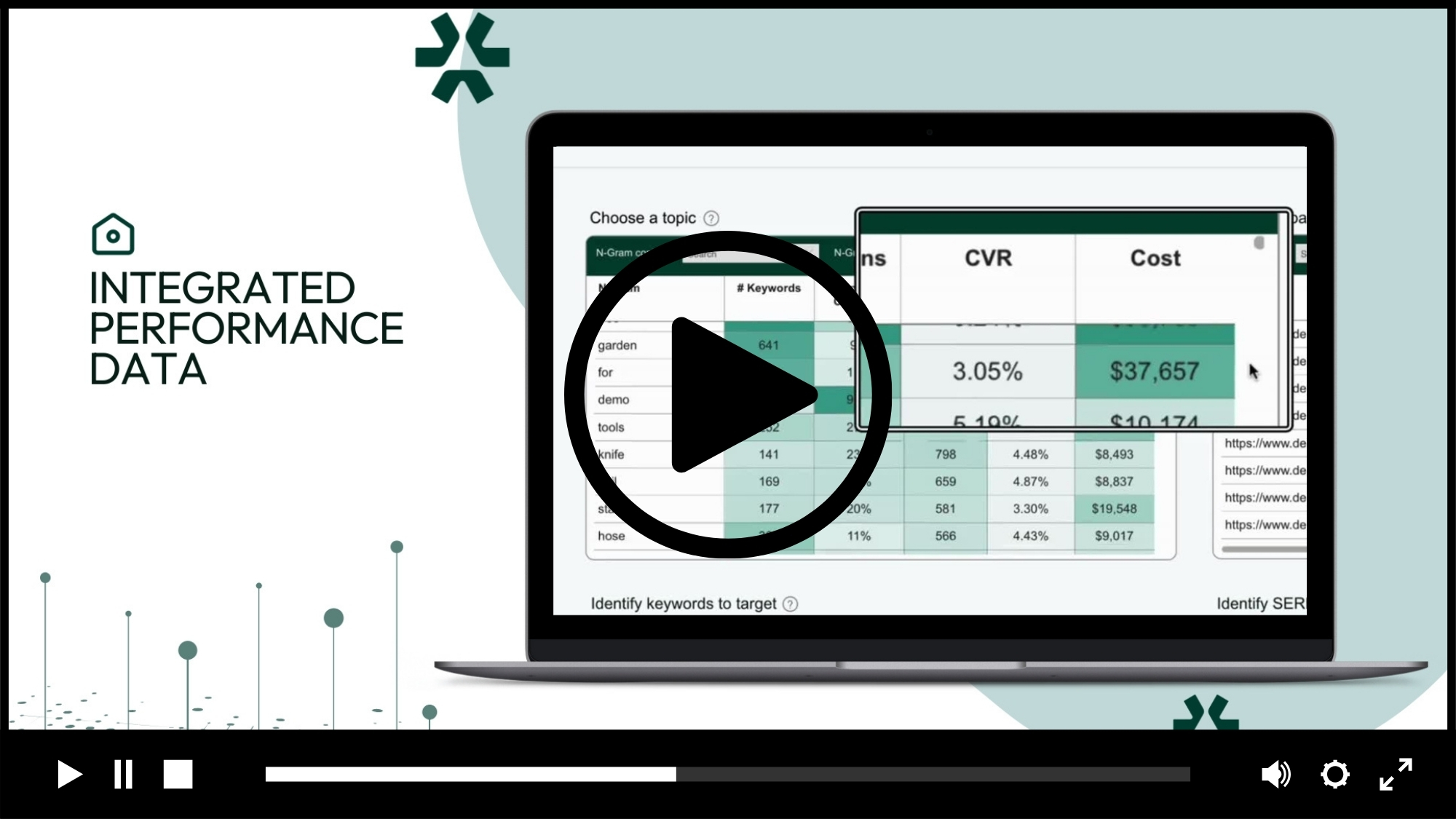
Lighthouse is Wheelhouse’s proprietary search intelligence platform. It reads the SERP the way search engines do: paid and organic together, search features broken out, competitor positions mapped, AI-generated responses tracked, at a scale no manual process or standard tool can match.
What Lighthouse does:
- Analyzes SERP data at scale, including paid, organic, search features, and AI-generated responses, in ways standard tools cannot replicate
- Uncovers high-value keyword opportunities that others miss
- Maps competitor strategies and SERP positioning to identify where your brand can gain ground
- Connects paid and organic search data to surface cross-channel opportunities and eliminate conflicting spend
- Projects the traffic and revenue impact of recommendations before resources are committed, enabling confident prioritization
- Builds long-term opportunity roadmaps that keep strategy moving
Healthcare and medical device brands compete in some of the most contested search environments online. Patients, providers, and prescribers are searching with high intent, and the difference between appearing at the right moment and being invisible comes down to understanding the search landscape at a depth most agencies cannot reach.

Compliance Monitoring
Safeguarding Analytics Integrity While Ensuring Compliance
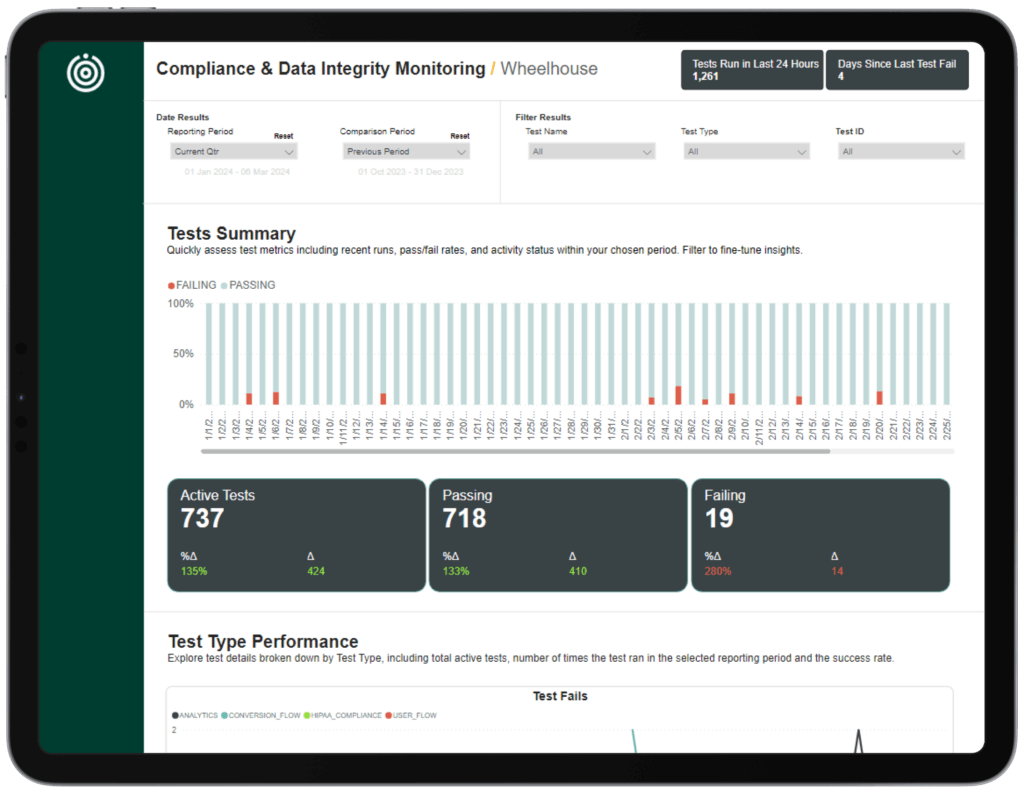
Our Compliance Monitoring solution runs continuous automated monitoring across your digital touch points, catching issues before they become exposures. Wheelhouse provides healthcare-specific configuration, the compliance interpretation, and the team that acts on what the monitoring finds.
What Compliance Monitoring does:
- Protects critical data and conversion systems through continuous 24/7 automated monitoring and anomaly detection
- Ensures HIPAA, CCPA, and GDPR compliance across all digital touch points
- Validates analytics accuracy and data collection integrity at scale
- Minimizes risk exposure by catching compliance issues before they become incidents
A compliance incident doesn’t announce itself. Tracking errors, data leaks, and regulatory violations accumulate quietly until they become a crisis. Our Compliance Monitoring solution keeps that from happening.
Privacy-first industries require the most capable digital marketing partners.
We’ve been solving problems in this space for over a decade. We know what it takes to perform.
Let’s talk about where you are.
No pitch decks, no obligation. Just 30 minutes with someone who’s navigated this environment before.
This site is protected by reCAPTCHA
and the Google Privacy Policy and Terms of Service apply.