The Ultimate Guide to Marketing Automation & CRMs
Marketing Automation and CRM platforms have become mission-critical infrastructure in healthcare.
Published on December 15, 2025
They enable organizations to engage patients, providers, and partners while maintaining compliance with HIPAA and other privacy laws. As patient expectations evolve and regulatory pressure intensifies, these tools offer a way to deliver personalized, data-driven outreach, without compromising trust.
Yet many healthcare organizations still rely on non-compliant or fragmented tools: generic CRMs not built for HIPAA, or marketing platforms that fail to protect PHI. The result? Outreach gaps, compliance exposure, and missed opportunities to engage with precision.
This guide was built for healthcare marketing, compliance, and IT leaders navigating this complex and high-stakes environment. We examine marketing automation and CRM platforms through a dual lens:
- Privacy & Compliance Utility — The platform’s ability to operate within HIPAA boundaries, including BAA support, PHI-safe workflows, and audit readiness.
- Performance Utility — How effectively the tool supports real-world engagement: campaign orchestration, patient/provider segmentation, referral tracking, and marketing-to-care integration.
You’ll find vendor rankings, scorecards, implementation guidance, and real-world use cases — all grounded in healthcare-specific needs and enforcement realities.






Wheelhouse Insight
What Are Marketing Automation & CRM Solutions?
Marketing Automation and Customer Relationship Management (CRM) platforms are often described as distinct categories. One powering outreach, the other managing relationships.
Unlike in other industries, healthcare requires CRM and marketing automation to function as a unified system for powering compliant, personalized outreach at scale. Without integration, teams risk fragmented communication, limited targeting, and costly compliance gaps.
A CRM platform is designed to store and manage contact information, track interactions across touchpoints, and build longitudinal profiles of patients, providers, or partners. It’s the system of record for understanding “who” your audiences are.
A Marketing Automation platform activates that understanding. It orchestrates outreach across channels (email, SMS, paid media, and more) and enables segmentation, personalization, and trigger-based campaigns that drive engagement and action.

Wheelhouse POV
Why It Matters
For most industries, CRM and marketing automation platforms are about sales acceleration and lead nurturing. But in healthcare, these tools play a much higher-stakes role: enabling compliant, personalized communication with patients and providers, without triggering HIPAA violations or trust-eroding missteps.
Traditional Tools Don’t Cut It
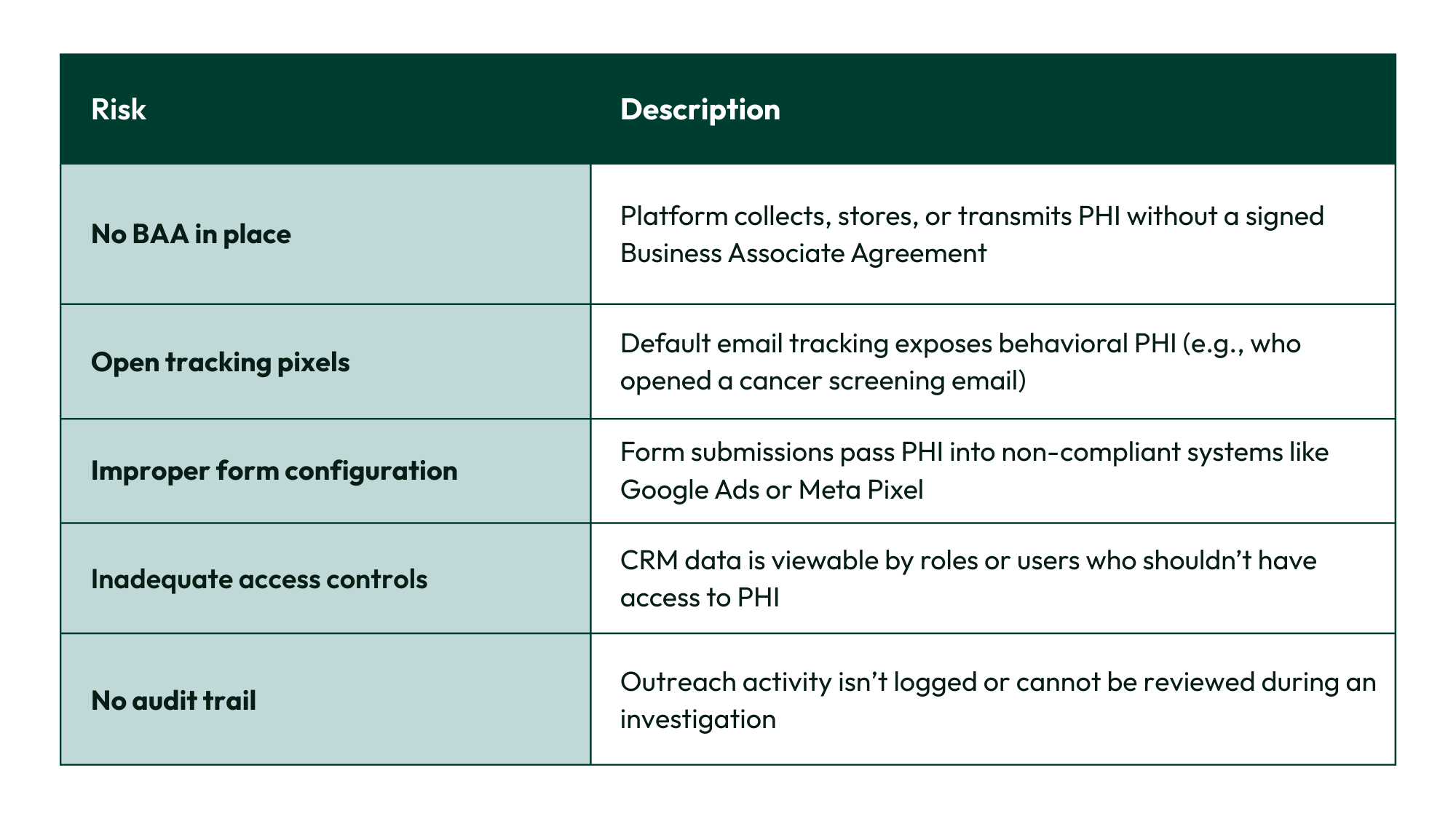
Off-the-shelf CRMs and email tools can’t handle Protected Health Information (PHI). Standard features like open tracking, IP logging, or form fills can expose behavioral or clinical data, even before the campaign sends. Even well-intentioned marketers can put their organizations at risk.
Without HIPAA-ready platforms, even a simple reminder email or referral follow-up becomes a legal and operational liability.

Wheelhouse Caution
What Healthcare-Grade Platforms Enable
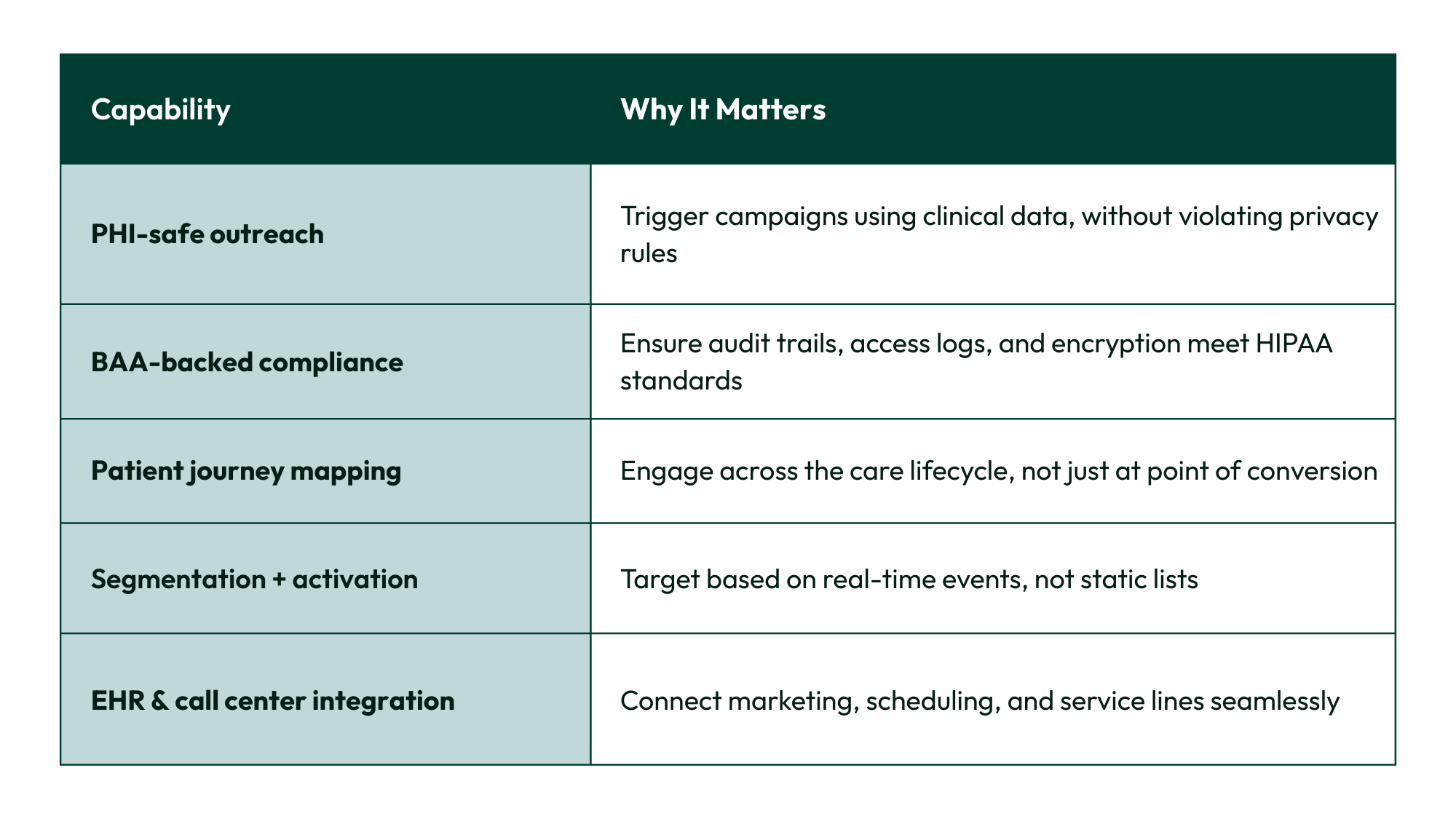
Bridging the Gap Between Marketing and Care
Not only do they power campaigns, Healthcare CRM/MA platforms also bridge operations. The best tools integrate with Epic, Salesforce Health Cloud, or your call center to ensure that patient communication is connected, consistent, and compliant.
When done well, these tools:
- Drive screenings, referrals, and recall campaigns
- Improve show rates and reduce leakage
- Support value-based care with proactive communication
- Demonstrate marketing’s impact with encounter-level ROI
Wheelhouse POV
Role in the Healthcare Stack
CRM and marketing automation platforms function as the orchestration layer for healthcare engagement. They receive data from upstream systems and activate communication across secure channels, all within the boundaries of HIPAA and related regulations.
These tools support two critical functions:
- They use first-party data to trigger outreach. Events from the EHR, website, call center, or analytics platforms can launch automated communications based on real-world behaviors and clinical milestones.
- They safeguard PHI during outreach. They ensure that communications containing identifiable or clinical data are handled within a HIPAA-compliant environment.
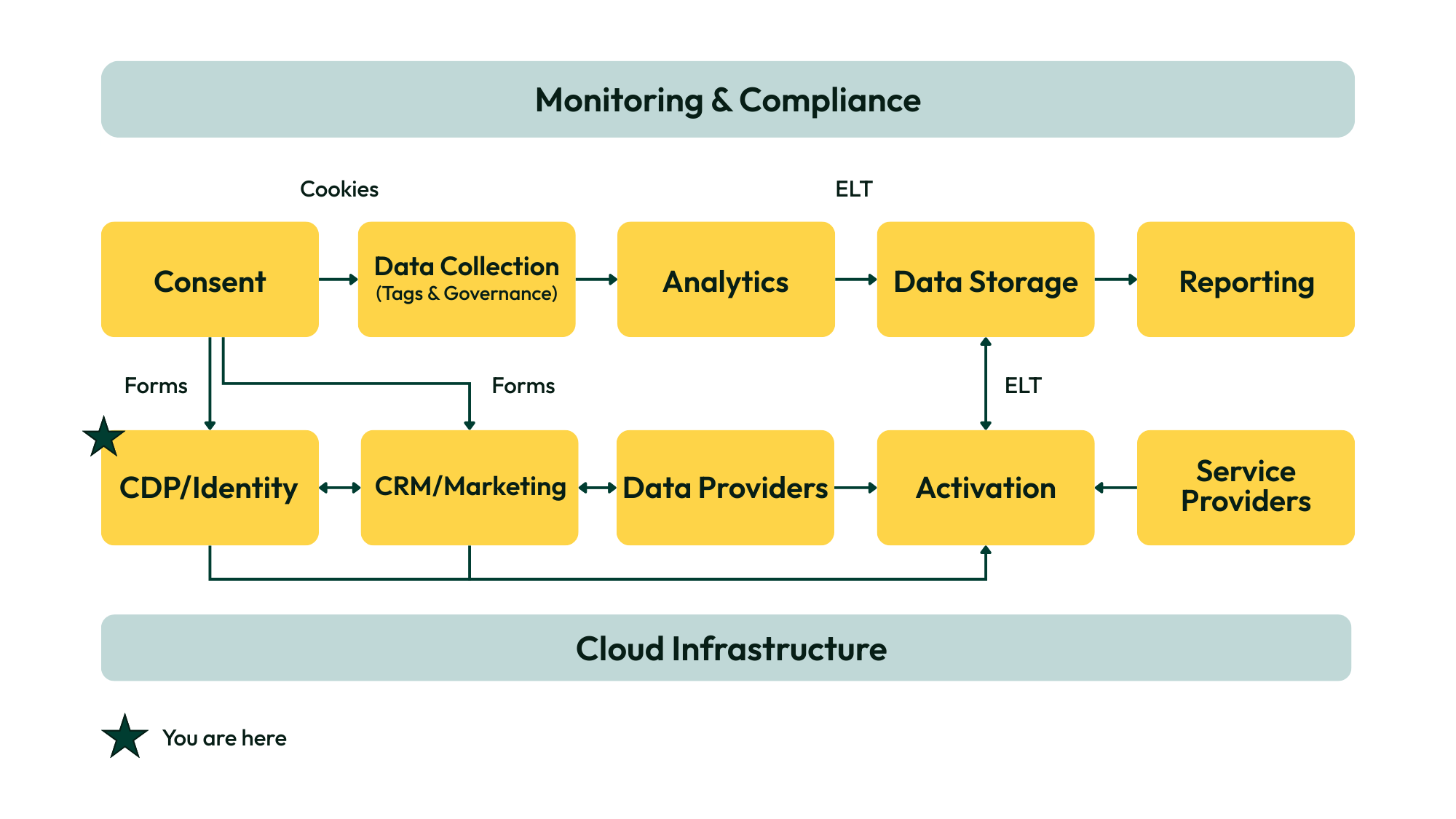
Upstream Inputs
- EHR / Call Center / Scheduling Tools: Offers eligibility signals, appointment data, and clinical context.
- Consent Management: Provides preference and legal status for communication.
- CDP / Analytics / Tag Manager: Supplies segmentation, identity, householding, behavior, and journey data.
Downstream Connections
- Email / SMS Platforms: Deliver the actual message.
- Personalization Layers: Tailor content based on profile or interaction history.
- Reporting & Attribution: Capture engagement metrics and revenue impact.
Core Capabilities of a Healthcare-Grade Platform
Not all CRM or marketing automation tools are suitable for healthcare. Many platforms are built for general B2B or B2C use and lack the privacy features, integration points, or workflow flexibility required in a regulated clinical environment.
Healthcare-ready CRM/MA platforms must support the following capabilities as foundational:
1. Contact and Relationship Management
- Centralize patient, provider, and partner records
- Track interactions across touch points (calls, appointments, campaigns)
- Enable lifecycle visibility for outreach, care gaps, or follow-ups
2. PHI-Safe Campaign Orchestration
- Send targeted messages using real-world triggers (e.g., missed appointment, due for screening)
- Ensure email and SMS are encrypted and stored within a BAA-covered environment
- Prevent risky defaults like open tracking pixels or third-party redirects
3. Segmentation and Audience Building
- Build dynamic lists based on clinical, demographic, or behavioral data
- Trigger campaigns from EHR signals, website actions, or inbound inquiries
- Sync audience lists with call center, scheduling, or patient access teams
4. Automation and Journey Management
- Configure multi-step outreach workflows (e.g., test reminder → education → scheduling CTA)
- Use branching logic based on patient behavior or system responses
- Monitor outcomes and adjust journeys over time
5. Audit Logging and Access Controls
- Track who sent what, to whom, and when, including PHI-level audit trails
- Restrict access using role-based permissions
- Prepare for compliance audits or incident investigations
6. Interoperability with EHR and Analytics Tools
- Exchange data securely with Epic, Salesforce Health Cloud, or other systems
- Enable closed-loop tracking from campaign to encounter
- Support flexible architecture (e.g., flat-file uploads, APIs, or real-time syncs)
Wheelhouse Caution
Compliance Considerations
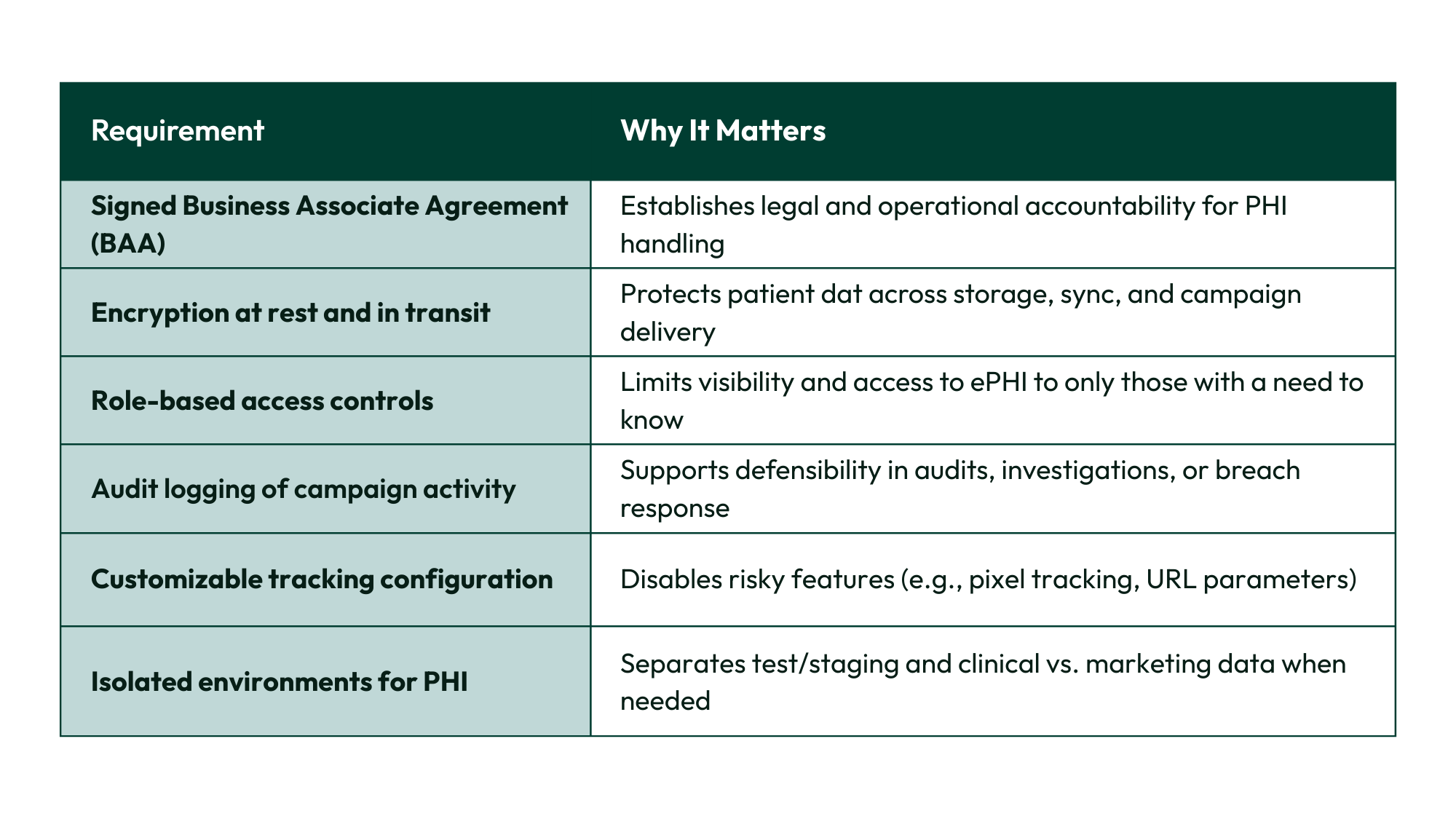
HIPAA doesn’t distinguish between marketing and operational communication. If a message contains PHI or is triggered by a clinical event, it must meet the same standards for privacy, security, and auditability as any other healthcare workflow.
CRM and marketing automation platforms (even those marketed for healthcare) must meet strict requirements to ensure they handle PHI appropriately and legally.
Common Compliance Risks
HIPAA Compliance Requirements for CRM & Marketing Automation Tools
Vendor Landscape
The healthcare CRM and marketing automation space is fragmented, with no single vendor dominating the category. Each platform reflects a different balance of scalability, compliance, and usability. Our evaluation focused on solutions that meet HIPAA requirements while supporting real-world marketing and care coordination.
Vendors are grouped into three categories based on functionality: full-stack platforms, CRM-focused tools, and marketing automation-first systems.
Platforms Offering Both CRM and Marketing Automation
For healthcare organizations seeking a unified system to manage data, orchestrate outreach, and remain compliant, full-stack platforms offer a comprehensive approach.
Salesforce, with its Health Cloud and Marketing Cloud integration, is widely adopted among enterprise systems. It offers deep capabilities across marketing, clinical, and analytics layers, though it requires strong internal support to configure and maintain. LeadSquared provides similar functionality in a more healthcare-native package, designed to support provider engagement, referrals, and service-line campaigns. Zoho offers a modular, cost-effective alternative for mid-size organizations with the internal capacity to manage HIPAA configuration and customization.
Oracle Eloqua has been part of the Oracle Marketing Cloud for over a decade. It serves as the foundation for large-scale marketing automation in many enterprise healthcare systems. While it is not healthcare-native, its segmentation and campaign capabilities remain valuable for organizations that need complex, multi-audience orchestration. Within the broader Oracle Health stack, Eloqua is often used alongside other clinical and operational tools. HIPAA compliance typically requires coordination across multiple teams and careful configuration.
Adobe Marketo continues to support provider and MedTech campaigns, offering strong B2B workflows, lead scoring, and automated engagement capabilities. However, it is not covered under Adobe’s Healthcare Shield program. HIPAA compliance with Marketo still requires technical customization and a custom BAA, making it best suited for organizations with mature internal security teams and clear governance over PHI workflows. For healthcare systems already using Adobe Experience Cloud, tools like Journey Optimizer or Real-Time CDP may offer HIPAA-enabled alternatives, but Marketo itself remains outside that perimeter.
CRM-Only Platforms
CRM-focused tools are best suited for organizations prioritizing contact management, outreach tracking, and integration with systems like the EHR or call center. These platforms typically require a separate marketing automation layer for campaign delivery.
Cured CRM, Enquire, and Welkin Health offer healthcare-specific capabilities and integrations that reduce implementation time and support longitudinal engagement. Microsoft Dynamics 365, when deployed with its Healthcare Accelerator, fits well for IT-led organizations already using Microsoft infrastructure. Healthgrades CRM supports acquisition efforts and campaign analytics. Tools like Monday.com and Freshsales can serve as lightweight CRMs when configured appropriately. Insightly is commonly used in B2B medtech and service-oriented healthcare organizations.
Marketing Automation-Only Platforms
These tools are focused on campaign execution, including email, SMS, and landing pages. While they are typically easier to deploy, they must be evaluated carefully to ensure HIPAA compliance and proper data protection.
Tebra is a provider-centric platform that combines marketing, scheduling, and outreach tools in a secure interface. Paubox Marketing allows encrypted email delivery without requiring patient portals. HubSpot, at the enterprise tier, can be configured for HIPAA compliance, although it remains a generalist platform. LuxSci, Act-On, and ActiveCampaign provide options for organizations seeking flexible, PHI-safe outreach systems depending on their security needs and workflow complexity.
Evaluation Framework
To assess HIPAA-ready CRM and Marketing Automation platforms, we evaluated vendors against five weighted criteria reflecting the demands of privacy-first healthcare organizations.
1. Privacy & Compliance (30%)
This is the non-negotiable category. CDPs serving regulated environments must demonstrate:
- BAA availability (standard or on-demand)
- HIPAA-compliant deployment options, including support for PHI handling and encryption
- PHI-safe features (e.g., encrypted email, field-level restrictions)
- Audit logging and access controls
2. Healthcare Fit & Proven Use (25%)
This evaluates how well a platform aligns with healthcare-specific data, workflows, and use cases.
- Adoption within provider or payer ecosystems
- EHR or patient system integrations
- Support for regulated workflows like referrals, post-visit outreach
- Industry-aligned onboarding and support
3. Core CRM & Marketing Automation Capabilities (20%)
This category focuses on the platform’s ability to support full-funnel patient and provider engagement:
- Multi-channel campaign automation (email, SMS, etc.)
- CRM capabilities such as segmentation, lifecycle management, lead tracking
- Personalization and behavior-based triggers
- Lead scoring, campaign analytics, and orchestration workflows
4. Integration & Workflow Flexibility (15%)
This assesses how composable and interoperable the platform is.
- Integration with EHR/EMR platforms (e.g., Epic, Cerner)
- API, webhook, or custom event support
- Workflow builders or low-code automation
- Compatibility with analytics, CDP, or consent systems
5. Usability & Support (10%)
This addresses both user experience and the quality of vendor partnership.
- UI/UX accessibility for marketing and compliance teams
- Onboarding experience and documentation quality
- Dedicated healthcare support or customer success resources
- Training, implementation, and post-sale support
Vendor Scorecard
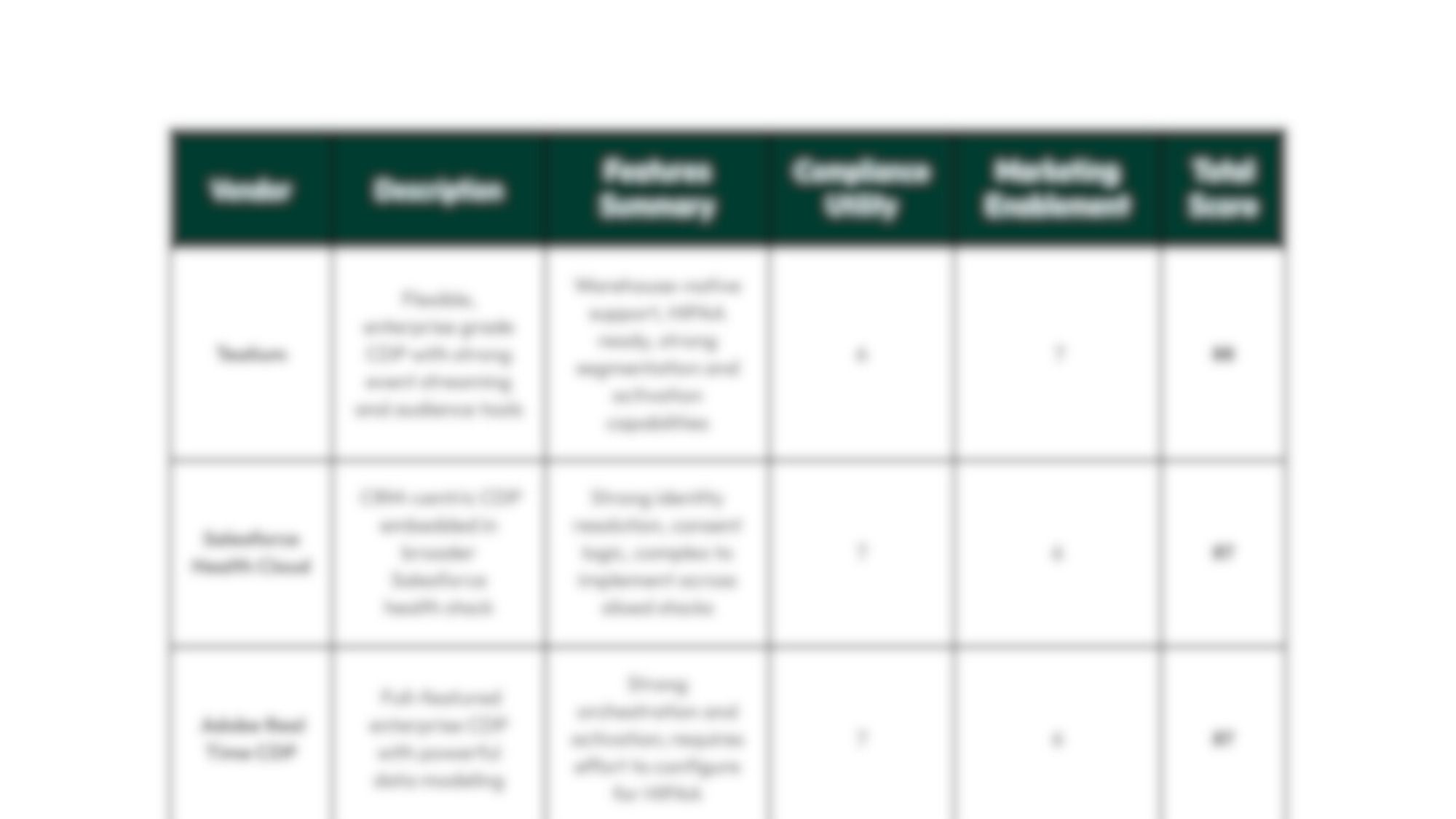
To support vendor selection, we translated our evaluation rubric into a normalized scorecard that reflects both compliance readiness and marketing performance. The table below summarizes how each CRM and Marketing Automation platform performs across privacy, healthcare alignment, functionality, interoperability, and support dimensions.
Dual Utility: Compliance vs. Performance
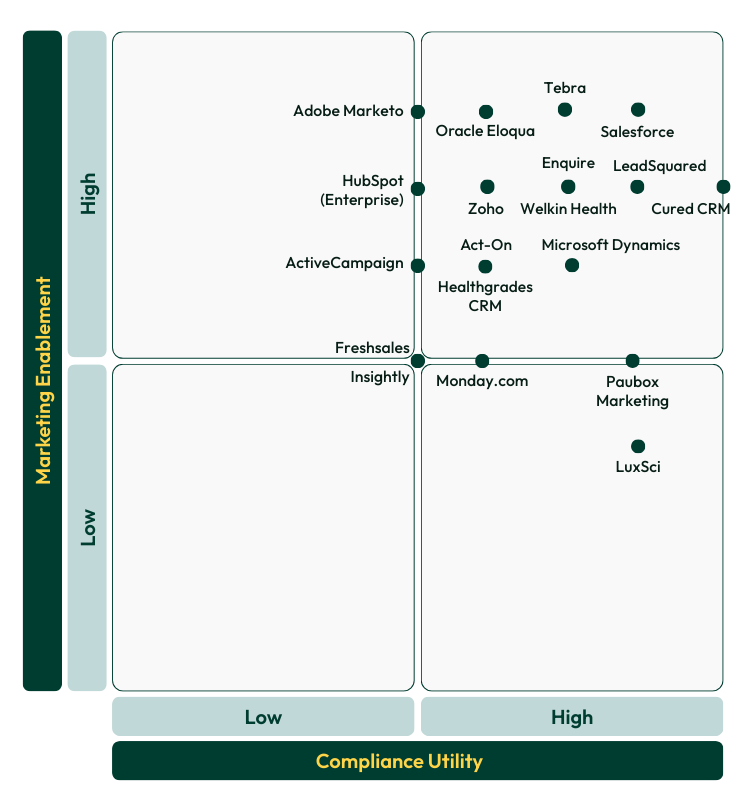
Selecting a CRM in healthcare is about trade-offs. Organizations must weigh two competing imperatives:
- Compliance Utility – How well the platform enforces HIPAA standards, from consent and suppression to PHI-safe architecture and auditability.
- Marketing Enablement – How effectively it supports segmentation, personalization, campaign execution, and performance optimization.
The Dual Utility Framework scores each platform on these two axes (out of 8), then maps them into a quadrant that helps privacy-first organizations evaluate real-world alignment for healthcare marketing.
Future Outlook
The future of CRM and marketing automation in healthcare is being redefined, not just by martech vendors but by EHR platforms themselves.
Epic’s expansion into patient engagement is reshaping the baseline. With MyChart, Cheers, CRM modules, and native campaign tools increasingly embedded into the EHR environment, health systems are being nudged toward a model where outreach, communication, and segmentation originate inside the clinical system. In this model, the EHR is no longer just a data source or a recipient of marketing outcomes. It becomes the engine.
This shift raises the bar for traditional CRM and MA platforms. To stay relevant, they will need to:
- Integrate more deeply with the EHR, beyond flat files or periodic syncs
- Align with clinical workflows and timing, such as visit-based triggers or care plans
- Demonstrate their value as engagement layers that enhance, rather than compete with, what Epic or Cerner now offer natively
At the same time, healthcare marketers are unlikely to rely solely on EHR-native tools. They will continue to need:
- Greater flexibility in message design and campaign logic
- More advanced UX and audience-building capabilities
- Support for non-clinical outreach such as brand campaigns, education, or events
The likely outcome is hybridization. Health systems will use EHR-native tools for clinical communications and high-trust use cases, while layering in external CRM and MA platforms for acquisition, personalization, and brand engagement.
About This Guide
This guide was created through a collaborative process that blended the speed and structure of AI with decades of real-world healthcare marketing experience.
We used AI tools to help us gather, synthesize, and organize foundational information about this category and the vendors included. These tools supported brainstorming, research structuring, and drafting early content sections. We also used AI to transcribe and analyze hours of interviews with our internal experts, vendor partners, and healthcare industry leaders, transforming those conversations into the practical insights shared throughout.
Every section was manually reviewed, edited, and enriched by our team to ensure accuracy, nuance, and relevance to healthcare marketers navigating complex privacy challenges. We refined the structure iteratively, using both AI suggestions and human judgment to create a guide that is clear, credible, and actionable.
While AI helped us work more efficiently, it’s the combination of technology and lived experience that gives this guide its depth and utility.
Created by Wheelhouse DMG
Legal Disclaimer: The information contained in this communication should not be construed as legal advice on any matter. Wheelhouse DMG is not providing any legal opinions regarding the compliance of any solution with HIPAA or other laws and regulations. Any determination as to whether a particular solution meets applicable compliance requirements is the sole responsibility of the client and should be made after consulting with their own legal counsel.
More Ultimate Guides
Explore our other Ultimate Guides to help you navigate your privacy-compliant MarTech needs.