Paging Doctor Robo
After a tumultuous 2025 in healthcare marketing, we started 2026 with a seismic shift: On January 8th, OpenAI launched ChatGPT Health, allowing consumers to connect medical records to AI. The announcement sparked fierce debate and concern over data protection, security, and misdiagnosis. But were those voicing concerns actually a vocal minority?
In the weeks leading up to this announcement, we surveyed 1,099 Americans to understand how they use and trust different sources for health information, and how they expect those search behaviors to change through 2028. The results revealed a market already in transition.
The ecosystem is now defined less by channel dominance and more by roles, trust, and interpretation. Efficiency and attribution remain important, but they’re no longer sufficient. Influence increasingly depends on credibility, audience-specific journeys, and how information is understood as much as where it’s found.
Organizations that adapt to this reality will be better positioned to navigate the next phase of health information behavior.
What Performance Marketers Need to Know
Performance is no longer captured by controlling a single channel. It’s shaped by how channels work together to move audiences toward confidence and action.
The shifts outlined in this report change what “performance” actually means. As health information journeys fragment and trust consolidates, traditional optimization frameworks become incomplete. We explore what’s changing and what to do about it.
01
AI has reached critical mass, but users aren’t verifying what it tells them.
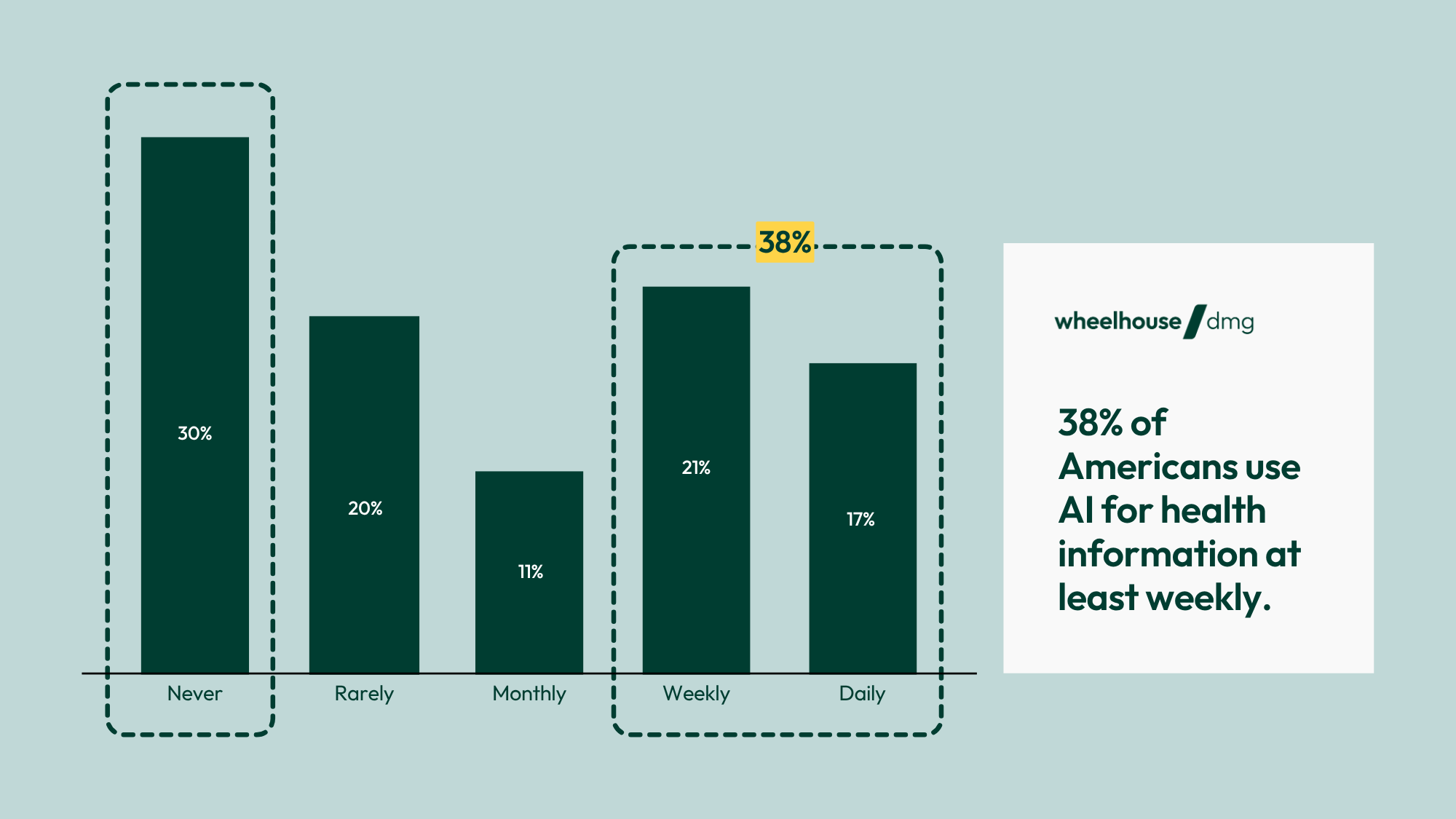
38%
of Americans use AI for health information at least weekly
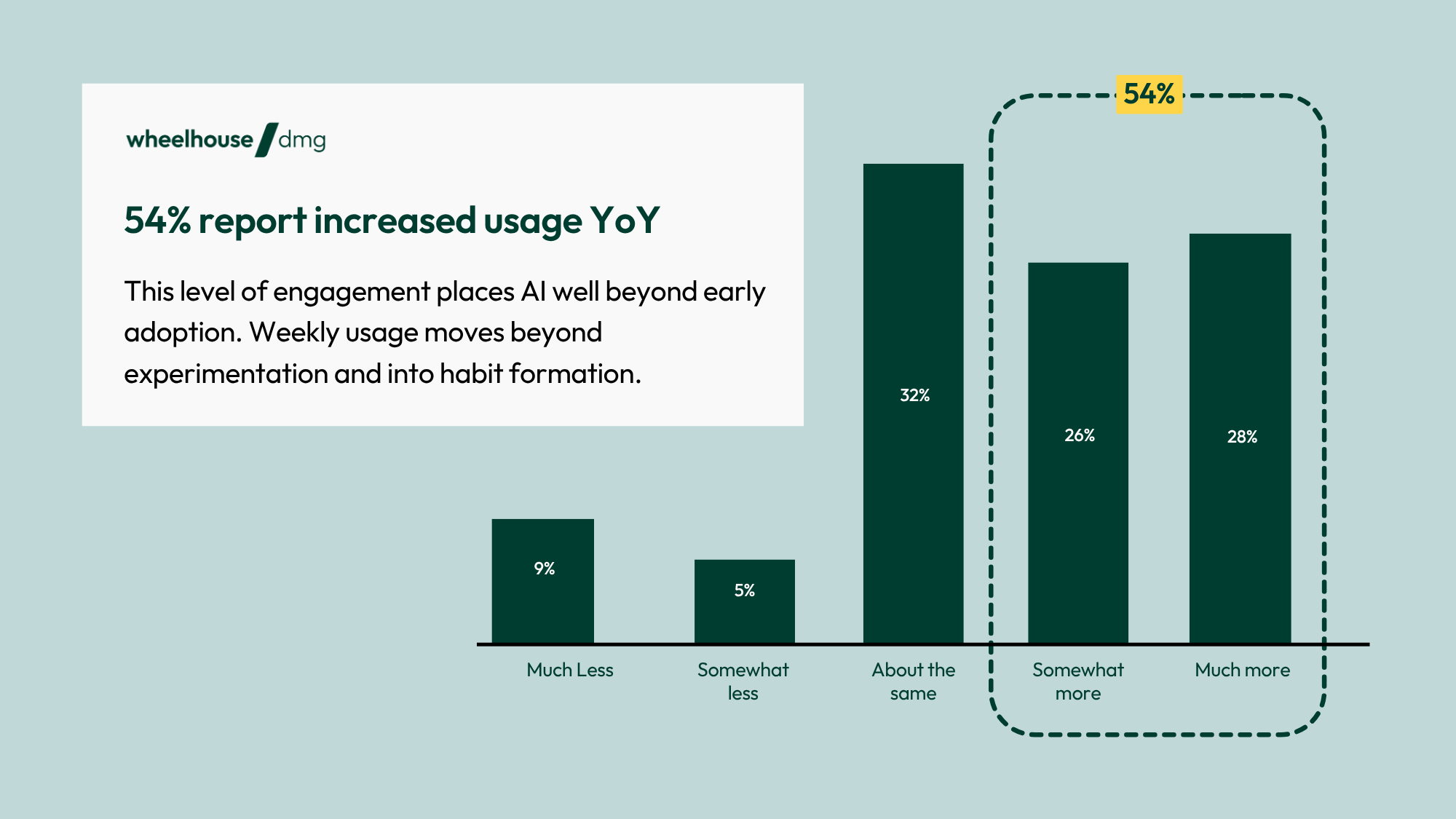
AI has already reached habit-level use for health information.
Artificial intelligence has crossed a critical threshold in how Americans seek health information, with AI healthcare search trends indicating a dramatic shift from experimentation to routine behavior for a meaningful portion of the population. The latest AI health information statistics confirm what many in the industry have observed: AI is increasingly embedded within the health information ecosystem.
AI’s Role Is Interpretive, Not Just Informational
AI’s impact on health information cannot be understood through usage metrics alone. Unlike search engines or social platforms, AI does not simply surface content. It interprets it. Users increasingly turn to AI to summarize findings, compare perspectives, and explain medical concepts in accessible language.
This interpretive role changes the structure of the journey. Instead of navigating from link to link, users increasingly engage with synthesized answers that collapse complexity into a consolidated (and often simplified) response. As a result, AI functions as a cognitive shortcut, reducing friction while increasing confidence.
The Paradox: Trust Without Verification
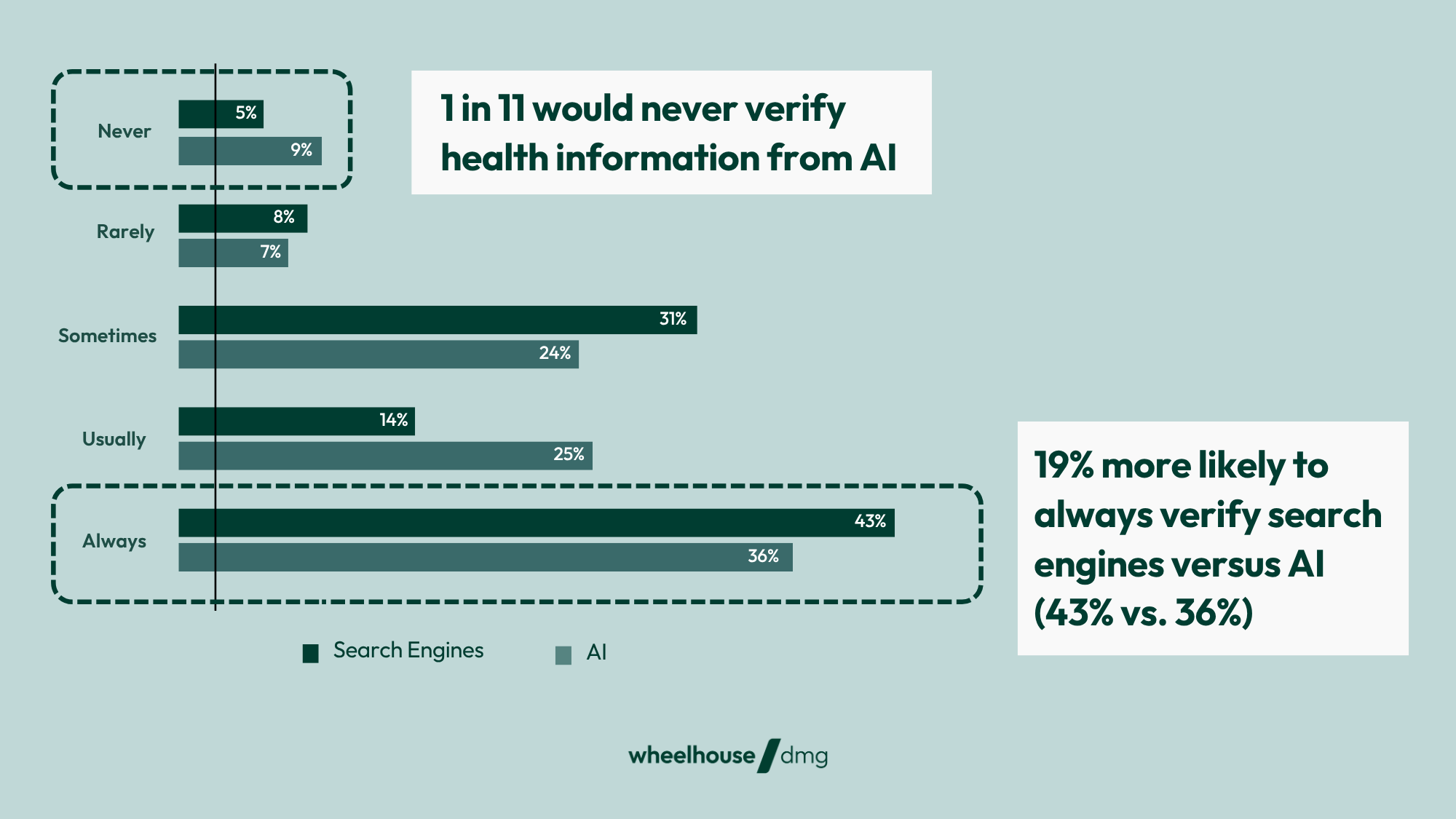
Here’s the critical finding for performance marketers: Americans are significantly more likely to always verify health information from search engines (43%) than from AI (36%). At the other end of the spectrum, 9% would never verify AI health information versus just 5% for search.
Despite AI’s novelty, users exhibit a surprising level of complacency, often accepting AI-generated responses without cross-checking. This pattern suggests that AI’s perceived clarity and confidence may reduce friction in ways that discourage critical evaluation.
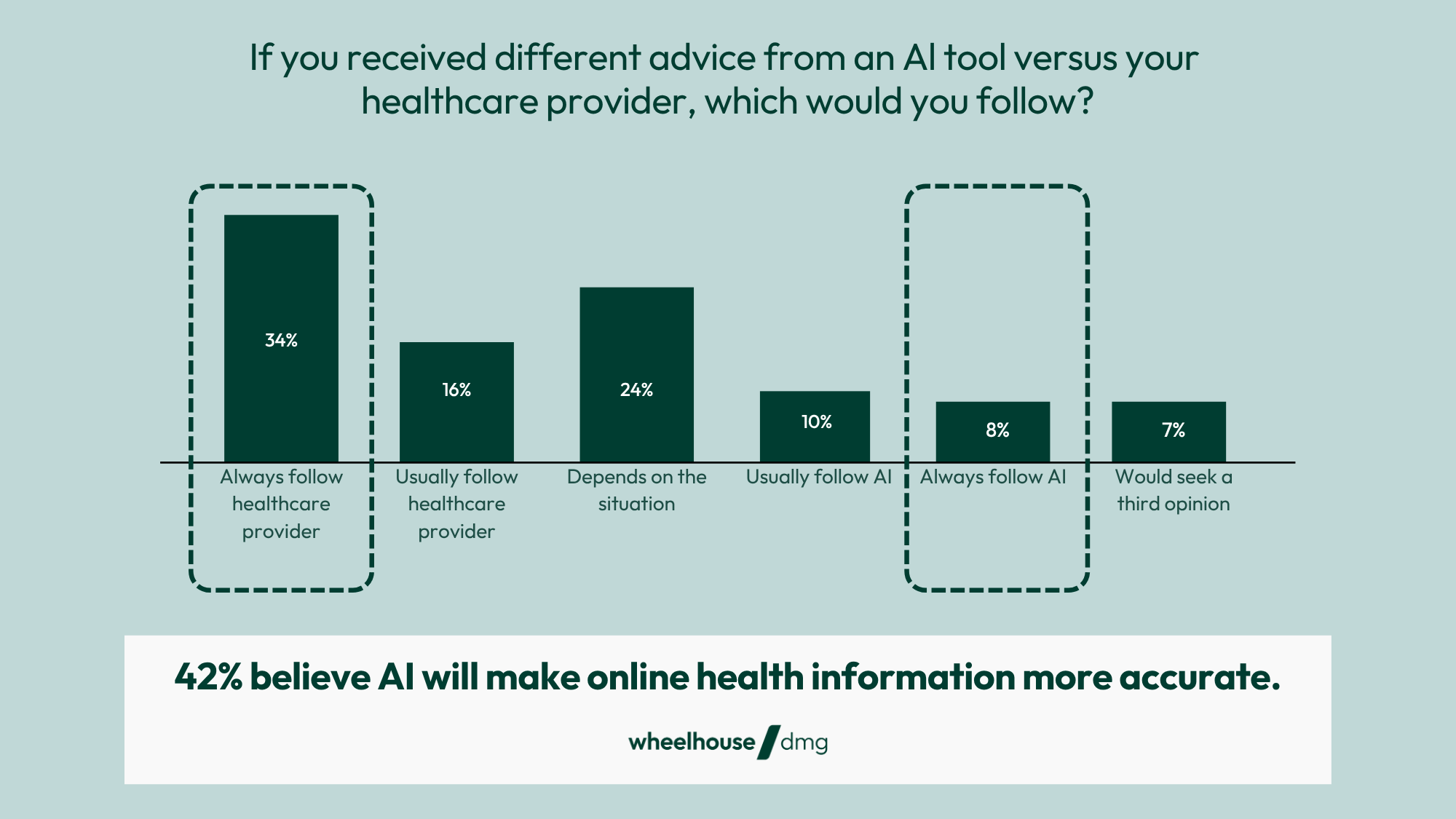
When AI-generated advice conflicts with guidance from a healthcare provider, a meaningful minority of Americans report willingness to defer to AI. While most respondents still favor human providers, fewer than half say they would always follow their provider’s advice in the face of disagreement. Some would usually or always follow AI guidance, while others would decide based on context or seek a third opinion.
Adoption Is Uneven but Momentum Is Broad
AI usage is not evenly distributed across the population. Men currently use AI for health information more frequently than women, and adoption is highest among younger, more educated, and higher-income audiences. Healthcare professionals also report higher usage than the general population.
Even among older cohorts, awareness is high and usage is growing. The difference is not exposure, but comfort. Younger users integrate AI seamlessly into existing information workflows, while older users approach it more cautiously.
What This Means For Performance Marketers
AI’s rise introduces a new dynamic into performance marketing. AI is not a channel in the traditional sense. It does not sell impressions or clicks. Instead, it mediates how information is discovered, interpreted, and remembered.
Performance in an AI-mediated environment depends on being understood, cited, and trusted by systems that sit between brands and audiences:
- Content MUST be legible to AI systems, not just search engines
- Authority signals matter more when information is summarized rather than browsed
- Visibility alone is insufficient if interpretation occurs elsewhere
At the same time, the verification gap creates opportunity. Organizations that provide clear, authoritative, and verifiable information stand to benefit as reference points within AI-mediated journeys. When AI draws from credible sources, those sources gain indirect influence even when they are not directly visited.
02
Search is rebalancing, losing exclusivity while remaining foundational.
13%
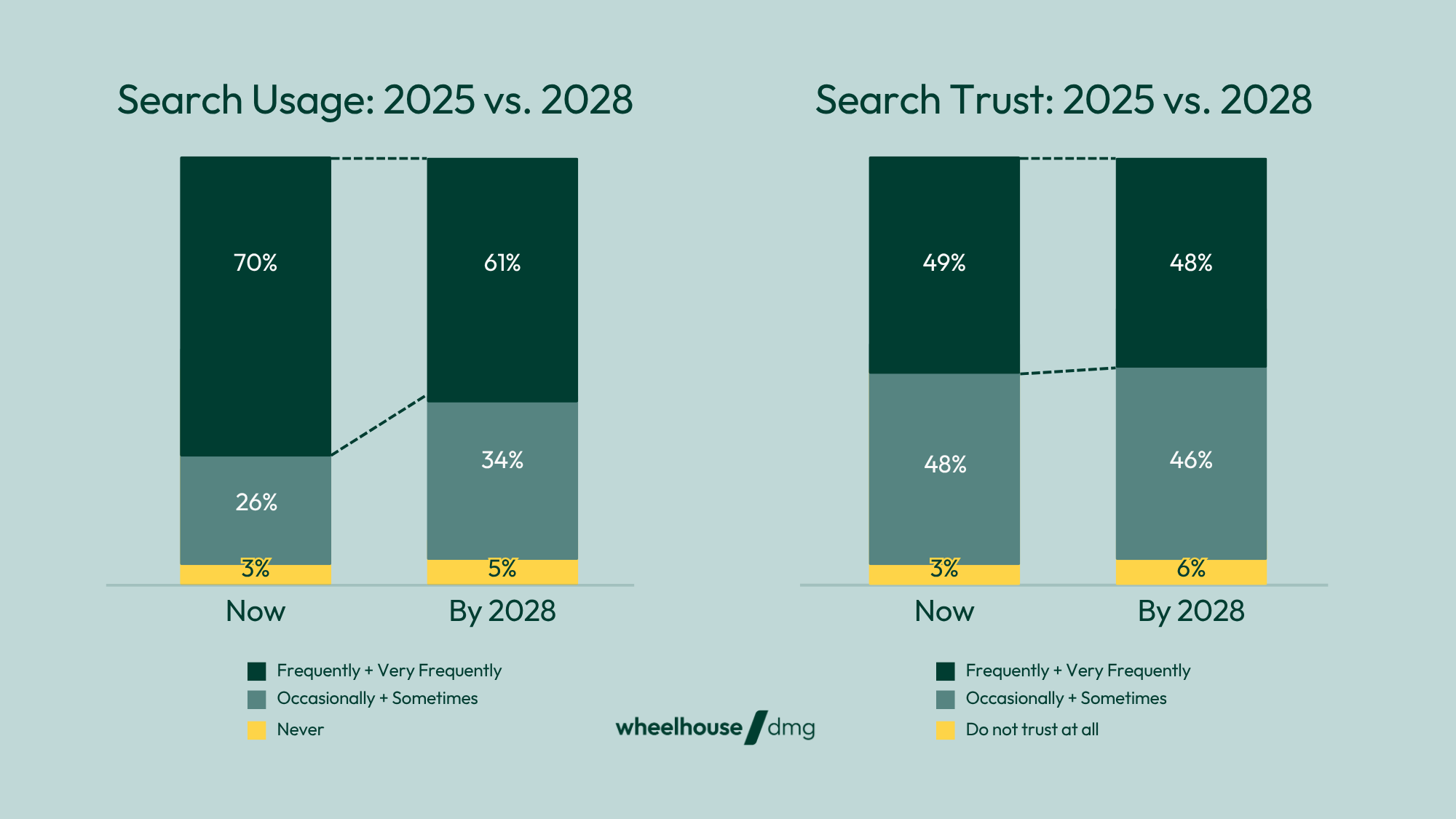
decline in frequent usage of search engines for health information projected by 2028
Search occupies a clear leadership position today, but usage is softening.
Search engines remain the dominant entry point for health and medical information in the United States. Nearly all Americans use search at least occasionally when seeking health information, and it continues to rank as the most frequently used source overall.
For many people, search is the reflexive starting point, especially when questions feel urgent or unfamiliar. Its combination of scale, speed, and familiarity makes it the most accessible option for initial discovery. Compared to social platforms, forums, or AI tools, search enables users to quickly scan multiple perspectives and decide where to go next. Yet dominance in aggregate masks important shifts occurring beneath the surface.
Search’s Softening Usage
While search remains widely used today, the intensity of reliance on search is beginning to soften. Fewer Americans expect to use search frequently or very frequently for health information over the next three years, even as occasional use remains widespread. This decline does not suggest abandonment. Instead, it signals a rebalancing. Search is losing exclusivity rather than relevance.
Users are increasingly comfortable starting their journeys elsewhere when circumstances call for deeper authority, clearer interpretation, or ongoing guidance. In this environment, search remains present across most journeys, but it is no longer guaranteed to be the primary driver of influence.
Trust Is Holding, but Fracturing at the Edges
Trust in search for health information remains relatively stable overall, particularly among those who have relied on it for years. However, closer examination reveals emerging fault lines. A growing share of users express skepticism toward search results, including an increase in those who report not trusting search at all.
The share of Americans who do not trust search at all is expected to double by 2028.
This shift reflects broader changes in how users evaluate digital information. Algorithmic opacity, commercial influence, and the growing volume of low-quality content are reshaping expectations. Search still provides access, but access alone is no longer sufficient to earn confidence. As a result, trust in search is becoming more conditional. Users may still rely on it for discovery, but increasingly look elsewhere for validation.
Search Is Being Bypassed, Not Replaced
Importantly, search is no longer competing only with other websites. It is competing with fundamentally different ways of accessing information. AI tools provide synthesized answers rather than lists of links. Provider and medical sites offer perceived authority rather than aggregation. Social platforms supply lived experience, even when trust is limited.
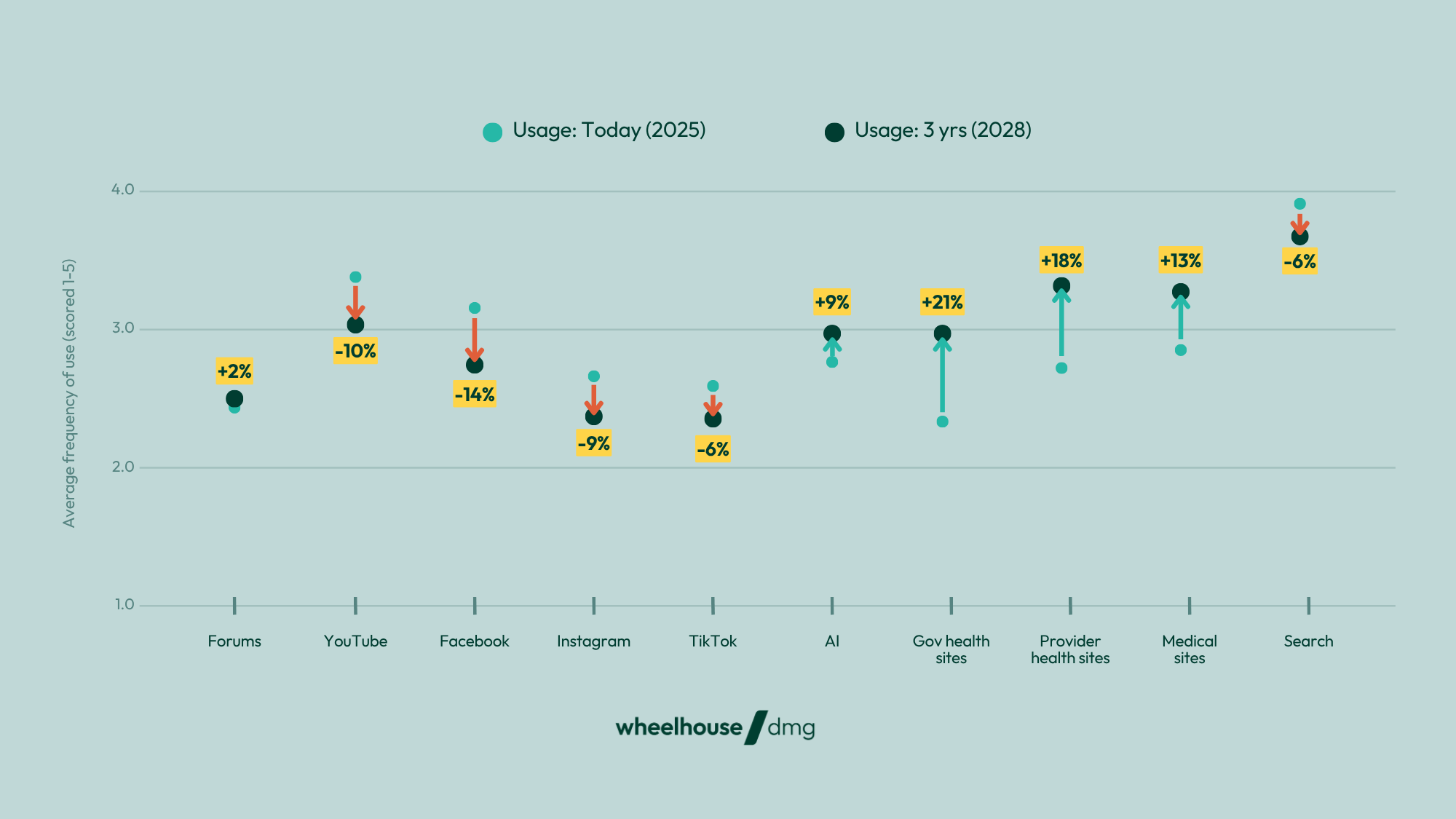
By 2028, users are expected to rely less on search as a primary destination and more on AI and official health sites for guidance.
What This Means for Performance Marketers
Search is shifting from primary authority to foundational infrastructure. It remains critical, but it no longer defines the entire journey. Users move in and out of search depending on context, confidence, and intent. For performance marketing, this means:
- SEO for AI matters as much as SEO for users: Optimizing content so AI systems find, understand, and cite your sources becomes critical
- Attribution models are incomplete: Last-click attribution increasingly misses where influence actually occurs when search serves as a bridge rather than a destination
- High-intent queries still convert: Search remains most effective for bottom-funnel, high-intent queries where users know what they’re looking for
- Informational queries are vulnerable: Top-of-funnel content that’s easily summarized by AI without requiring click-through loses value
03
Social hits a trust ceiling with high visibility but limited authority.
10%
average platform decline in frequent use for health information projected by 2028
Even the most trusted social platform trails provider and medical sites by a wide margin.
Social media remains deeply embedded in how Americans encounter health information, but its role is constrained by a persistent trust ceiling. Despite high visibility and frequent use among certain audiences, social platforms struggle to convert reach into credibility. This limitation shapes how, when, and whether social content ultimately influences health decisions.
The data does not suggest that social media is disappearing from health information journeys. It suggests that its influence is capped.
High Exposure, Limited Authority
Social platforms such as YouTube, Facebook, Instagram, and TikTok continue to play a meaningful role in health information exposure. Many Americans encounter health-related content on these platforms regularly, particularly younger audiences. However, usage does not translate into trust at the same rate as other sources.
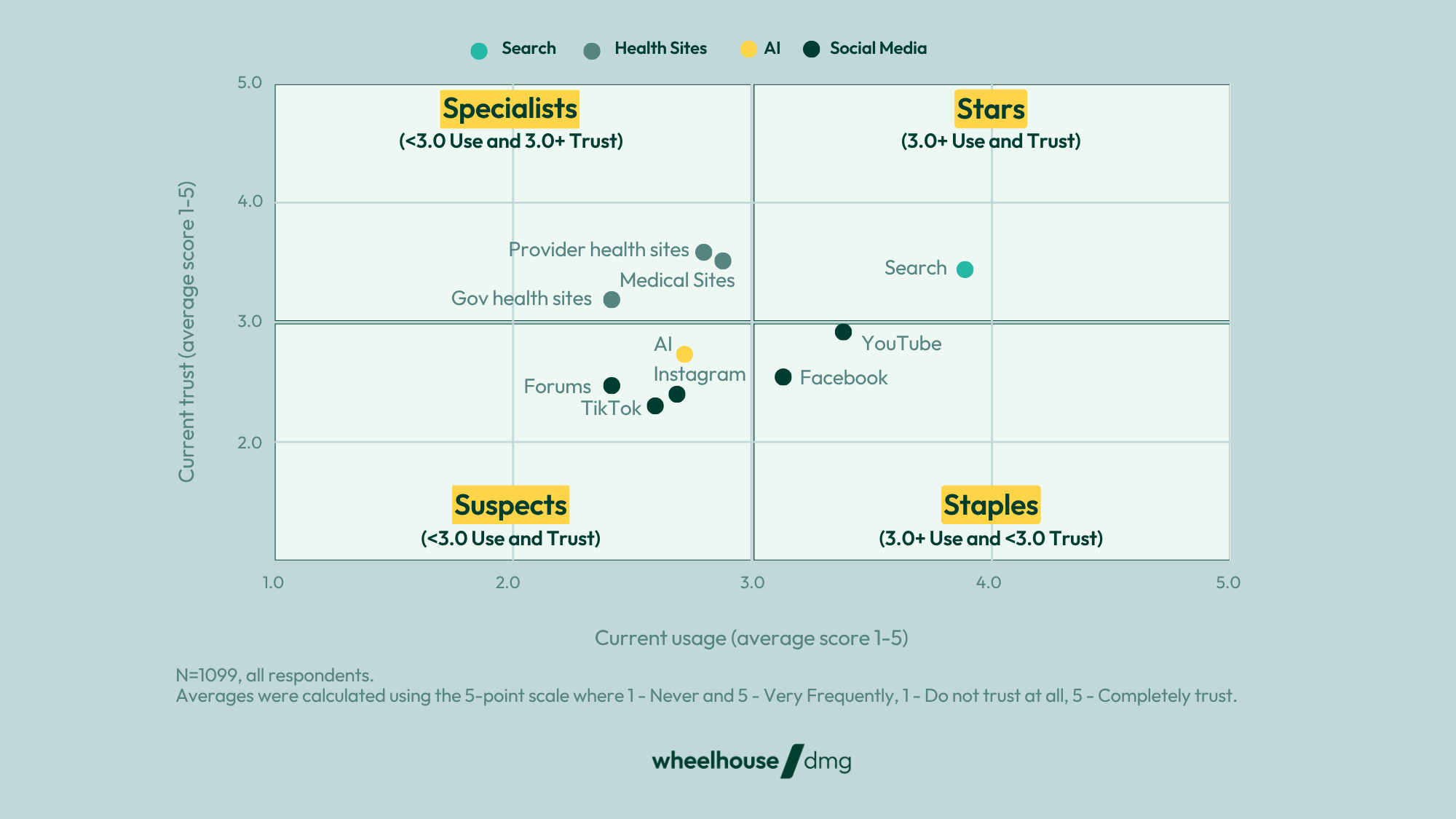
While platforms like YouTube rank relatively high in usage, their trust scores lag behind search engines and official health sources. Other platforms, particularly TikTok and Instagram, show even wider gaps between exposure and credibility. This disconnect defines social media’s role. It introduces topics, normalizes conversations, and surfaces lived experiences, but it rarely serves as the final authority.
Trust Lags Across All Platforms
When trust is evaluated directly, social platforms consistently rank near the bottom compared to search engines, provider sites, and medical websites. TikTok registers the lowest trust scores among major platforms, while Instagram and Facebook also trail significantly behind official and search-based sources. Even YouTube, which benefits from longer-form content and educational formats, fails to reach the trust levels of provider or medical sites.
These trust deficits are not temporary. They reflect structural characteristics of social platforms, including content moderation challenges, influencer-driven narratives, and algorithmic amplification that prioritizes engagement over accuracy.
Declining Reliance Over Time
Projected usage patterns reinforce the idea of a trust ceiling. While social platforms remain visible today, respondents expect to rely on them less frequently for health information over the next three years.
Facebook, YouTube, and Instagram are projected to experience some of the largest declines in frequent use for health information by 2028. This decline does not imply irrelevance, but it does signal diminishing authority within the health information ecosystem. As users seek greater confidence and clarity, they increasingly move away from platforms perceived as noisy or unreliable toward sources that signal expertise and accountability.
Social’s Role Varies Dramatically by Age
Age-based patterns clarify social media’s constrained influence. Younger audiences engage heavily with social platforms as part of broader exploratory behavior. Older audiences rely on social media far less and assign it minimal authority in health contexts.
Even among younger users, social content often triggers further validation rather than action. Social sparks interest, but decisions tend to be informed elsewhere. This reinforces the idea that social media functions as an entry point rather than a destination in health information journeys.
What This Means for Performance Marketers
For performance marketers, social media’s role must be thoughtfully considered. Social platforms are not going away, but their function is narrowing. Social is effective for awareness and exposure, normalizing health conversations, and reaching younger audiences early in the journey. Social is not effective for establishing authority, driving final health decisions, and replacing trusted sources.
The strategic implication: Use social to earn the click to owned environments where you control credibility signals. Optimize social creative to generate engagement, but optimize landing pages for trust and conversion. Track social’s influence on mid-funnel behaviors (newsletter signups, content downloads, provider searches) rather than expecting direct conversion.
Performance strategies that over-index on social for conversion or credibility risk inefficiency and erosion of trust. Social performs best when paired with pathways to authoritative destinations that can absorb and validate interest.
04
Official sources are gaining ground as trust consolidates around accountability.
21%
projected growth in usage for government health sites by 2028
Official health sources rank among the most trusted destinations for health information across all age groups.
As social media encounters a trust ceiling and AI introduces new verification challenges, patient online search behavior shows Americans are increasingly gravitating toward sources that signal expertise, legitimacy, and accountability. This shift is not subtle. It represents a measurable reallocation of attention toward official health sources, including healthcare provider sites, medical websites, and government health resources.
This movement reflects a broader recalibration in how people assign authority. In an environment defined by information abundance and interpretive intermediaries, trust becomes the differentiating asset. Official sources are gaining ground precisely because they offer clarity, provenance, and perceived responsibility.
Trust Concentrates Where Accountability Is Clear
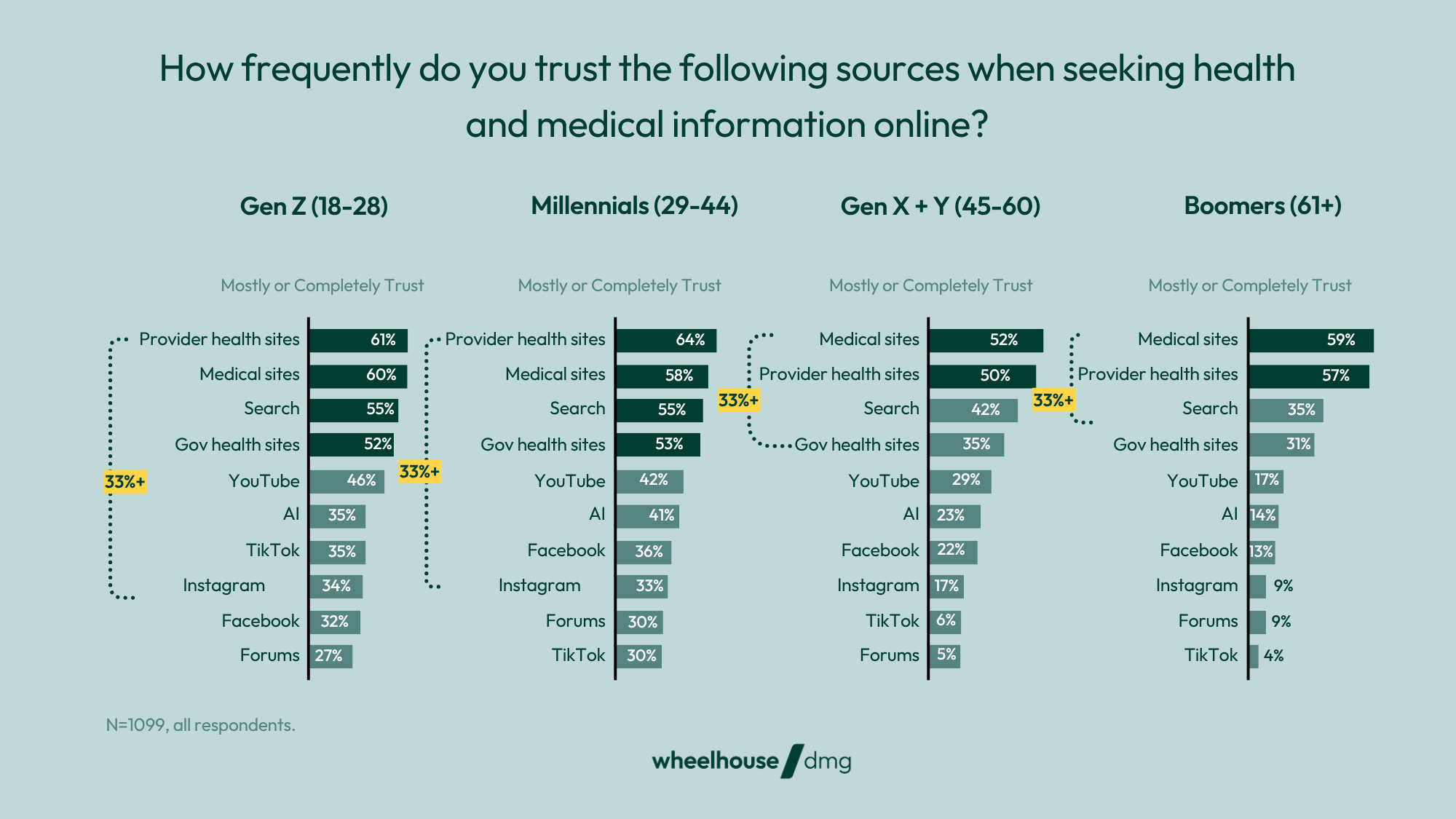
Across age groups, official health sources consistently rank among the most trusted destinations for health information. Healthcare provider sites, medical websites, and government health resources outperform social platforms and rival or exceed search engines in trust.
Rather than relying on aggregation or amplification, these sources benefit from institutional legitimacy. Their authority is rooted in professional standards, regulatory oversight, and established accountability mechanisms. As uncertainty grows elsewhere in the ecosystem, these signals matter more. This trust advantage positions official sources differently from both social platforms and AI tools. They are not optimized for virality or titillation, but for reassurance and confirmation.
Usage Is Catching Up With Trust
Historically, official health sources occupied a paradoxical position: high trust, but comparatively lower usage. That dynamic is beginning to change. Respondents increasingly expect to rely on provider sites, medical websites, and government health resources more frequently over the next three years.
The Institutional Advantage in an AI-Mediated World
The rise of AI further amplifies the importance of official sources. As AI tools synthesize and summarize health information, they rely on upstream content that is accurate, authoritative, and clearly sourced. Official health sites are structurally well positioned to serve this role. In this context, influence does not require direct visitation. When AI systems draw from trusted institutional content, those sources shape understanding even when users never land on the original site. Authority travels indirectly.
This dynamic helps explain why official sources are gaining relevance at the same time AI adoption accelerates. Rather than competing, the two trends reinforce one another.
Age Differences Narrow at the Point of Trust
While age strongly differentiates how people explore health information, it matters less when decisions feel consequential. Across cohorts, older and younger users alike converge on official sources when seeking confirmation, reassurance, or guidance.
Younger audiences may arrive via social or AI, but resolution often occurs elsewhere. Older audiences may bypass exploration altogether and go directly to trusted institutions. In both cases, official sources anchor the final stages of the journey. This convergence reinforces the idea that trust consolidates even as discovery fragments.
What This Means for Performance Marketers
The flight to quality reshapes how performance should be evaluated in healthcare. Official sources may not deliver the lowest cost per click or the highest engagement metrics, but they increasingly define credibility and influence. For marketers, this shift suggests:
- Authority is becoming a performance variable: Being present in or associated with official sources affects conversion more than reach alone
- Owned and institutional environments matter more: In AI-mediated journeys, being the source AI cites matters more than being the page users click
- Partner strategically: For brands and services, being featured on provider websites or in patient education materials from health systems dramatically increases authority
If you’re a provider or health system: Your owned properties are becoming more valuable. Don’t treat your website as just an SEO play – it’s becoming a trust anchor in an increasingly fragmented ecosystem. Invest in content quality, user experience, and making information easily discoverable by both humans and AI.
If you’re a brand or service: Partner with official sources. Co-create content with medical societies, research institutions, or provider networks. The halo effect of institutional credibility transfers more effectively now because users actively filter for authority signals.
Performance strategies that discount these environments risk optimizing for efficiency while sacrificing trust.
05
Age determines everything as younger and older audiences follow completely different journeys.
41%
average platform usage for finding health information by Gen X + Gen Y
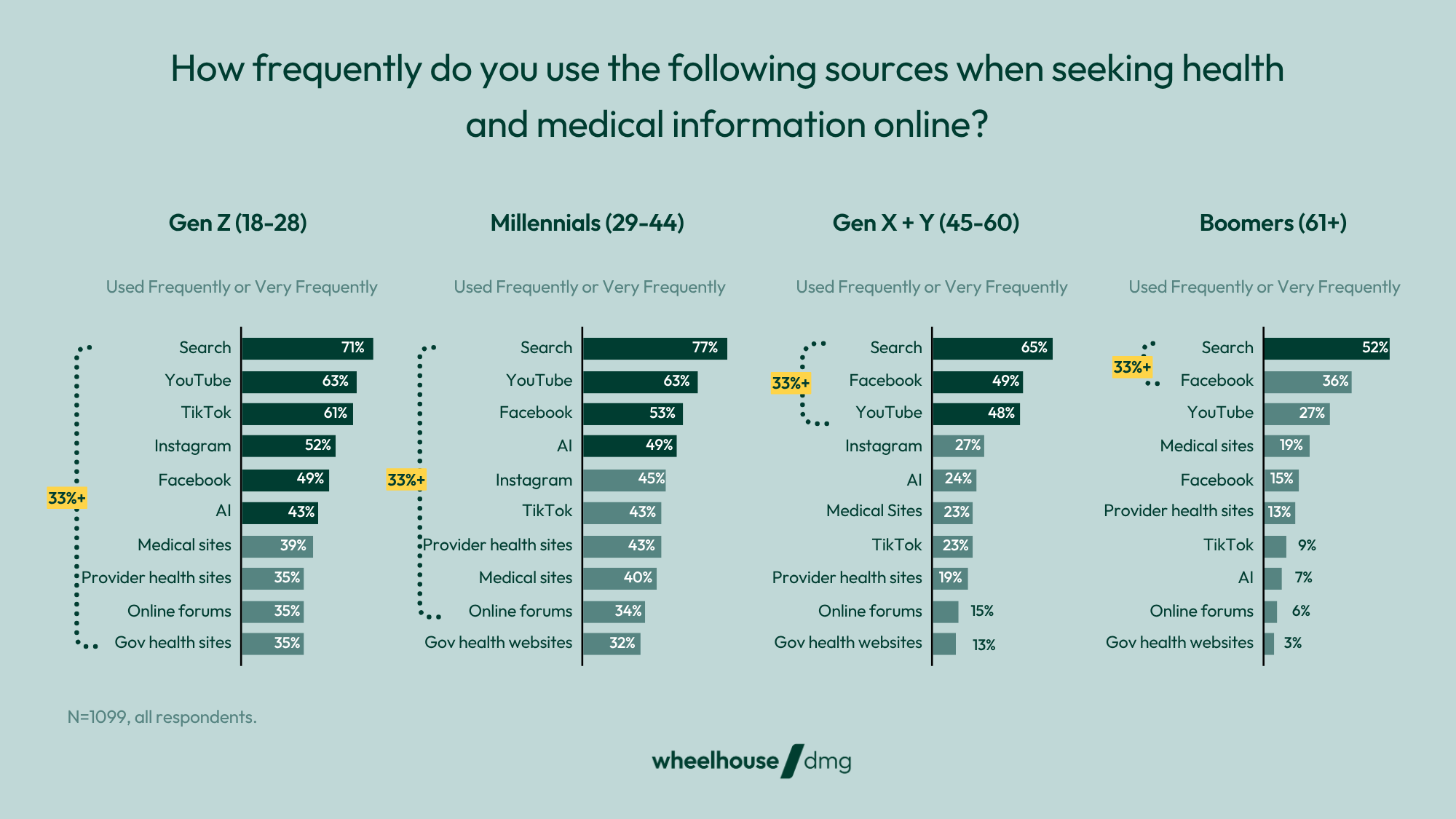
Sources for medical and health information concentrate tremendously as people age.
Health information search behavior in the United States is not converging. It is diverging. While the overall market shows clear structural shifts, age is the strongest predictor of how individuals actually seek, evaluate, and trust health information.
The data does not point to gradual differences along a continuum. It reveals polarization. Younger and older audiences follow fundamentally different models for discovery and validation, applying different standards of credibility and relying on different combinations of sources. These differences shape not only which channels matter, but how influence is formed.
Understanding this polarization is essential. Strategies that assume a single health information journey, adjusted only by channel weighting or creative variation, increasingly fail to resonate with any audience meaningfully.
Younger Audiences: Exploration, Synthesis, and Context
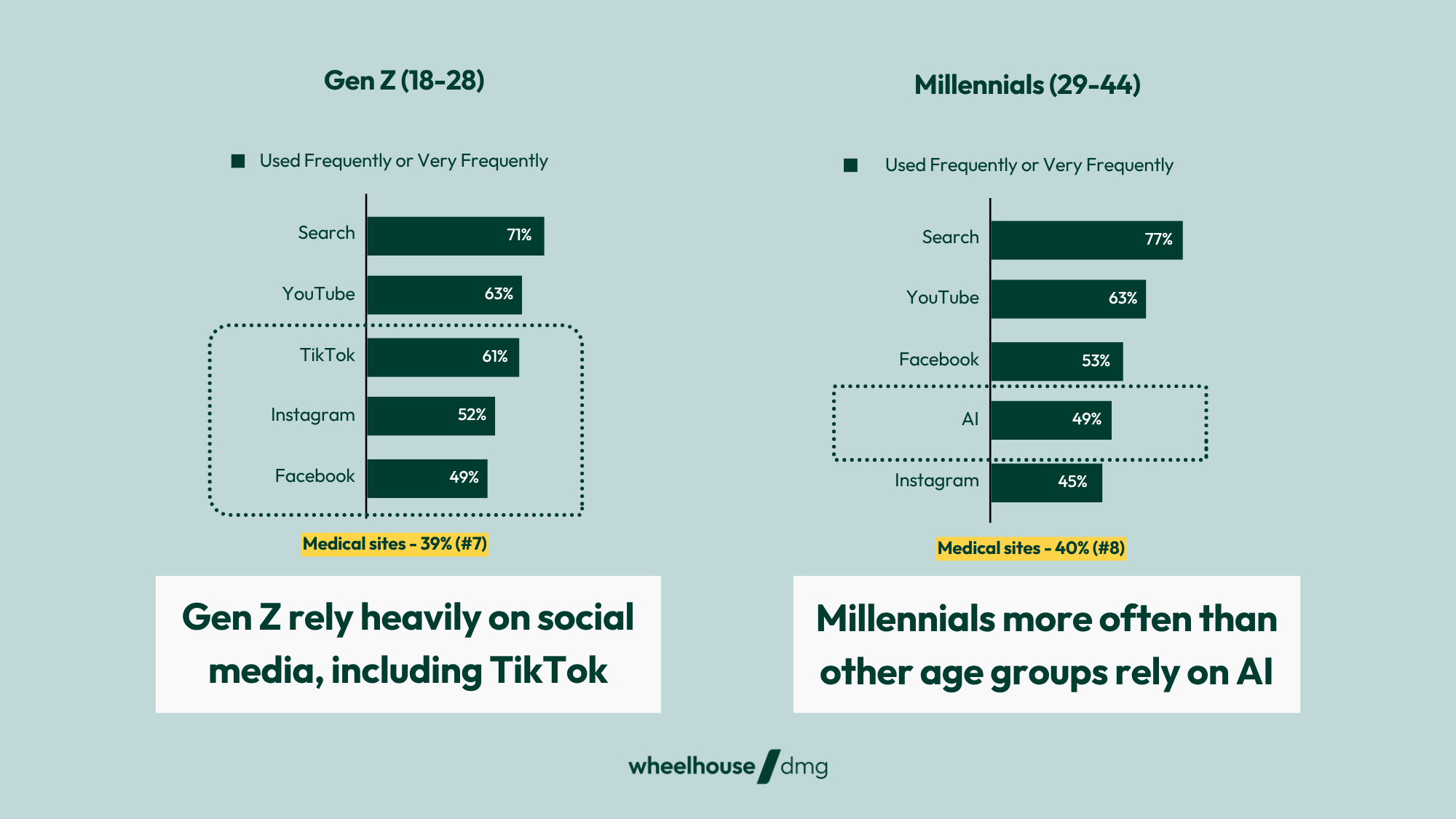
Younger Americans approach health information as a process of exploration rather than confirmation. They consult a wide range of sources, moving fluidly between search engines, social platforms, AI tools, forums, and websites. No single source dominates the journey. Instead, understanding emerges through comparison and synthesis.
For these audiences, discovery is iterative. Search often initiates exploration, but rarely serves as the final authority. AI tools increasingly function as interpreters, summarizing and contextualizing information gathered from multiple sources. Social platforms contribute lived experience and peer perspective, even when trust in those platforms is limited.
Trust among younger users is situational rather than institutional. Credibility is earned through clarity, relevance, and consistency across sources rather than through formal authority alone. As a result, younger audiences are more willing to experiment with emerging tools and alternative sources, even when verification behaviors lag behind confidence. This pattern explains why AI adoption is strongest among younger cohorts and why traditional authority signals, on their own, are insufficient to command sustained attention.
Older Audiences: Confirmation, Authority, and Reassurance
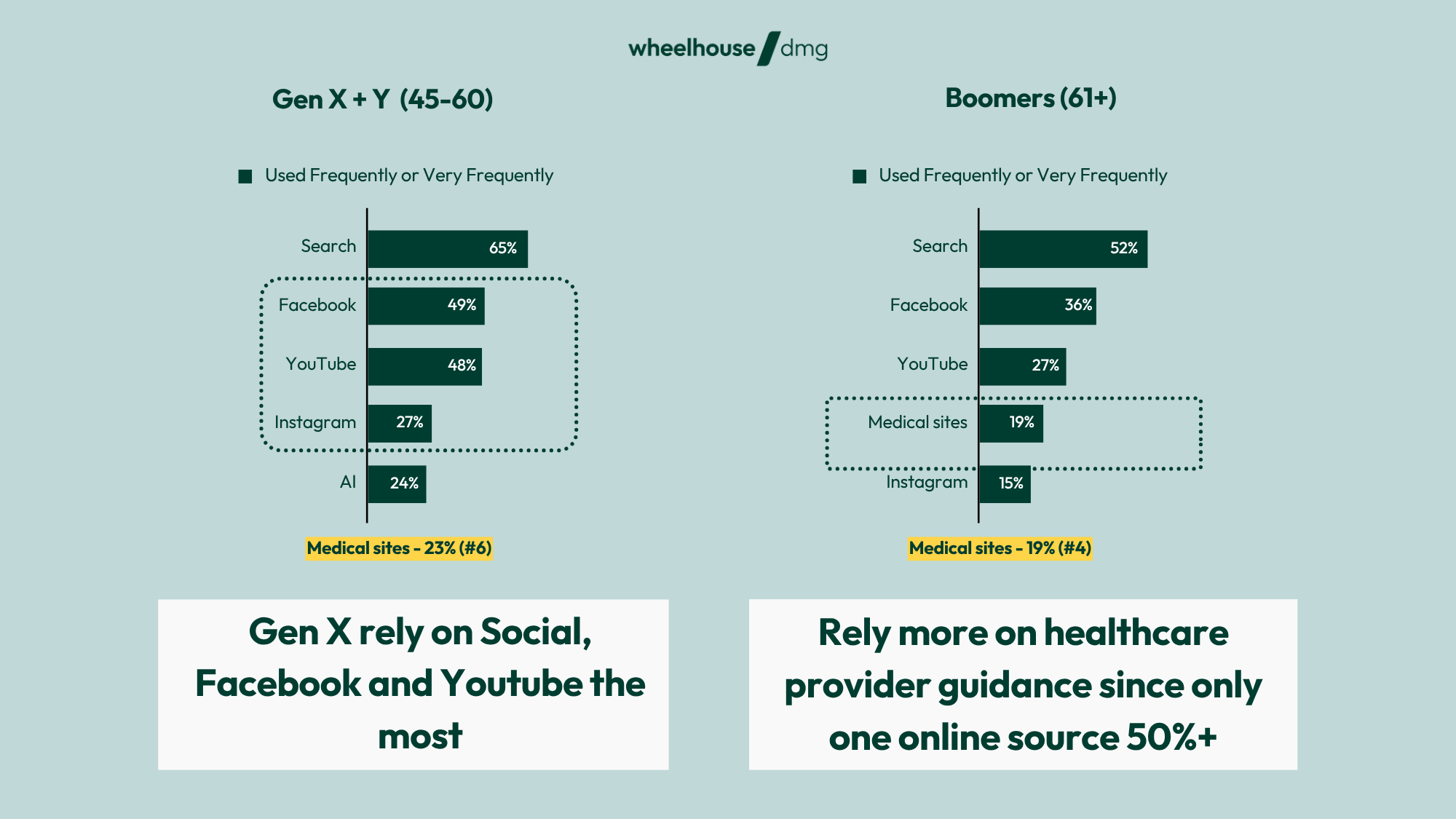
Older Americans follow a markedly different path. Their health information journeys are narrower, more deliberate, and anchored in a smaller set of trusted sources. Search engines and healthcare provider guidance dominate behavior, while reliance on social platforms, forums, and AI tools remains comparatively limited. For these users, trust is cumulative and institutional. Credibility is associated with established organizations, professional expertise, and familiarity built over time. Once a source earns trust, it tends to retain influence across multiple decisions and contexts.
Exploration is constrained not by access, but by preference. Older audiences prioritize clarity, reassurance, and confirmation over breadth. New intermediaries face higher barriers to adoption, particularly when accountability, provenance, or medical oversight are unclear. This concentration of trust helps explain why official health sources continue to gain influence among older cohorts and why skepticism toward emerging tools persists even as awareness grows.
Why Blended Strategies Underperform
Many health marketing strategies attempt to address age differences through compromise, blending channels, messages, and experiences in pursuit of broad appeal. The data suggests this approach is increasingly ineffective.
For younger audiences, experiences that rely too heavily on institutional authority can feel incomplete or inaccessible. For older audiences, experiences that emphasize exploration, synthesis, or AI mediation can feel untrustworthy or overwhelming. Efforts to average these expectations often dilute relevance for both groups. The issue is not messaging tone or creative execution. It is structural. Younger and older audiences are not at different stages of the same journey. They are following different journeys altogether.
What This Means for Performance Marketers
Age polarization fundamentally reshapes how performance should be evaluated and optimized. For younger audiences, performance depends on:
- Presence across multiple discovery environments
- Tools and content that enable synthesis and interpretation
- Signals of relevance and coherence rather than institutional authority alone
For older audiences, performance depends on:
- Alignment with trusted and authoritative environments
- Clear provenance and accountability
- Reinforcement of confidence rather than exploration
In this context, age becomes a stronger predictor of health information behavior than channel preference alone. Performance marketing strategies that ignore this reality risk optimizing for efficiency while eroding influence.
The tactical implication: Segmentation by age is no longer just a media planning input. It is a journey design constraint. You cannot optimize a single journey across these audiences. Attempting to do so produces diluted results that underperform for both groups.
Moving Forward
The five shifts above point to the same conclusion: the frameworks most performance marketers still use to measure success in healthcare weren’t built for how people actually find, evaluate, and act on health information today. Closing that gap starts with knowing exactly where those frameworks break, and what to build in their place.
Attribution Is Broken
Traditional attribution models assume influence occurs when someone clicks. But when AI synthesizes information from multiple sources before a user ever clicks, last-touch attribution misses the actual influence. When users start in search, validate through AI, and convert on an official health site, single-channel metrics can’t capture the journey.
What to do: Track assistive influence across channels. Measure validation behaviors outside paid environments. Accept that your content may shape decisions without generating clicks.
Trust Is Now A Performance Variable
Trust has traditionally been treated as a brand concern rather than a performance metric. That separation no longer holds. As users rely more heavily on synthesized information, trust determines whether information is accepted, questioned, or ignored. The new reality is efficiency without credibility is fragile. Campaigns that perform well in the short term but erode trust will underperform over time.
What to do: Treat trust as a measurable constraint. Align messaging with trusted third-party sources. Design journeys assuming users will validate claims elsewhere, and make that easy for them.d deliver exceptional performance in the competitive healthcare and medical device landscape.
AI Changes Where Performance Happens
AI introduces a new layer between marketers and audiences. Influence increasingly occurs when information is summarized and contextualized rather than when it is clicked. When AI synthesizes your content without generating a click, traditional analytics miss it entirely. If AI misinterprets your content, you lose influence even if your facts are right. AI preferentially cites sources with clear provenance, citations, and institutional backing.
What to do: Optimize content for AI systems, not just search engines. Use structured data and clear citations. Ensure your content can be accurately excerpted. Partner strategically with authoritative sources to strengthen credibility signals.
Age Determines Journey Design
Age polarization fundamentally alters how performance should be planned and measured. Younger audiences need breadth across discovery environments and tools that enable synthesis. Older audiences need clear alignment with authoritative sources and reinforcement rather than exploration. Attempting to optimize a single journey across these audiences produces diluted results.
What to do: Segment strategies by age for journey design, not just media planning. Build distinct paths that reflect how each audience actually forms confidence.
Specific Guidance by Role
If you’re a healthcare provider: You’re in the best position of anyone. Your challenge isn’t credibility, it’s accessibility. Your website is becoming a trust anchor in a fragmented ecosystem. Invest in content quality and user experience. Make your information easy to find and easy to understand for both patients and AI systems. Don’t chase viral reach at the expense of credibility.
If you’re a health brand or service: You’re operating in a more competitive environment. Partner strategically. Being featured on provider websites or co-creating content with medical societies dramatically increases your authority. Design marketing journeys assuming users will validate claims elsewhere. Invest in educational content that withstands scrutiny rather than content optimized purely for engagement.
If you’re running performance marketing campaigns: Balance exposure with pathways to validation. Use social to earn the click to owned environments where you control credibility signals. Track mid-funnel behaviors like newsletter signups and content downloads, not just direct conversions. Optimize for both human and machine interpretation.
The Bottom Line
Performance is no longer captured by controlling a single channel. It’s shaped by how channels work together to move audiences toward confidence and action. Search remains foundational but doesn’t own the journey. Social drives exposure but rarely resolves decisions. AI mediates interpretation. Official sources anchor trust.
Organizations that understand their role, steward trust carefully, and adapt thoughtfully to change won’t just perform better in the near term. They’ll help shape a healthier information environment for the years ahead.
Legal Disclaimer: The information in this communication should not be construed as legal advice on any matter. Wheelhouse DMG® is not providing any legal opinions regarding the compliance of any solution or other laws and regulations. Any determination as to whether a particular solution meets applicable compliance requirements is the sole responsibility or the client and should be made after consulting with their own legal counsel.