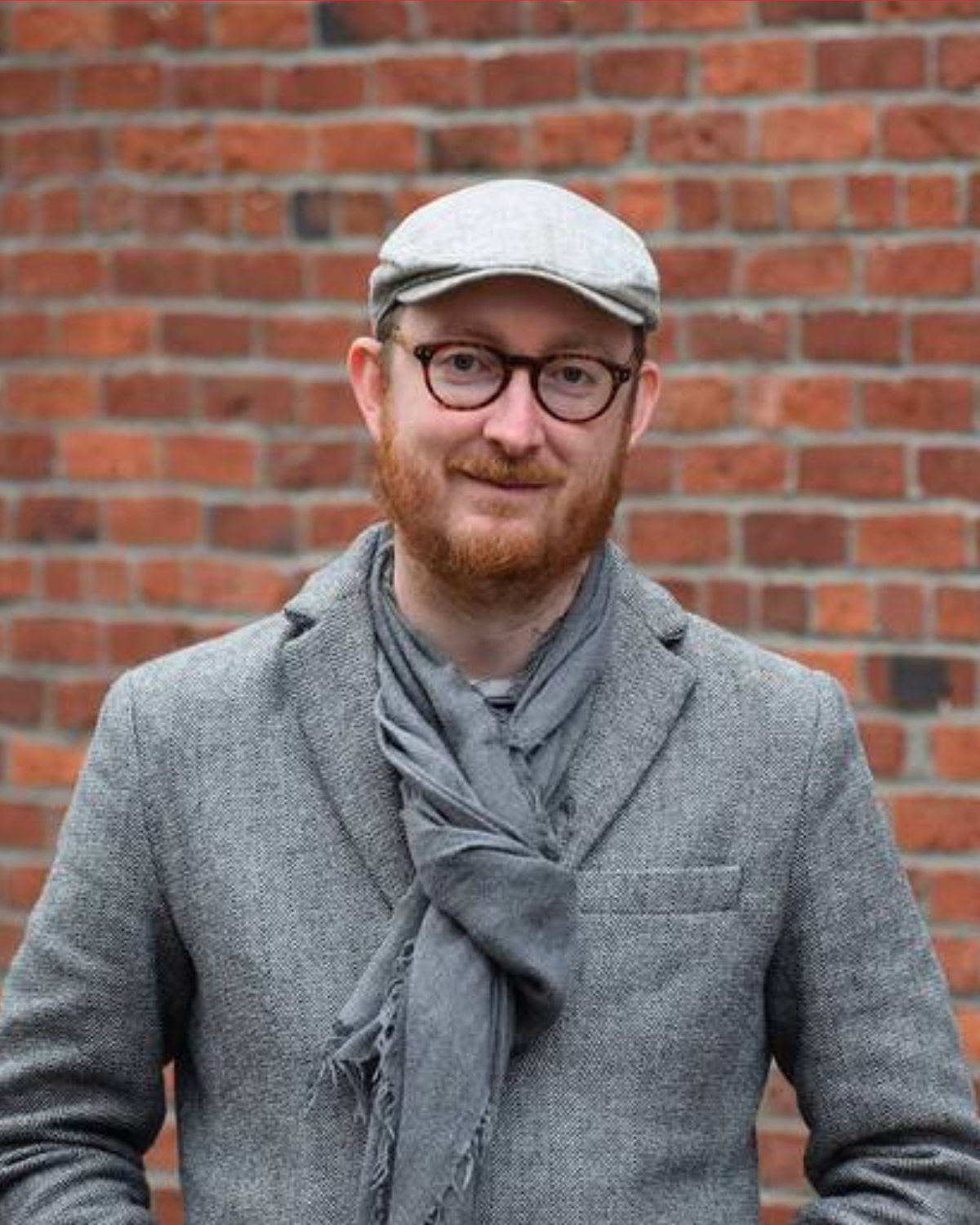
Episode 46: How to Cut Through the Noise with Audience-Focused Content Marketing
Hosted by Aaron Burnett with Special Guest Courtney Patterson
Great content doesn’t sell, it serves, and Courtney Patterson has built her entire marketing philosophy around that distinction.
Courtney is the Content Strategist and Marketing Lead at Implant Direct, with a career spanning FinTech, SaaS, and medical device across some of the largest companies in the world. Along the way, she developed a content framework rooted in three questions: Why me? Why now? And why should I care? If you can’t answer all three, the content isn’t ready to publish.
In this episode, you’ll learn why audience-centered content drives better results, how marketing in a regulated med tech environment changes the way you craft a narrative, what AI can genuinely help with in the content creation process and where it falls short.
Listen & Subscribe:




Introducing Courtney Patterson
Courtney Patterson: Marketing, ultimately, is figuring out what makes people move. You have to understand who you’re targeting and who your audience is to figure out what is going to make them actually take action. When I think about it from that perspective, I think about three questions, which are: Why me? Why now? And why should I care?
Because otherwise you’re just spraying content out there for no reason and you’re just wasting people’s time. And we don’t live in a world where time is in abundance right now. I think cutting through the noise can be really challenging, but I love what I do because I love the idea of getting to do things from a value-based perspective.
Aaron Burnett: That’s Courtney Patterson, content strategist and marketing lead at Implant Direct. Courtney’s career includes marketing roles with household names and startups in FinTech, SaaS, and medical device manufacturing. Along the way, she developed a content marketing philosophy rooted in three questions: What do I have to say that adds value? Why is now the right time to publish? And why will my audience care?
In today’s conversation, Courtney shares what her three question framework looks like in practice, her strategy for creating audience-centric content that generates meaningful results, and her take on what AI can and can’t replace in the content marketing process.
You won’t want to miss this episode of The Digital Clinic.
A Message from the Sponsor
Aaron Burnett: This podcast is sponsored by Wheelhouse Digital Marketing Group. Wheelhouse provides exceptional performance marketing for healthcare and medical device manufacturers. Every Wheelhouse client saw record performance in 2025, even after implementing HIPAA-compliant data solutions.
Find out more at wheelhousedmg.com.
From Creative Writing to Corporate Marketing
Aaron Burnett: Can you give me your professional history? You’ve worked for some of the largest companies on the planet and you now work in healthcare and med tech, so walk us through that career transition or that career history and then let’s talk about where you are now.
Courtney Patterson: Yeah, definitely.
I went to school UC Santa Cruz and got my degree in creative writing. I quickly realized that I needed to be more in the corporate world, just because creative poetry and fiction doesn’t really put food on the table unless you’re Stephen King. I went ahead and ended up applying for an office manager position at my first company, LeadCrunch.
I did so well in the interview process that they decided to go with someone else, but they liked me so much that three months later they emailed me and said, “Hey, we have these two positions in sales. Which one do you want?” And so, I chose the sales development representative because I felt like that was more human. I was able to focus on messaging and creating relationships and things of that nature. So I went ahead and did that.
Through that process, very quickly, I merged into marketing. I ended up writing a couple of articles, one of which made the organic top 10 list on Google, and I didn’t really know what I was doing.
I just was using the sort of skillset that I had learned as a writer growing up, going and taking classes, and just really writing and having a lot of trial and error, if you will, and just being so meticulous with my writing. So that was interesting. And then I moved into an actual marketing position where I worked for a company that basically did demand generation pilot programs for all different types of companies.
So, I was working with FinTech, SaaS, med device, just different types of companies and I got a lot of experience with that, which was really fun. Then I did some freelancing. I had some people ask me to help them out with things, and I was good at that. And then segued back into working underneath like the umbrella of a company and did some interesting things.
I ended up at Cisco and was leading the team there, the Americas Virtual Demand Center. There were different folks for each of the regions, but overall, I was making the decisions as far as what was going to be global. And then most recently I was actually in a position as an operations manager, which was definitely interesting.
It wasn’t exactly what I was planning to do, but the gal that was interviewing me basically said, “I really think that you’ll be really good at this. Even though your bread and butter has been marketing and content creation, I think you think strategically and this is all going to make sense.” It ended up being really interesting and I learned very quickly that strategy and strategic thinking is the same across the board, like the principles are the same. And if you are just looking for pockets of issues, then you can find solutions. And I think that’s how my brain tends to work. Now I’m over at Implant Direct doing marketing for them, content creation. So yeah, this is my first med device company, if you will.
Aaron Burnett: So that last role prior to Implant Direct was a Microsoft role, is that right?
Courtney Patterson: So it was actually for Designit, but they were my entire client base. So I was a hundred percent dedicated to Microsoft, so it felt like I was working for Microsoft.
Courtney’s Role at Implant Direct
Aaron Burnett: What’s your purview at Implant Direct? What are you focused on there?
Courtney Patterson: Mainly focused on just essentially getting marketing out that is going to drive sales with our products.
We have an array of different dental implant and full arch restoration products. Things that are really important to have the right tools for. Implant Direct is constantly evolving with the different changes, and they have dentists that they cooperate and collaborate with to figure out what these tools need to actually look like and how they need to fit into the patient’s mouth and that sort of thing.
So I’ve just done a bunch of stuff with emails, SMS, social, pretty much all types of content across the board, figuring out what makes people tick on different platforms. I think LinkedIn has its own personality, Facebook has its own personality, and Instagram has its own personality, so we don’t want to copy and paste everything on the same platform. I think there needs to be some differentiation there.
Aaron Burnett: So are you a part of setting strategy, and are you also a part of measuring and reporting out on performance of your work?
Courtney Patterson: Essentially, I am the one that’s creating the strategy around what content we’re using.
They needed someone to come in and refresh things a little bit. I’ve been focusing on what my work is actually doing. I haven’t necessarily had a ton of access to the data, but every time I speak to my colleague, he tells me how great it’s all going. I just keep writing honestly.
Navigating Regulatory Language in Medical Device Marketing
Aaron Burnett: With the shift into a med tech context, to what extent have increased privacy regulations, data privacy and patient privacy regulations, required adjustments in your work, or adjustments in the way that your work is targeted?
Courtney Patterson: The biggest thing that we’re focused on is making sure that we don’t reach out to people that we don’t have the permissions to reach out to.
And that’s been challenging, because we want to potentially win back some clients and things like that. Med device is absolutely something where you have to be on it in terms of what you can say. I’m used to being able to be a little bit more creative, not necessarily hyperbole, but just being able to not have to stand behind something medically in terms of the type of language that I use and how I create a narrative and things of that nature. So that’s been a bit of a different shift for me, just being super intentional and making sure that the words themselves can’t be seen as claims that we can’t make, if that makes sense.
The Ethics of Social Media: A Marketer’s Internal Tension
Aaron Burnett: Yeah. Alright. So you are a content creator, and you also are a social media marketing strategist and expert. In the research that I’ve done, I have also seen quite a few comments from you on the risks of social media, particularly for younger folks. So how do you reconcile that tension? You create content for social media, you create strategies for social media, and you have deep concerns about social media.
Courtney Patterson: Yeah, I think that’s a really great question. Honestly, it can be a bit of a tug of war for me internally. I think social media is absolutely a great tool, but I think that we as a society have gotten away from using that as a tool, and it’s almost like it’s using us. Who really has agency anymore?
I think about how addicted people are to their phones and to their screens and how little we’re having conversations. For me, with the dental industry in particular, the way I see it is we’re driving engagement and conversions for dentists that need tools. But I think that when you look at a broader picture of social media, and especially children growing up and they don’t really know what’s going on with their bodies and their minds and just all these different hormones and everything. It can be really challenging.
And then there are, of course, a lot of dangers on social media. Unfortunately, we have a lot of people out there that are not there for the right reasons. It’s very easy to exploit it. So, the thing that I try to think about is who I’m serving. I really try to envision, in particular right now, the doctors and the dentists that I’m serving, and think about what their worries or concerns might look like right now, what their workload could look like, how stressed out they are, and what could make their life better.
I’m not just looking at it from a transactional approach. I’m looking at it as a way to serve them in general. Yeah, you’re correct. I definitely have a lot of concerns about social media.
Marketing as a Moral Act: The “Why Me, Why Now, Why Should I Care” Framework
Aaron Burnett: So you’re conscious and careful about who your work is serving, that your work is serving someone. I’ve also seen language around the notion of marketing as a moral act.
Tell me more about that.
Courtney Patterson: Marketing, ultimately, is figuring out what makes people move. You have to understand who you’re targeting and who your audience is to figure out what is going to make them actually take action. Because we live in a world so full of information these days, we’re bombarded by 80 million different ads probably before we brush our teeth in the morning. To some degree, it’s not about them seeing the content necessarily. It’s about them taking action on the content.
When I think about it from that perspective, I think about three questions: why me, why now, and why should I care? And everyone I’ve ever coached, or anyone I’ve ever managed that was maybe a little bit more junior than me, I’ve always told them, if you can’t answer those three questions, you shouldn’t be putting out the content. They need to understand: why would you reach out to me right now? Why me? And why should I care? Because otherwise you’re just spraying content out there for no reason. You’re just wasting people’s time and we don’t live in a world where time is in abundance right now. I think cutting through the noise can be really challenging, but I love what I do because I love the idea of getting to do things from a value-based perspective.
And for me, I am a person of faith, and so it’s important to me that I’m not coming at these things in a way of manipulation or kind of a bait and switch type of thing. I think there’s a lot of people that are so focused on the numbers. They forget that these are real people that we’re reaching out to.
I try to really keep that at the forefront.
Persuasion vs. Manipulation: Making the Audience the Hero
Aaron Burnett: I think a lot of marketers think of the work that they do as an effort to educate, but also to convince prospects to convert and to become customers. How do you react to that? How do you feel about the notion of convincing? Does that fit within this moral framework, or do you view your role as achieving something different from that?
Courtney Patterson: I don’t know if I would say convincing. I think it’s more persuading, but the biggest thing that I’ve come to find is that whenever you’re reaching out to someone with a product or a service, you always want to make them the hero of their own journey. And you’re just the magical sword that they picked up along the way that’s going to help them in battle.
It’s not about you, it’s about them. So what I found across the board, even in my own LinkedIn inbox, I get pitched all the time and it’s interesting to me how many people just drone on about what they do and they’re not focusing on what I do. And again, it’s like, why me? Why now? And why should I care? But the reality is that people wan to hear about themselves.
Dale Carnegie in his book, How to Win Friends and Influence People, talks about how our name is the sweetest word in the English language to us. It’s important to remember that, I think, and there’s an aspect of giving people information that they didn’t previously have, so I don’t necessarily see it as convincing.
I think there’s definitely campaigns out there and companies out there that do that. They use manipulative techniques and they use AI videos that aren’t real and different things of that nature, which we’re not doing. So I’m grateful for that because that would definitely go against my values. But I think people have needs, right?
We all have needs. And so if you put out the proper marketing and the proper message, then you’re serving that need hopefully, and making someone’s life just a little bit easier and taking one thing off the list basically.
Putting the Hero Framework into Practice at Implant Direct
Aaron Burnett: So, you made an interesting comment about wanting to ensure that you want people to feel like they are the hero of their own journey.
That certainly is resonant, that conforms with the power of myth throughout history. How does that show up in your marketing? How do you employ that for Implant Direct, for example?
Courtney Patterson: The biggest thing is not talking about how great Implant Direct is, but talking about how great they are and how great they could be. They’re already skilled dental clinicians, but how much better could they be? A few months ago, it was about 2026, right? Leveling up your skillset, leveling up your practice, scaling, creating predictability and sustainability. That’s what I focus on. It’s about them. It’s not about how great Implant Direct is, and look at our shiny products, because at the end of the day, people don’t do business with businesses.
Before the Industrial Revolution, everyone was basically an entrepreneur: a blacksmith, a butcher, those different types of roles. And so you were voting with your dollar on who you wanted to succeed, and you voted with your dollars for who you enjoyed as a person. And I think that still happens today, but we forget that because we’re so focused on the company as a whole that we forget the people that are in the company or the people that we’re reaching out to. I do believe that every company should take the standpoint that they should be the hero of their own journey.
Like for me, I know when I get messages on LinkedIn and they’re just droning on about themselves, I’m automatically turned off. And I think that’s just a human nature thing, to be honest with you. How do I react when I get messages? What is my first thought? Because that’s data for me too, and that’s learning for me.
And I look at when I get convinced or when I actually take action on an ad on social media, if I buy a product or something. What is it that made me do that? So I’m always thinking strategically, and obviously it’s not a one-to-one because dental implants are not the same as a face mask or some sort of cosmetic or what have you, but it is the same principle: you’re serving needs and you’re giving someone something that maybe they knew they needed or maybe they didn’t realize they wanted.
Measuring Audience Connection Beyond Standard Metrics
Aaron Burnett: All marketers are looking at performance metrics, and those metrics tell them whether what they’re putting out in the marketplace is working or not working. If you’re taking the approach that you have just described, I’m assuming there might be other metrics aside from, let’s say, an open rate or a click-through rate in an email or engagement, that you are looking at that tell you whether you are achieving that connection and resonance with your audience. What do you look at that tells you that you’re connecting and that people who are engaging with your content feel like they are the hero of their own journey?
Courtney Patterson: I think that is a little bit challenging just because I don’t necessarily have the hands-on relationship at the moment with the data the way that I would like to.
But I think that when I look at our user-generated content, for example, they speak about how great Implant Direct is with them and how they came alongside and really helped them set up the systems and the different workflows. So, I think that’s in the forefront of my mind.
But the other thing is, for instance, I did some SMS messaging and my colleague told me that we had 292 new users that month. These were folks that actually made a profile and were either purchasing something or planning to in the future. So, in this particular role, I don’t necessarily know exactly what that looks like because this is newer for me, but I think that for someone to create an account says something. If you’re doing that, it’s because you have some semblance of trust with the company.
If I had the opportunity to, I would love to chat with some of the doctors and ask them like, “Hey, what do you think of this?” When I first started my position, I have a friend who’s a dentist, and I was asking him if I could run the content by him because it was a totally new world for me, and I just wanted to figure out like, what is it that you care about?
Aaron Burnett: Are you aware of the moment when you experienced language in a way that made you think, “Ah, that really touched me”? I can think of moments in my own life when I was reading and I was really impacted by what I was reading. Do you know when you became a word nerd?
Courtney Patterson: I think I do. I know when I became pretty engrossed in the idea of expressing myself through stories, that was at a young age.
I remember I read a memoir that really spoke to me and it just made me feel not so alone in some of the things I was dealing with as a young girl. I had such a visceral response to it that I found myself writing after that, and writing has just always been a part of my life. It’s always been a way for me to let off some steam, to unload, to make sense of what’s going on in my life and in my mind.
I’ve been the gal that wakes up at two or three in the morning writing poetry. It’s fun, and it’s fun to see how things transition. I don’t know if you’ve ever heard that quote: “Art is never finished, only abandoned.” But I really believe that’s true.
AI as a Tool vs. AI as a Replacement for Human Creativity
Aaron Burnett: As someone who loves language, what is your perspective on your relationship with AI?
Courtney Patterson: Yeah, that is an interesting one. AI is obviously a great tool. It’s definitely a way to get the wheels turning. I think the line that needs to be solidified is when people start taking credit for AI output as if it’s their own creative writing. “Oh, I wrote this book, I wrote this memoir, I wrote this fiction piece, I wrote this poem.” No, you didn’t.
I think in the corporate world it’s a little bit different because yes, it’s important to have that authenticity, but it’s not the same thing. People, I don’t think, are really thinking, “Oh, someone really spent hours and hours coming up with this exact phrasing.”
You think about products and services, a lot of it is like, “Hey, we realize that you’re awesome. You have a need. We want to serve that need, we want to serve you. Can we connect or click here to purchase or click here to learn more?” You’re not reinventing the wheel per se. But when you’re thinking about creative writing, that’s a whole different ballgame.
The Future of AI in Content Marketing
Aaron Burnett: What do you think will be the role of AI in content creation?
Courtney Patterson: I think AI can play a very important role in the sense of different industries. Instead of spending hours and hours trying to understand a specific industry, AI is able to pull a lot of things and you can learn from it as you go about how your audience thinks, how these tools really matter in the marketplace. Where people maybe want AI to go is that it just writes all the content for us, right?
I found that even when I’ve used it, I’ve had to correct it. I’ve had to change or further explain what I wanted, which isn’t a bad thing. I don’t think that we should be relying completely on AI. I think that can be a dangerous place to get to. A lot of people, I think, would love nothing more than to be able to let AI just do its thing.
But then again, what does anything mean anymore? What’s the value of something? If it was just written by a robot and just sent out, I don’t know. I think everything loses its value in that case, and everything does feel manipulative at that point too.
Aaron Burnett: How do you hope that AI evolves in the world of marketing?
Courtney Patterson: I hope that there’s a way to have a brainstorming mode, if you will, where you can say, “Here’s what I’m thinking, here are the details of the framework. Give me some data to show me what psychologically would be the best practice technique.”
I do a lot of research on whether it’s FOMO or the aspect of gain. Most of the time it’s FOMO. We’re all afraid of missing out. That’s typically how you can really get people to take action. This was several years ago, but I worked at a company called SAP Insider. We had an event that didn’t have enough registrations. My boss told me, “Hey, we need to make a new download for this.” Make an email, basically. So I did and I had to throw it together relatively quickly. I ended up putting at the bottom a date that had already passed, and we got 600, almost 700 downloads in a 12-hour span. I can’t say for sure that was because the date had already passed, but I wonder if people thought, “Oh, maybe I didn’t miss it,” or something. I just found that to be so interesting. I think it’s really small details in marketing, and I think that’s what makes it hard with A/B testing too. You can’t test so broadly that you have these totally separate things, because then you don’t know what worked and what didn’t.
But then you also don’t want to be testing an exclamation point versus a period. It might matter in some cases, but that’s what I found to be a little bit challenging. How do we test things? Because I’m a big believer in making different versions and seeing what happens in the wild, seeing what people actually enjoy and what makes them move, versus me just determining “this is going to work” and putting out one thing. I’ve always been really fond of A/B testing, but it can be a little bit challenging.
Aaron Burnett: I think that’s true. I’ve enjoyed talking with you. It’s been very interesting.
Courtney Patterson: Thank you. It was wonderful chatting with you as well.
Sponsored by Wheelhouse DMG