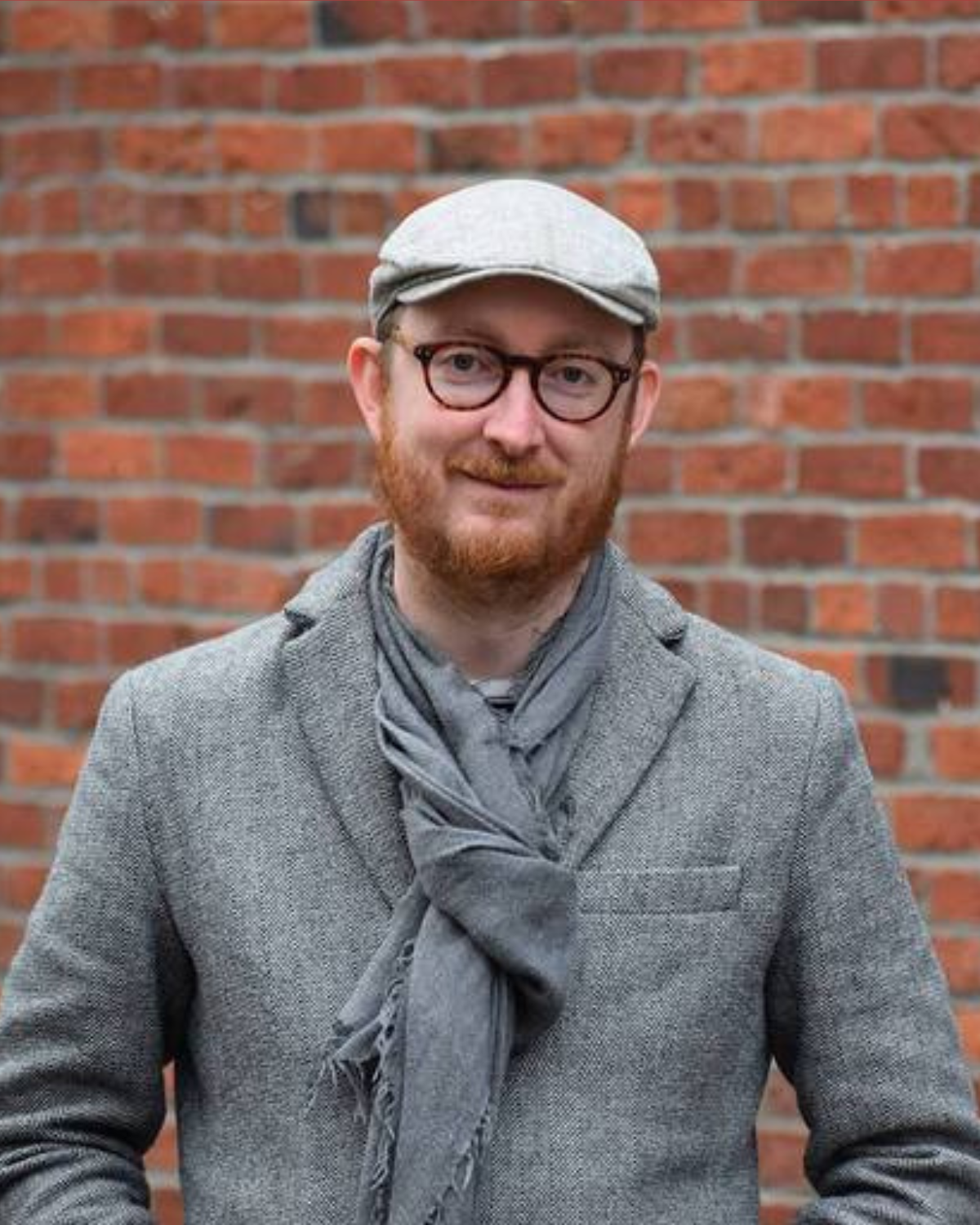
Episode 57: How a MedTech Brand Doubled Engagement with Bold Humor
Hosted by Aaron Burnett with Special Guest Mike Harris
How can medical device marketers break away from dry spec sheets and build memorable brands in highly regulated markets?
In this episode of The Digital Clinic, Aaron Burnett sits down with Mike Harris, Senior Product Manager of Foot & Ankle Upstream Marketing at Acumed. Drawing from his transition from 3D animator to upstream strategist, Mike shares how storytelling, humor, and creative craft can double audience engagement while maintaining strict compliance.
Listen & Subscribe:




Introducing Mike Harris
Aaron Burnett: Today I am joined by Mike Harris, senior product manager of foot and ankle upstream marketing at Acumed. Mike’s career path is anything but standard in orthopedic device marketing. He started as a graphic designer and 3D animator, running Acumed’s in-house studio and managing tactical marketing communications before transitioning to what he calls the dark side: upstream product management. Today, he has a leadership role at the intersection of clinical market research, voice of customer data, and early-stage product strategy.
In this conversation, Mike shares how his background in creative design and storytelling changes how you approach an information-rich but highly regulated industry. We talk about how he used humor and analogies to double engagement on social channels, how to build trust with compliance teams while skating right up to the edge, and why true creative discernment matters more than ever in the age of AI. It’s a fun and candid look at what happens when you combine creative craft with deep product strategy, and it’s a great conversation.
I think you’ll really enjoy this. Let’s get into it.
A Message from the Sponsor
Aaron Burnett: This podcast is sponsored by Wheelhouse Digital Marketing Group. Wheelhouse provides exceptional performance marketing for healthcare and medical device manufacturers. Every Wheelhouse client saw record performance in 2025 even after implementing HIPAA-compliant data solutions. Find out more at wheelhousedmg.com.
From Graphic Designer to Orthopedic Product Manager: Mike Harris’s Career Path at Acumed
Aaron Burnett: Tell me a little bit about your professional background. You have a very interesting career path from creative to product marketing management. Tell me a bit about that, and then I’ll have all sorts of follow-up questions for you.
Mike Harris: Oh, excellent. Yeah, thanks for having me, Aaron. It’s funny, because as I looked at the other speakers here, I thought, “There’s a lot of experience here.” And I do come from kind of an unorthodox background. Like many people around 2008 or 2009, I was re-finding my adult life and my passion, and I decided to go into graphic design and marketing communications. I went back to school and interned for a little company in Hillsboro, Oregon, called Acumed. It was a blast, with a lot of fun people. I got really deep into the minutiae: there are these surgical techniques, and we have these surgeons coming in. They do labs, and we sell a product that goes on people’s bones.
At the time, being just what I was, I was really ignorant of the whole thing, but I fell in love with it. Once I graduated, I came back as a graphic designer, and from there I went on to do 3D art for Acumed. I ran their 3D program. I ran their in-house studio, and then I basically ran the tactical portion of the entire marketing communications arm.
I had a director above me; he was strategy, and I was tactics. Somewhere right after the pandemic, I said, “You know what? I think I’ve done as much as I can do here without taking your job.” He was a fantastic leader, and instead of being threatened by that, he said, “Well, you have a great relationship with one of our VPs in the foot and ankle department, and she’s been looking for a director. You’ve led people. You should try that out.” And so I went to the dark side of marketing and went to product management.
Aaron Burnett: That hurts a little bit. I like the product management side.
Mike Harris: Yes. Well, the dark side. I’ve now fully embraced the dark side of the Force. But the truth is that there’s no other part of our business, maybe besides sales, that touches the customer so intimately, and I got tastes of it all throughout my career.
You’d do 3D and maybe work with a surgeon for a day, or you’d do a layout for a surgical technique and see their notes. Maybe in filming you’d do a lab or some Q&A, much like this, but ultimately it was an hour and a half at a time. Now I get to be with the customer really whenever I want to, set up calls, have conversations, and understand what makes them tick and what their problems are in a way that I never could.
And ultimately, I help guide the direction for what we offer our customers and, ultimately, their patients. At the end of the day, if you don’t have that patient mindset, if you don’t want to see someone healed, then why are you in it?
What Is Upstream Marketing in Medical Device Product Management?
Aaron Burnett: Yeah. Yeah. All right, so you have quite the title. It’s long. You are a senior product manager for foot and ankle upstream marketing. Let’s unpack that in a couple of ways, because I think that lays good groundwork for some of the questions I have about the intersection of your creativity and marketing. Tell me a little bit more about the foot and ankle practice and products at Acumed. And then I’d also like to know what upstream marketing means in this context.
Mike Harris: Certainly. Let me do the latter first and then the former. When we think about, and this is just how Acumed’s doing it; quite frankly, they’ve done it other ways, and other companies have other names for this. I feel my job is related to guiding the direction for our portfolio, identifying gaps and places for us to play, and then having and guiding those conversations with clinicians so that those directions are guided by clinical intelligence and not just the whims of an organization saying, “I want to make more money in this market.”
In a nutshell, that’s what I get to do, but ultimately, my day-to-day is a lot of VOC and more Excel than I care to admit: figuring out what the market size is and what we can hope to achieve in this market. The TAMs, the SOMs, the SAMs, looking at CPT data, all that stuff. But the downstream, and when I was director, the downstream and upstream were both part of my bailiwick, the downstream is really when the product is out and exists in the field. We know we’re going to carry it. How do we train on it? How do we talk about it?
How do we support our sales field in its delivery to the surgeon? And then, should there be questions mid-surgery, downstream handles that. A lot of the actual social media and the upkeep of collateral also falls to downstream marketing. I get to kick it off, but ultimately, once it’s out of my hands, I never touch it again.
So I get version A, right? If I’m lucky.
How Acumed’s Hand and Wrist Products Expanded Into Foot and Ankle Surgery
Aaron Burnett: Sure. Okay. And then can you tell me a little bit more specifically about the foot and ankle category and the sorts of products and solutions you’re helping to create strategy for, develop, and bring to market?
Mike Harris: Acumed is unique in that when we’ve measured brand recognition in the past, Acumed has ultimately been very high in the minds of hand and wrist surgeons. Our volar distal radius plate and the Acutrak headless compression screw are pretty well known in the industry, even among other groups. People come in all the time and say, “Hey, I know Acutrak, but I don’t know everything else.” But the reality is that Acumed was founded on the idea of being a company that looks to find solutions for problems doctors see, no matter the niche or the place. And there were actually a lot of legacy products we came out with that do touch that foot and ankle group.
Some of the first things Acumed launched were things like fibular rods and fibula nailing, which really weren’t being done in a big way in the US. By accident, or maybe even on purpose, the Acutrak headless compression screw, which was so impactful for scaphoid fractures, also became a standard for a lot of foot and ankle surgeons, almost by dint of its existing. And there were plenty of other products we launched through our history that ultimately dovetailed really well with the problems foot and ankle docs were seeing, including some of the first anatomic plates for MTP fusions. Today we’ve got a robust market that plays very well in the hands of foot and ankle MDs, and really, the thrust of my job is trying to find where else we can go. And I think my supervisor would like me to leave it at that.
How to Use Storytelling in a Data-Driven Medical Device Market
Aaron Burnett: I can appreciate that. I understand. Yeah. As I was completing research for this interview, one of the things I found intriguing and fascinating is that you’re in a market space usually typified by data, spec sheets, and all sorts of arcane information. It’s information-rich. But your emphasis, historically and philosophically, has been to focus on story. How do you do that in a market space like this?
Mike Harris: I don’t think they’re mutually exclusive. It’s funny, if you had asked me 14 years ago, when I went back to school, I did not want to be in Excel sheets. I did not want to understand how to do an ROA or a cash flow. But obviously, being in the director seat, and in this role, you can’t get around it. It’s something you have to do. It’s just like my creative role: learning a lot of programs is part and parcel of being a creative. You’re going to learn how to edit video. You know this. You’re going to learn how to edit audio. You’re going to learn how to sweeten audio.
You’re going to learn After Effects if you have to. If someone says, “I need an illustration,” you’re going to try your hardest. And it’s the same thing here: you’re going to learn how to make a decent Excel sheet that’s readable by another human being, that you can send up to finance, and they go, “Oh, you’re not crazy. This makes sense.” But what I found through that is that the lesson is in the data. So today, when I get into a conversation with someone at the company, or I have to take an idea and justify it to someone here or maybe to a customer, the first thing I have is the story. I know the data supports that story, and that might be…
I’ll try to give you an example. We recently launched something called the Acu-Ready Kit. It’s a kit that essentially replicates what we do in our trays in a sterile, disposable way. I’m not going to spend time marketing this, but ultimately, the reason I felt this would have some legs is that I kept hearing stories from reps about lost cases. They keep telling me, “Mike, since 2020, things don’t work the same way. SPD that used to work just fine doesn’t anymore. We need to have backup trays for backup trays. We have to have two to three trays going into this.” And ultimately, that information said, “Okay, I see that there are misses here. I see that there are gaps that we don’t see.” The data is telling me that as a rep, you are servicing this account with six hours of extra service that’s not really being looked at or viewed by anyone. It’s invisible, right? So now when we launch this product, the story really is that this is making the facility’s job easier.
This is making your job easier, and you’re saving the doctor’s surgery. It’s not a tray-versus-disposable conversation anymore. It’s a tray versus no surgery happening that day. And you can imagine, and I don’t have to tell your audience that would be an amount of money that would far more than make up for the disposable versus the tray.
Aaron Burnett: Sure. Yeah.
How a Creative Background Strengthens Medical Device Product Management
Aaron Burnett: As I mentioned at the outset, it’s unusual to have someone with a creative background in your role. How have your creative education and experience informed your perspective and approach differently in this role, which is so analytically driven? My hypothesis is that this gives you kind of a superpower. What’s the superpower you get from the creative disposition you bring to your work?
Mike Harris: It goes a little bit back to what I was saying before, in that it’s really about learning skills on the move and learning programs. It’s not faking it till you make it, because ultimately, I never feel as if I don’t have the ability to achieve what we’re doing. And as much as rigor, data, and statistics have been brought to the market, there are a million different ways that other marketers view that data and process it to try to get to their story. There are a couple of things I look back on and owe to my creative upbringing, and maybe these aren’t the sexiest answers, but one of them is a rigor toward process.
The process is the process, you get to the end of the process the same way, and you have to like the process; otherwise, you’re just going to make yourself miserable. So if I were to work on a design brief or a design project, I’d start in pencil. I’d start with brainstorming, I’d start with sketches, and from there I’d move on to a rough draft, then another rough draft, and iteration, iteration, iteration.
A lot of folks look in on that process midway and say, “That’s really ugly.” And you’re like, “Yeah, but don’t worry. It’s iterating.” And I think the same thing is very true of marketing, in that if you look at the process anywhere before, maybe, three months before launch, it’s pretty ugly, right? The data’s not exactly where you want it. You’re still gathering some information. You’re still getting to a place where you feel really happy with your level of assurance in the data. And then you finally get to a point where you’re like, “Okay, we’re going to put it out there.” And ultimately, when you cross the finish line, you see whether you’re right or not.
Thankfully, I’ve been right more often than not, but I haven’t been doing this that long. The other thing, and this is a very unsexy answer, is organization and file prep. That sounds silly, but naming saves you every time, and that was definitely something I learned from design and creative.
Aaron Burnett: Yeah. Are you familiar with the book Creativity, Inc.? It’s the story of Pixar.
Mike Harris: Yep. I’ve read it. Yes, sir.
Aaron Burnett: Trusting the process. Yeah. Every Pixar movie starts as a disaster. They’re not threatened by that. They know that’s the way it’s going to be, and as you said, it’s a disaster until you’re about 75% of the way through, but it always turns out okay.
Mike Harris: Well, that’s the hope.
Aaron Burnett: Yeah, yeah, exactly.
How Acumed Used Humor on LinkedIn and Instagram to Reach Orthopedic Surgeons
It has for Pixar, anyway, and it sounds like it has for you as well. So let’s harken back to the director of marketing role you had, where you were also focused on downstream marketing. One of the things you did that was innovative, novel, and very successful was to focus on social media marketing—in particular, to find orthopedic surgeons on Instagram and other unconventional channels, and to find them with content and approaches that were also novel and unconventional.
Tell me a little bit about that.
Mike Harris: It’s funny, Aaron, I had almost completely blocked it out until your email, until this conversation. So I’ll put it this way. My foot and ankle VP at the time, her name was Rachel Edwards, and she’s since moved on to a different opportunity. We knew we were a small part of Acumed’s total bailiwick, right? We’re not a big section of the total hand and upper extremity monolith that it is today. But ultimately, our thought was: we have something special in the people who work here, at least today, that we want to show people, and that is a sense of humor. It’s an opinion, even if the opinion is maybe a little crass and perhaps grating. We want to show that off. And so from day one, she said, “Mike, I’m going to give you this dead channel,” which at the time was owned by a sister company we had retired. So it was a LinkedIn channel, and I started a new Instagram channel. And she said, “You’ve got one job, and it is to make some noise.”
For lack of a better term, she had a lot of belief in my ability to speed just under the speed limit so I wouldn’t get in trouble, but I wouldn’t get noticed. And for what it’s worth, when I look back at it, it was very much a process-driven thing, Aaron. I had a great team with me on it. I didn’t do it in a silo. I incepted it and said, “Here are some of the things I know we need to do. On the technical side, we’re going to be on LinkedIn and Instagram, so let’s make sure we’re using a square format. We want people to click through this. We don’t want them to look at the image and just pass it by, so let’s make sure there’s a story and a punchline within that reel, as much as we can, so that they’re incentivized to click through. We tell the algorithm this is clickable. This is worth looking at.” And ultimately, it was not just me. It was a team that worked here. I’ll give a quick shout-out to Logan, Lauren, Lena, they know who they are, and then Christian was a secret weapon from back in school. She helped us with the design portion, because I frankly couldn’t design at all in my commercial role.
But we really trusted the process. We set up a monthly check-in. We took all of our bad ideas and put them in a giant pool, and we just played a big game of, okay, for an hour we’re just going to tell jokes, and if one lands, we use it, and if it doesn’t land, we don’t use it, or if we think it’s a little too weird or maybe we’re infringing on someone’s IP.
Ultimately, we were also trying to bleed in some of the approved, regulatory-OK marketing messaging. I had already told my quality and regulatory stakeholders, “I’m not going to trespass here. Don’t worry. I’m not going to get us in trouble. What I want to do is add some humor and some levity to this.” And I will tell you, the response was way more promising than I ever thought.
I had surgeons from all over the world reach out to me or Rachel directly and say, “You guys are doing something really interesting here. It’s really fun.” But it was also something that, as I left the director role for the upstream role, I had to leave behind. And I think it did what we wanted it to. Those two channels still exist today. And while we’re not doing the same kind of content, because we don’t have that same focus, I think gaining that initial threshold of users and followers certainly helped. And I can tell you, when I look on Instagram today, I still get people mentioning Acumed Foot and Ankle surgeons using our products in the field, which is really the whole point. You’re getting that mention. You’re getting that throughput there.
Social Media Results: Doubling to Tripling Competitor Engagement Benchmarks on LinkedIn
Aaron Burnett: We wouldn’t be marketers if I didn’t ask you about performance. What sort of performance were you able to drive? What sort of gains were you able to drive on those channels using this approach?
Mike Harris: Well, ultimately, we doubled, especially on LinkedIn, which has some great tools. Again, I don’t work for Microsoft, so I’m not marketing for them. But when you looked at LinkedIn and the analytics tools they gave you, there were some great tools to compare against, I believe, up to 10 other competitors and how their posts were doing.
We easily doubled or tripled their engagement metrics with the type of content we were doing. Again, if you’re incentivizing someone to click on an image and get to the end of the story, that counts as engagement. If you’re incentivizing your company to like and share, that’s base-level statistics.
But we were also reaching out to our sales field and sharing their stories when they were making them, or reaching out to our surgeons, and where appropriate and approved, we were saying, “Hey, this is an interesting technique. This is a novel way to do it. This is totally within the framework of our clearance.” But ultimately, it’s someone we want to show is doing something with a product and helping a patient in a way that we feel deserves a mention.
Example: Using Puns and Analogies to Compete With Arthrex TightRope
Aaron Burnett: Yeah. Can you think of an example of a post or some content you created that really knocked it out of the park in a surprising way? Maybe it was really humorous, or, as you mentioned, it skated right up to the edge in terms of being crass. What surprised you and stands out in your memory?
Mike Harris: Well, there’s one that didn’t stay up that I will tell you about. Orthopedics has a lot of devices that are things… Let me take a step back here. All thoughts are my own.
Aaron Burnett: Sure.
Mike Harris: I am an employee of Acumed, but this is my opinion only. So orthopedics has a lot of things. There’s a magazine called “BoneZone,” for goodness’ sake. We offer nails and screws. There’s a lot of lowbrow humor right at your fingertips, and for the most part, we did a great job of avoiding that. One that went over the line was an unfortunate one that maybe played with the word “nail” too much, but I’ll leave that where it is, because that ultimately was not my best moment.
But when I look back, what was really successful was a lot of dad humor, and a lot of puns focused on how we explain the story of this product in a way that actually resonates with the audience. I believe there were a couple of posts we did where we were talking about the Acu-Sinch Knotless, which was a syndesmotic repair device.
Its direct competition is the Arthrex TightRope, which is the monolith in this industry. They’ve got NFL commercials. They have mentions during ESPN. We’re not going to be able to buy that kind of marketing. But what we can do is say, “Hey, we’re the underdog here. Doc, are you tired of the fiddle factor?”
So we had “fiddle-free” and “Are you tired of all those strings?” So there was a lot of imagery of people on tightropes. A lot of marionettes, creepy marionettes, and that was one of the things we said. A lot of folks were like, “These are some creepy images,” when we picked some of these. I’m like, “I want the creepier, the better.” But those resonated. Not only did they have a sense of humor and show that portion of us, like, we’re fun, we want to engage you, not just with boring bullet points, but they also said, this is the actual benefit of this product: it takes away some of that fiddle factor.
We know from VOC and data that this is the major contributor to surgeon frustration. Yes, the TightRope can get done in 60 seconds. Ours can get done in 30. That’s not official, but that’s a difference. And when I went and visited surgeons in their ORs and saw the product being used, they would deploy the device, and then the surgical staff would say, “That’s it? We’re done?” That tells me there’s a full circle there, that we’re nailing it. No pun intended.
Aaron Burnett: You said you were gonna stay away from it.
Mike Harris: Yeah, well, that’s as close as I can get. I would say there was a lot of conversation, especially on Instagram, about doing reels that were trying to get that internet-y, TikTok-type zeitgeist.
There are a couple on there you can still see on the channel where we said, “Hey, this is something that’s going around. This is a sound bite everyone’s using. Let’s try to do something with it.” A lot of people caught eating food and making faces during meetings, which we abused for the fact of social media. Ultimately, the team also did a really good job of reining me in. I’m a little chronically online. I don’t know if you remember the dog—the Borzoi, the big white dog with the…anyway. There was a whole meme with it, and they said, “Don’t do it, Mike. It’s a bad idea.” It’s still my favorite meme to this day, but your audience can look at it and be like, “What a weirdo.”
Aaron Burnett: Yeah, that’s going to be the first thing I do after our conversation. I have to.
Mike Harris: It’s literally singing a song by FKA twigs in Miss Piggy’s voice. But that’s me. I’m a Muppet lover.
Why Whimsy, Analogy, and Hidden Meaning Make Medical Device Brands Memorable
Aaron Burnett: All right, so that’s actually a nice segue. That sense of whimsy and humor, you carried that over into the visuals and into illustrations for your marketing as well, which again is an unconventional approach in an otherwise very serious-minded market category. I think I know the answer to this, but I’ll ask anyway. Why did you decide to take that approach? And then what advantage do you feel you got from taking that approach?
Mike Harris: I mean, Aaron, I think every marketer I’ve met who works in orthopedics dreams of reaching that commercial marketing like Zenith, right? We all think about the customer-facing products—brooms, Windex, that stuff—and these companies have so much fun with their products.
Ultimately, it’s a boring product that does the same thing as Windex’s off-brand cousin and a million other window-cleaning products. Orthopedics, with the exception of a few items, is very much a realm of three bullet points that regulatory said you could use, and here’s your FDA clearance. Don’t get outside of it. And then what can you do? You can show the product in the bones it goes in, and they all look like that. When we looked at LinkedIn and Instagram, they all looked like that. That irked me, because there’s got to be something else. So I said, “Okay, I can’t turn a plate into a different color and make it do all sorts of weird things.
It’s not going to be a character. That’s not our brand. But can we use imagery and analogy and synonym to try and play at this idea of whimsy?” That’s kind of the whole premise: how do I step away from the bullet points, the FDA clearance, and the plate-on-a-bone of it all to get somewhere that’s a little more high-minded? Not necessarily high-minded, but I’ve always felt that the logo designs that are most effective, that we resonate with the most, also have a hidden item. When you understand that this thing exists, you tell your friend. You go, “Did you know?” A good example is the FedEx arrow, right?
There’s negative space in the FedEx logo between the E and the X that forms a right-facing arrow. That’s their punchline. Maybe they just said, “Oh, if we kern these really close together, it’ll work great,” but that’s their punchline. It’s the same with Toyota: the logo spells Toyota if you break it down into ovular shapes for the letters.
Those kinds of things, to me, make a brand mark resonate, and that’s what I wanted to try to do with the jokes. If you’re anticipating where I end with the joke, or you’re delighted by it, or you’re trying to fill in the gaps and get there before I do, then I’m activating your brain, and it’s not just images and words on paper or on your phone screen, in this case. It’s actually activating your cortex, and you go, “Okay, I’ve now formed a memory.” If I made you laugh, or if I made you upset, frankly, it’s also doing something where you’re saying, “Now I resonate with that.” And really, that was the onus of the channels at the time: get followers, get engagement.
How to Stay Compliant While Using Creative Marketing in a Regulated Industry
Aaron Burnett: Yep. Yeah. I think that’s a really key point: moving from passive to active engagement with the content. That’s great. All right, so you mentioned something else that’s key. You’re in a highly regulated environment. You mentioned that at the beginning of this process, you went to your compliance team and said, “Listen, I understand the constraints. I’m going to play within the lines, but I’m going to do it in a novel way.” That addresses another key thing, and maybe a question people listening would have: how do you stay compliant? How do you not get in trouble? And I think you answered it: you start by acknowledging the actual hard-line boundaries and just play within them.
Mike Harris: I couldn’t have said it better myself. Thankfully, I’ve worked here for roughly 14 years, and I had some really good stakeholder relationships across different lanes. So when I took on this role as director, that was part of the benefit: we didn’t have a new person coming in, jockeying for position. I was just saying, “Hey, guys, you know me. You know the roles I’ve been in before. You know the video content and the social content I’ve made. I don’t bring you something that I think is going to trespass on these lines. I know the clearances well enough, and I know the cleared language well enough, that I can maintain that.”
That way, hopefully, it’s more of a—I don’t want to say a rubber stamp—but it’s more like, “Here, do you have any concerns?” And they can highlight one or two minor things, but we’re not having to redo the whole thing. I remember going out with the compliance officer and saying, “Nope, we’re going to go to a bar.
We’re going to have some food. We’re going to have some drinks. I’m going to show you a PowerPoint presentation. I’m going to show you examples of what I’m thinking.” We had a more regimented approval process when we started, and as we continued, we kind of backed off of that, because they were like, “These are all fine. I don’t care to see these anymore, Mike. I’m tired of you coming to me at 6:00 AM with an idea and then having to get approval in 24 hours. You’ve got it. You’re not doing anything wrong here.” But the whole time, there were checks and balances. There were people saying, “Hey, submit them all in an Excel sheet somewhere. Point us to the links. We’ll approve them. As long as you have them done in enough time, we’ll go ahead and give you our check-offs.” And that worked great. I did not have any challenges, but I owe that, firstly, to the relationships we had existing and had cultivated as a group.
And secondly, to just having the conversation with them beforehand. I always find that this is the trap we get into in any marketing role, and this is not just Acumed; this is any marketing I’ve ever seen, where you’ve got all these things you want to say, but you didn’t do any of the pre-work to get there.
You didn’t talk to the people. You didn’t say, “These are the things I want to say. How can I say this in a way that gets there?” Or, frankly, you didn’t do the research to validate your opinion. You go, “Oh, well, this is right because I know it is.” It’s like, okay, well, then there’s probably a scientific paper somewhere you can reference to get to your point, or get close to it. So, yeah, maybe that’s kind of haughty to say, but it’s there. And frankly, if you don’t have the data to show it, we work in a regulated industry, you shouldn’t be saying it.
How Earned Trust Creates Creative Freedom in Orthopedic Marketing
Aaron Burnett: Right. I think the other thing you mentioned, which is a universal truth for any form of marketing in a highly regulated industry, and should actually be a universal truth for marketing in any industry, is that you earned and then maintained trust. And because of that, you were also allowed degrees of freedom, which is different from being a marketer who is transgressive, always trying to color outside the lines. That is not the same thing. You’ll just get in trouble that way.
Mike Harris: Well, Aaron, I don’t think in orthopedic marketing we know what transgressive really looks like anyway. We’re not terribly allowed to do that. When I look at companies that have done a decent job at this, I think there are a couple in the same vein. They said, “Let me play with the line, but I’m not going to get over it.”
Paragon 28 did this, especially in the early days when they were really young, before they got purchased. There’s another company called Seeley that was doing some interesting stuff. There was an xfix company, and I thought what they were doing was interesting, but they were just tickling the edge, right? They were not trying to go all the way over. And I think it’s because they had smart marketers who were like, “Hey, listen, there’s a level at which the cops come here and put me in shackles, and I don’t want to be there.” And it was the same thing here. Acumed, like most orthopedic companies, is a conservative company at heart.
I will tell you that not everything I said went over terribly well internally. But ultimately, Rachel gave me a ton of leash. We had some minor corrections, but for the time I had the social media, we kept it running, and I think there were only one or two scenarios where someone was like, “Mm, maybe you went too far.”
How AI Is Changing Creative Work and Medical Device Marketing
Aaron Burnett: Yeah. That’s great. All right, this wouldn’t be a conversation about marketing if we didn’t talk about AI. This is a particularly interesting and germane context in which to speak about it, because you’re also a creative. There’s the impact of AI on marketing in general, and then there’s the impact of AI on creative work and the exponential ethical implications of that impact. Tell me about your perspective on the use of AI in marketing generally, and then in creative work specifically.
Mike Harris: I don’t know if you can tell, but my whole demeanor changes.
Aaron Burnett: Yeah, it’s not your favorite topic.
Mike Harris: No, no. I actually think my view here changes day to day and is a little more nuanced than one might think. Agreed 100%: for creative work, it is probably the largest disruptor in my experience, but I’ve only been doing this for 15 years. It’s going to be the largest disruptor, most likely, since the invention of digital layout tools, since we moved to the Mac. I will tell you this: I do some fractional, I don’t know, is the term “fractional” now? I do some freelance work on the side for marketing communications, illustration, and graphic design, and I’ll tell you, I’ve never been busier.
Aaron Burnett: Hmm.
Mike Harris: It’s a bit antithetical to the whole “AI is going to take my job” idea.
Aaron Burnett: Right.
Mike Harris: I owe that to the fact that I’ve cultivated a curious mind, and I understand the content in a way that maybe not all creatives do with really deep content. If you imagine I’m going to lay out a book as a graphic designer, I don’t care what’s in the book. Does that make sense? I care that I’ve generally, and someone in the graphic design community is going to kill me, like, I read everything I lay out. But ultimately, the gray matter of what’s laid out isn’t as important as: Is it organized? Does it look correct?
Is it legible? Is it readable? And I think I’m the inverse. I’m going to read every word, I’m going to understand it, and then I’m going to take ideas I see in that text back to the team and go, “I don’t think this means what you think it means. I think you should take a chance to change this.” So that’s where I’m not concerned about AI taking over the creative part of my life. That being said, I’m completely opposed to it in general for image creation, and there’s a whole host of reasons I don’t have to get into. I think there are much better pundits who could tell you.
Where AI Helps Marketers: VOC Transcripts, Summaries, and Data Analysis
When it comes to the marketing portion of it, there are certain tools that are invaluable, no doubt, right? I use an AI tool when I do recordings for VOC, and it takes that recording and turns it into a readable transcript. That technology has existed for years, but it’s based on learning. It learns what syllables mean, it translates them, and it says, “You probably didn’t mean what it sounded like you said. You’ve got a bit of mush mouth, so this is the word you meant.” That’s all AI. That’s all large language models. But now that tool has transformed, and the app says, “Would you like me to give you a summary of that?” And that’s very helpful, right? “Would you like me to do an in-depth summary? Would you like me to highlight all of the points you made here?” These interviews are an hour and a half long. There’s no way I’m running through 10 hour-and-a-half-long interviews for a PowerPoint I have to make in the afternoon, right?
It just doesn’t exist. So that’s completely there, and obviously, for things like writing, we’ve been using large language models forever to tell us, “Hey, here are synonyms you can use. That’s not really how people speak. That’s bad grammar.” Those things have always existed. I think where I push back against it, especially in what I’ve seen, is this:
We have an onus as human beings. We’re an orthopedic business. We have surgeons who, yes, may be aided in a diagnosis by AI, but at the end of the day, the robot is likely never going to have the dexterity to completely do the surgery for the surgeon. Even in cases like total knees and those kinds of robots, they’re being guided by an operator, right? A skilled operator. And one could argue that in the art of medicine, there’s an artist, and there’s that same effect, I think, even for white-collar data work. Yes, the machine can help you organize the data. It can help you translate the data from where it was. It can help you provide a better-looking graph or table. But you have to be able to take the story out of that data and tell other people, so that you’re actually making a decision.
You’re making a plea to that other person’s humanity to say, “This is what I learned from this. Maybe I got this data from AI, but I learned something from it. Now it’s part of me, and I’m going to impart it to you.” And you’ll take a little bit of that, and hopefully it can help you sell this better or help you treat your patients better, whatever it might be. And if I can’t do that, if I can’t cross that “Hey, how did you activate my brain?” then I’m useless. Then why don’t we just run the whole thing through AI? Why don’t we just put our whole strategy into AI, press Enter, come back later, and say, “It told me to do this”? The single most disappointing thing I’ve ever seen from somebody was, “I ran it through AI, and it told me this. What do you think?” It’s like, well, you didn’t do anything, then. I used AI to get some of the stuff here, but then I had to take time with it. I had to sit with it, learn from it, read it, reread it, and maybe ask for other data. But I didn’t just put it in Claude, press Enter, and go, “I’m done. My day’s over.”
Will AI Change Art the Way Photography Sparked Impressionism?
Aaron Burnett: Yeah, I think that’s true. I have an almost 18-year-old daughter who has very passionate opinions about AI. Her opinions are very much against it, particularly in creative endeavors. I was on a long car ride with her yesterday, and she had ample time to fill me in on her opinion. She was pretty animated about it. One of the things she said is that there’s virtue in the work. Some things are supposed to be hard to do, like the virtue in learning how to manipulate an image in Photoshop and enhance it to get the aesthetic outcome you want. And I see that.
I do think there’s value in that. But I also wonder. There were moments in the history of art when, for example, impressionism was catalyzed by the rise of photography. Photography could now do what a lot of painters had done historically, so there was a need for a different style so that artists could set themselves apart. There is an underlying element of discernment, style, and taste that informed impressionism. I do wonder if there might be a similar evolution in art, where a higher order of creativity is enabled by some of the more mundane or process-oriented art being taken care of through AI augmentation. I’m not sure about that, but I do wonder. I imagine it felt super uncomfortable for painters as photography arrived on the scene, and this feels super uncomfortable for people now as well. It’s hard to gauge the degree of discomfort and whether this is a pattern match or not.
Mike Harris: I think some of that’s already going on, because when I look at creators I follow who may have been trending more toward photorealism in their art, they are definitely moving the other way. Just because why would I do that? A computer can replicate it much faster and better than I can.
Let me take my creative mind and create something new and fresh, a new viewpoint on everything. And this is funny: there are a lot of folks who have opinions about impressionists like Picasso, and you look at Picasso and it’s a mess. But then, of course, in design school you study art history, and you go, “Oh, okay, I see what he’s doing.” He was allowing a different viewpoint to inform each part of the subject. And while that leads to an overall disjointed image, it’s also not untrue to the room he was in with the person he was in, or the object he was in.
Ultimately, that is what he saw, just in different fragments. So to that point, I think there will be a movement away from formulaic or maybe trite art forms. AI is really good at creating one type of face, which tends to be the standard anime face, and okay, I could see how people will turn to that, and there will probably be a market for it.
Just like your kid, my kids will outright decry it if they find out it’s made by AI. It’s a nonstarter for a lot of content, even on social media now. People are just like, “If there’s an AI tag on it, I’m out.” And, quite frankly, one of my favorite hobbies when I’m surfing LinkedIn, if I see something that’s made with AI, is AI slop, and I think it should be added to everything.
Why the Process and Labor Behind Creative Work Still Matter
Hey, listen, I’m a little dogmatic here. But I’ll just give you this as kind of my final thought. And this goes back to exactly what your daughter’s saying; she’s right on the money. The truth of it and the honesty of it is in the work, in the process of doing it, and in the labor.
I ask this question of a lot of folks because it’s the closest analogy to me. When you want a good meal, where do you cook it? What device do you use to cook it? And we’ve already invented a thing that’s ultimately better at getting food to an edible temperature than anything else on Earth, but we don’t use it for all of our cooking. And I think that’s what we’re going to find. We’re going to get to an equilibrium where we say, “This is an AI thing. We’ll do that. And this is a thing I’m going to do on my own because I want to enjoy the process, and I want the viewer to understand that it took me time to get here.” And hopefully, just like cooking, it’ll impart love, it’ll impart effort, it’ll impart humanity into their viewing, into their experience of it.
Why Taste and Discernment Will Define Creative Jobs in the AI Era
Aaron Burnett: Yeah. Well, to build on your Picasso example, what’s fascinating about Picasso is that people know his later work, the style in which he ultimately landed, which is abstract and avant-garde. But if you look at what he did in the decades before, he had a classical art education, and the paintings he did earlier in his life showed a high degree of skill.
He could paint in an almost photorealistic way. He could do classical painting. It’s that foundation that enabled the departure to a more avant-garde style. And I do think that if we’re going to get to a point where taste and discernment are the higher-order qualities, you have to have foundational knowledge that allows you to know the difference and to know which choices to make to create something better than what a derivative LLM could create.
Mike Harris: I think you’re right on the money. For creatives, that will ultimately be the thing you’re hired for. I could see a scenario in the future where a lot of creative work is generated by AI, with very skilled operators of that AI who just have a high degree of discernment, a high degree of “this is good taste, that is not.”
I don’t really want to color-correct 1,000 images, right? I have a friend who worked for a snowboard company, and his first job was not to photograph, not to do product photography. It was touch-up for product photography. Hundreds and hundreds of photos a day.
And that’s probably not a good use of your discernment, your talent, your creativity. It’s a lot of pixel management.
Aaron Burnett: Yeah, I think that’s right. Well, I think that’s a beautiful place to end. The through line in your career, I think, has been discernment and taste combined with talent, and I appreciate the conversation and everything you shared with us today.
Mike Harris: Well, Aaron, it was a pleasure to chat with you. Hopefully I haven’t put myself too far out on a limb with any of these opinions.
Aaron Burnett: It’s been a great conversation. Thank you.
Mike Harris: Thank you, sir.
Key Takeaways: Storytelling, Humor, and Human Discernment in Healthcare Marketing
Outro: As Mike highlighted today, standing out in a crowded, highly regulated market means activating people’s cerebral cortex, using storytelling, humor, and design to create memorable connections without crossing compliance lines. Whether you’re developing upstream product strategy, testing new social media formats, or figuring out where AI fits into your workflow, real impact comes down to craft, to process, and to human discernment.
You can connect with Mike Harris on LinkedIn to follow his work at Acumed. If you enjoyed today’s discussion, be sure to subscribe to the podcast, leave us a review, and share this episode with anyone on your team who’s looking to bring more creative storytelling into healthcare marketing. I’m Aaron Burnett, and I’ll see you next time on The Digital Clinic.