When ChatGPT’s Tracking Signals Changed, Our Analytics Told Three Different Stories
In early October, something unusual happened to ChatGPT traffic. Websites that had been receiving identifiable referrals suddenly started reporting substantially fewer of them. In some cases, Direct traffic increased at the same time, raising an important question: had ChatGPT stopped sending visitors, or had those visitors simply become harder to identify?
On October 14, Search Engine Roundtable reported that ChatGPT was no longer consistently appending utm_source=chatgpt.com to outbound links. Cedric Huesler at Adobe examined approximately 500 pages where ChatGPT had previously driven at least 5% of visits. He found ChatGPT-attributed visits down roughly 31,000 per day, while Direct increased by approximately 26,000 per day on those same pages. The issue was reportedly a bug, with tracking parameters beginning to return on October 15.
We wanted to understand what was actually happening beyond the initial reports. Were tracking parameters disappearing from AI-generated answers? Were websites losing identifiable referrals? And could we find evidence of that traffic appearing as Direct instead? To investigate, we examined three independent datasets: citation URLs collected through our AI monitoring platform, website traffic measured through Parse.ly, and session attribution from a separate GA4 property. The findings revealed considerably different attribution patterns, even though we were examining the same period.
First, There Are Two Different Attribution Signals
Before getting into the findings, it’s worth distinguishing between two mechanisms that are often discussed interchangeably: HTTP referrers and URL tracking parameters.
An HTTP referrer is information a browser may pass to the destination website when someone follows a link. Analytics platforms can use that information to identify where visitors came from, including sources like ChatGPT. A URL parameter, such as utm_source=chatgpt.com, works differently. It’s part of the link itself and can be appended by ChatGPT when generating a citation. When someone follows that link, the destination website can read the parameter even if the browser doesn’t pass a referrer.
These signals operate independently, meaning a visit can have a ChatGPT referrer without a UTM parameter, a UTM parameter without a referrer, both, or neither. That distinction becomes particularly important when looking at how different analytics platforms classify traffic.
Parse.ly, for example, separates referrer attribution from UTM campaign data. A page view carrying utm_source=chatgpt.com can still be categorized as Direct if no referrer is present, even though the campaign parameter identifies ChatGPT as the source.
GA4 handles attribution differently, using available source information and campaign parameters to classify sessions. Since May 2026, its default channel grouping has also included a dedicated AI Assistant channel for recognized AI referrers. While these improvements make AI traffic easier to identify, neither analytics platform can reliably determine a visit’s origin when the necessary attribution signals are missing.
What Our Citation Monitoring Found
We started by examining URLs embedded directly in AI-generated answers. Using our AI monitoring platform, we analyzed an aggregated sample of ChatGPT citations to determine how frequently those URLs contained utm_source=chatgpt.com. Between October 1st and 8th, 99.9% of the 63,231 ChatGPT citations in our sample included the tracking parameter, consistent with the near-100% tagging rate we had observed for several weeks.
A slight decline began October 9, but the more significant change came on October 15th, when the tagging rate collapsed to 18.4%. It briefly recovered to 85.1% the following day before falling again. From October 17th through October 20th, only 7.9% of 27,125 citation URLs carried the parameter.
This wasn’t limited to particular websites or pages. The same destination URLs appeared with tracking parameters in some ChatGPT responses and without them in others. After October 17th, approximately 92% of responses in our monitored sample contained no tagged citations, and we found no replacement attribution parameter that could explain the change.
Gemini demonstrated a separate pattern. Its citation URLs were tagged approximately 95–97% of the time between September 23rd and 28th, before tagging fell to zero on September 29th and remained there through October 20th.
These findings establish that the tracking information embedded in AI-generated URLs can change substantially over a short period. However, our monitoring platform captures citation URLs within answers, not the resulting website visits. To understand whether those changes were reflected in actual traffic reporting, we needed to examine the website analytics separately.
What Parse.ly Revealed About Missing Referrers
In one anonymized website’s Parse.ly data, recognizable ChatGPT referrer page views fell approximately 90% beginning October 9th and remained depressed through October 20th. However, the decline in UTM-tagged traffic followed a different pattern.
ChatGPT UTM-tagged page views fell approximately 65% during October 9–14, compared with a weekday-adjusted baseline, but began recovering afterward. By October 16th, tagged traffic had returned to its previous levels, and from October 17–20, it was approximately 23% above the baseline. Meanwhile, the ChatGPT referrer numbers never showed the same recovery.
This difference is important because the website was receiving more page views carrying ChatGPT’s UTM parameter, even while Parse.ly continued recording far fewer page views with a recognizable ChatGPT referrer. It suggested that referrer identification and URL tagging were behaving quite differently during the same period.
Looking at overall Direct traffic didn’t provide an obvious explanation. Daily Direct traffic fluctuated far more than the number of lost ChatGPT referrals, making any potential attribution shift difficult to distinguish from normal changes in site-wide traffic. We therefore looked more closely at individual pages to see whether the relationship became clearer.
The Strongest Evidence Came From Seven Pages
We examined content pages that had received meaningful ChatGPT referral traffic before October 9th, then compared their performance with pages that had relatively little ChatGPT exposure. The most interesting results came from seven pages where ChatGPT had previously accounted for at least 2% of page views.
During October 9–14, compared with weekday-adjusted expectations, those pages showed:
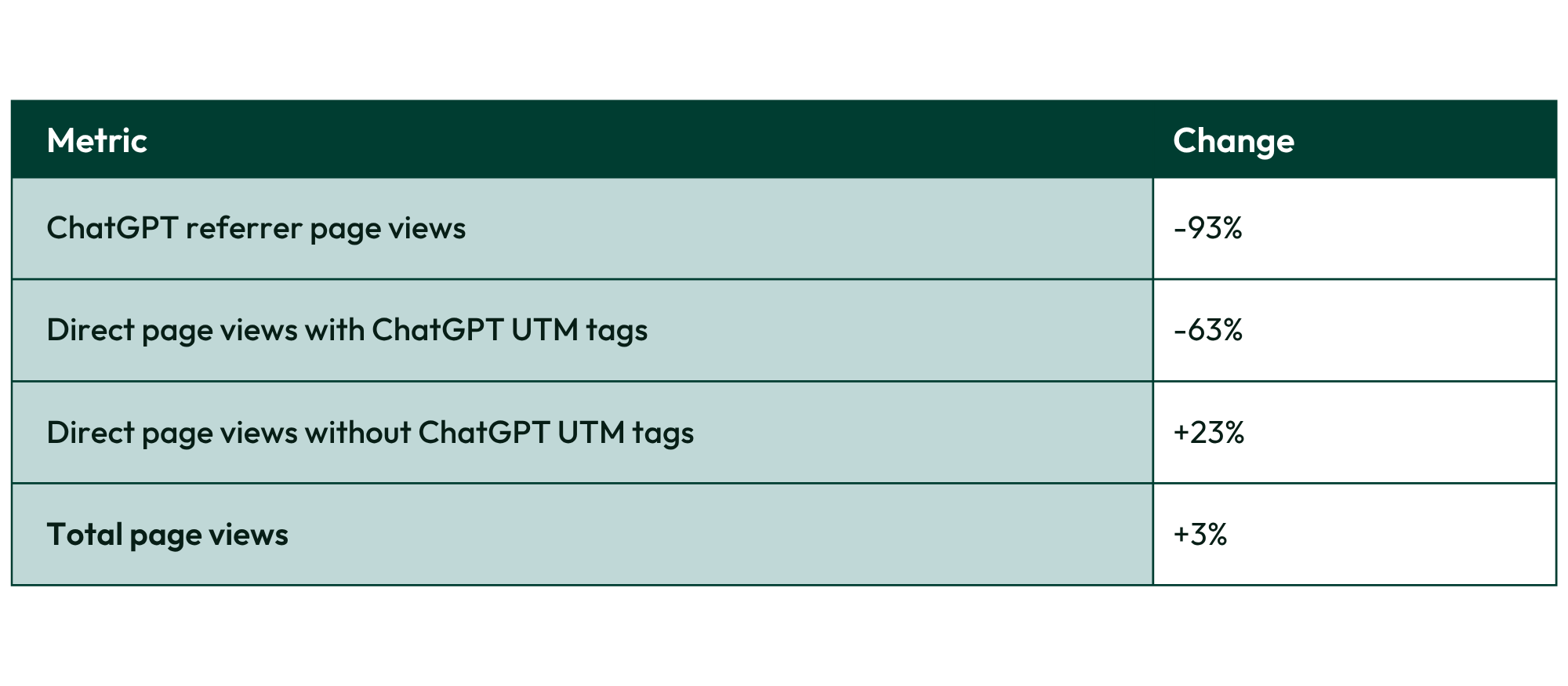
The absolute numbers provide additional context. Recognizable ChatGPT referrer activity fell by approximately 845 page views, while Direct page views that still carried ChatGPT’s UTM parameter fell by another 1,285. Together, those two identifiable categories declined by roughly 2,130 page views. Over the same period, untagged Direct increased by approximately 2,335 page views.
What’s particularly interesting is that total traffic to those seven pages remained relatively stable, increasing just 3%, which was within the observed range of normal variation. The comparison pages also behaved differently, with untagged Direct traffic declining approximately 6% over the same period.
Taken together, the results suggest that some previously identifiable ChatGPT activity may have become unattributed rather than disappearing entirely. Pages with meaningful historical ChatGPT exposure experienced a substantial decline in identifiable activity alongside a similarly sized increase in untagged Direct, while pages with little ChatGPT exposure didn’t show the same increase.
There are limitations to that conclusion. We can’t establish that every additional Direct page view originated from ChatGPT because untagged Direct traffic contains no information about its source. The page groups also covered different types of content, which could have experienced different demand patterns. Still, the timing and relative magnitudes are consistent with a temporary loss of attribution.
The pattern also weakened after October 16th. As UTM-tagged traffic recovered, untagged Direct returned closer to normal. Later increases in overall page views and Search traffic made it more difficult to separate potential attribution changes from shifts in underlying demand.
A Separate GA4 Property Told a Different Story
We also examined AI traffic in GA4 for a separate, unrelated website, where recognizable ChatGPT sessions followed a different trend. Rather than declining, average daily ChatGPT-attributed sessions increased from approximately 50 during October 1–8 to roughly 78 during October 17–20.
Direct sessions remained broadly stable in the comparison, and we didn’t find a consistent pattern of ChatGPT sessions declining while Direct increased on the pages examined. Despite the changes observed in citation URL tagging, GA4 continued identifying more ChatGPT sessions during the latter period.
This provides an important counterpoint to the Parse.ly findings, although it doesn’t necessarily mean GA4 was capturing every AI visit. The two analyses represent separate websites with different audiences and analytics implementations. They’re also measuring different things: GA4 reports sessions, while our Parse.ly investigation focused on page views.
What the comparison illustrates is that changes in AI attribution don’t necessarily produce consistent outcomes across websites or reporting platforms. In one dataset, recognizable ChatGPT referrers fell sharply. In another, identifiable ChatGPT sessions continued growing. Our citation monitoring showed yet another pattern, with URL tagging remaining depressed even after tagged website traffic had recovered in Parse.ly.
We can’t identify a single cause that explains every observation, but the differences demonstrate why relying on one measurement alone can make it difficult to understand what’s happening with AI-driven traffic.
What Marketers Should Take From This
We originally explored the AI attribution problem in AI Traffic Is Already in Your Analytics. You’re Just Not Seeing It, where server-log testing and changes in Direct traffic revealed activity that conventional referral reporting wasn’t adequately capturing. The October findings add another complication: the attribution signals themselves aren’t necessarily stable.
For marketers evaluating AI visibility, that means looking beyond a single acquisition report and understanding how the underlying traffic is classified. There are a few practical considerations worth keeping in mind.
Separate referral attribution from campaign tracking. If an AI platform stops appending UTM parameters, that doesn’t automatically mean its referrers have disappeared. Conversely, a platform can continue tagging outbound links while referrer-based reporting declines. Looking at both signals, where available, can help distinguish changes in tracking behavior from changes in traffic volume.
Look at individual pages, not just channel totals. Aggregate Direct traffic can be noisy, particularly when AI referrals represent a relatively small share of overall visits. Pages that historically receive meaningful ChatGPT traffic may provide a clearer picture. Comparing identifiable AI traffic, tagged and untagged Direct, Organic Search, and total traffic can help reveal changes that would otherwise be lost in site-wide reporting.
Use comparison pages and account for normal variation. An increase in Direct traffic isn’t evidence of lost AI attribution by itself. That relationship becomes more meaningful when pages with substantial historical AI exposure behave differently from pages with relatively little exposure, especially when total traffic remains stable. Seasonality, changing demand, and other marketing activity should still be considered.
Treat citation monitoring and website analytics as complementary. Citation monitoring can reveal which URLs AI platforms are generating and whether those links contain tracking parameters. Website analytics can show how incoming visits are classified. Looking at both provides more context, but neither offers a complete measurement of AI-driven traffic on its own.
The broader recommendation is to investigate changes in attribution before interpreting a sudden increase or decline in AI referrals as a change in performance. If the tracking mechanisms themselves have changed, the numbers may tell a different story than the underlying visitor activity.
The Measurement Gap Is Real, But It Isn’t Uniform
Our October investigation provides further evidence that meaningful changes in AI attribution can occur without a corresponding, measurable decline in overall website traffic. On one website, the relationship between lost identifiable ChatGPT activity and increased untagged Direct traffic was particularly compelling. On another, GA4 continued showing growth in recognized ChatGPT sessions. Our citation monitoring also recorded substantial changes in URL tagging that didn’t align consistently with either website’s analytics.
These observations don’t establish a universal undercount or tell us precisely how many AI-driven visits went unidentified. The website analyses cover individual properties, while the citation data reflects a monitored sample rather than all ChatGPT answers. What they do establish is that attribution mechanisms deserve scrutiny when evaluating AI traffic performance.
The industry is improving at measuring AI traffic. GA4’s AI Assistant channel is a step forward, and platform-level URL tagging helps fill gaps left by missing referrers. However, neither approach guarantees consistent measurement, particularly when the platforms sending traffic can change how those signals are provided.
For marketers investing in AI visibility, the implication is straightforward: a sudden decline in recognized AI referrals doesn’t necessarily mean AI stopped contributing, just as a growing AI Assistant channel doesn’t mean every AI-driven visit has been accounted for. We’re getting better at seeing the traffic, but understanding what our analytics may be missing remains an important part of measuring AI’s contribution.