Medical Device Marketing Has Gone Digital
A few weeks ago, we attended The MedTech Conference in Boston, which brought together medical device brands ranging from startups still working toward FDA clearance to industry leaders whose products impact millions of patients. Events like this are one of the best ways for us to hear directly from marketing and commercialization teams about what they’re working through as they bring their devices to market.
This year, we wanted to put some numbers behind those conversations, so we ran a quick poll at our booth to find out how familiar attendees are with the ideas shaping digital marketing today. Poll questions ranged from first-party data and health data privacy to AI search and attribution. Most knew the basics, but a few answers stood out. Take attribution, a concept that has long been part of the marketing zeitgeist in other industries. When we asked what attribution means in marketing, fewer than half of the attendees we polled chose the right answer, which is determining which marketing touchpoints get credit for a sale or lead. The gap reflects an industry that, until recently, hasn’t leaned on digital channels the way its counterparts in other verticals have.
For decades, go-to-market strategy for medical device companies has meant boots on the ground. Field reps called on physicians in their offices, trained clinical staff on their devices, supported procedures in person, and sponsored training and dinners at specialty conferences.
There were good reasons this approach lasted so long. For many devices, the physician’s preference largely determined what a hospital bought. Many devices are also technically complex, and physicians came to rely on reps for hands-on training and procedure support. Often, the reps’ support was as much a reason to choose a device as the device itself.
Those conditions haven’t disappeared, but they’ve been eroding for more than a decade. MedTech companies are relying less on reps alone and broadening how they reach patients and clinicians alike.
Why Are Medical Device Companies Shifting to Digital Marketing?
The first shift was buying power. Under pressure to contain costs, hospitals began routing device purchases through value analysis committees, and by 2012, 64% reported using one. These committees bring together supply chain, finance, nursing, and administration, and in a 2023 survey, just 18% of healthcare leaders said physicians take an active leadership role. Reps now have to make a financial case alongside the clinical one.
COVID accelerated the trend. In 2020, 92% of survey respondents said their hospitals were restricting reps. In-person access has partly returned, but many physicians now prefer digital channels when researching a new technology, and 64% of MedTech companies have launched or grown inside sales teams.
The category itself is also changing, and more medical devices now reach people the way consumer products do. In Rock Health’s 2025 survey of 8,000 U.S. adults, 57% said they own at least one wearable or connected health device, such as a smartwatch, blood pressure cuff, or glucose monitor, and wearable ownership alone has climbed from 13% to 46% in a decade. Across every device type, the most common way people got one was buying it themselves. Clinical tools are crossing over too. Nearly half of the glucose monitor owners in the survey reported no diabetes diagnosis, and the FDA now allows both hearing aids and glucose monitors to be sold over the counter. When the consumer is the buyer, digital is a natural way to reach them.
Digital isn’t only working for consumer devices. Inspire Medical Systems, which makes the first FDA-approved nerve stimulation implant for obstructive sleep apnea, shows it can work for a prescription device too, and at a scale a sales team alone couldn’t reach. Its therapy is for patients who can’t tolerate CPAP, so Inspire needed to reach those patients directly. In 2018, with 46 sales reps in the U.S., its primary patient outreach was Facebook, Google Ads, and radio, all pointing to a website with education, videos, and a physician finder. That year, close to 425,000 visitors used the site to find a physician near them, and more than 22,000 called a clinical site to schedule an appointment. As the model proved itself, Inspire layered on TV, and by 2023 its website drew nearly 13.4 million visits.
Not every device can follow Inspire’s path, though. How far digital can go depends a lot on what a company sells. Over-the-counter devices can use the full direct-to-consumer playbook, while prescription devices have to work through the physician, and the higher a device’s FDA class, the more its marketing has to stay anchored to clinical evidence and cleared claims. Either way, any campaign that touches a person’s health condition brings privacy rules into play.
How Well Do MedTech Marketers Understand Digital Marketing?
Back to the poll. Attendees answered seven multiple-choice questions, and while the poll was small and informal, the pattern was hard to miss.
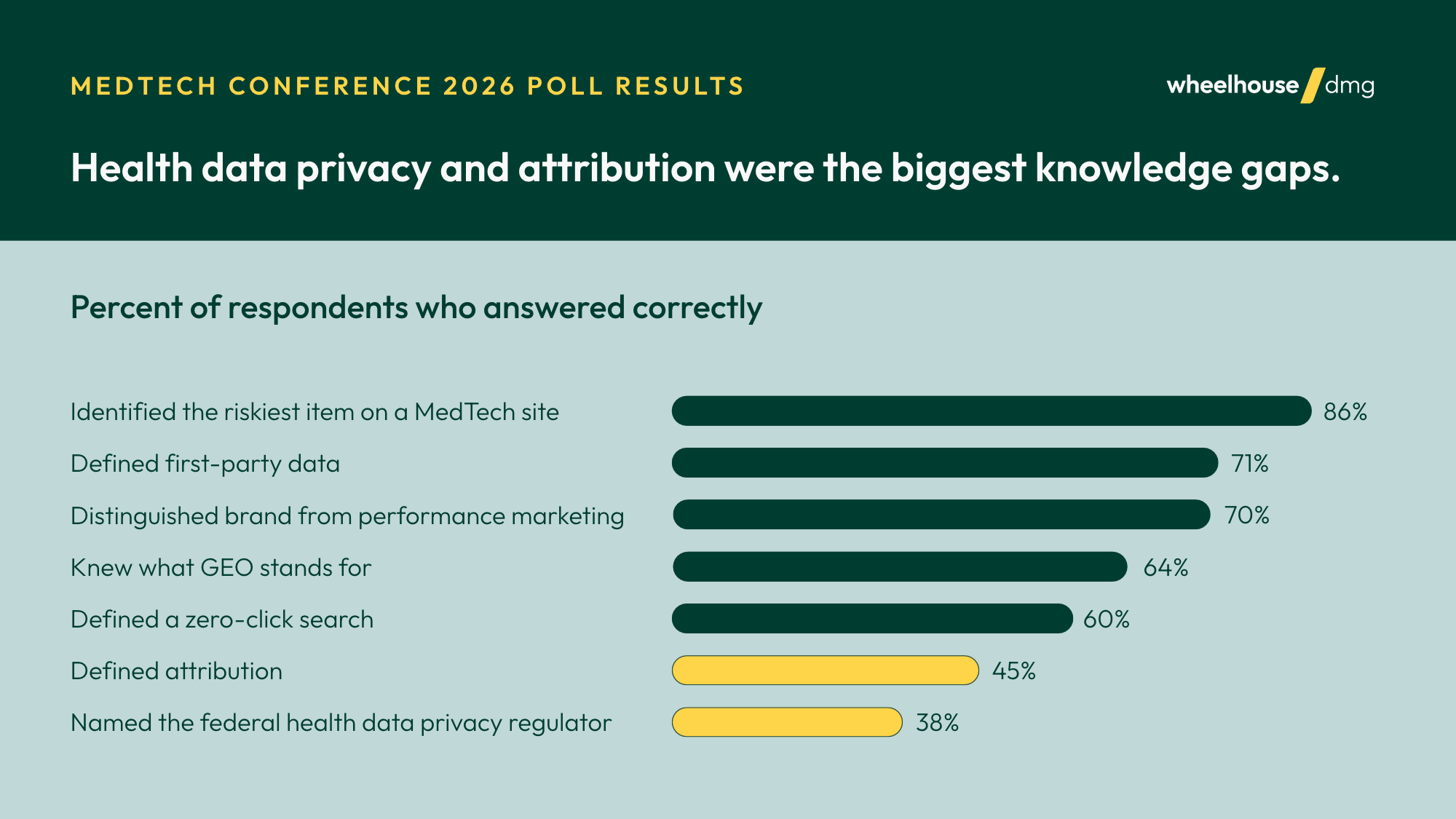
The most encouraging result was on privacy risk, where 86% recognized that an ad tracking pixel on a page where patients request information about their condition creates the most exposure. That matters for anyone marketing a device tied to a health condition. Attendees were solid on other foundations too. Asked to identify first-party data, 71% correctly chose the data a company collects directly, like CRM records and website activity, and 70% knew that brand marketing builds long-term preference while performance marketing drives measurable action now. That still leaves about three in ten missing the basics, but it’s a base to build on.
Newer search concepts were shakier. Only 64% knew that GEO stands for generative engine optimization, and 60% could identify a zero-click search, where the answer appears on the results page or in an AI summary and the person never visits a website. Search is changing quickly, and a sizable share of device marketers haven’t caught that wave yet.
The most remarkable result was attribution. Only 9 of 20 knew it means determining which marketing touchpoints get credit for a sale or lead, and 6 thought it meant giving credit to the agency that created an ad. In our work with privacy-first brands, attribution is a baseline expectation, and it becomes crucial the moment a company starts spending significant money on campaigns, because it’s how a team knows which of them are working. MedTech has long measured success by rep activity, so it makes sense that the discipline is still catching up.
We also found the enforcement question interesting. Only 8 of 21 knew the FTC is the agency that has taken action against health companies for sharing sensitive data through ad tracking tools, and 7 picked the FDA. The FTC’s cases against GoodRx and BetterHelp are the best-known examples. So while most attendees understand where the privacy risk sits, many are watching the wrong regulator.
How Should a Medical Device Company Start With Digital Marketing?
For a device company new to digital, the foundation comes before the campaigns. Start with your device class and claim boundaries, then build first-party data and tracking that keep patient information protected.
Decide how you will measure digital’s contribution to pipeline before you spend on media. That’s the attribution gap from our poll, and with long sales cycles, closing it is what keeps budget approved. If you’re working through this for your own device, I’m happy to compare notes.