
The Complete Guide to Healthcare SEO: Strategies That Drive Patient Acquisition
The State of the Channel
Why does healthcare SEO matter in 2026?
Healthcare search has opened up new terrain in the last two years. AI Overviews, ChatGPT, Gemini, Perplexity, and Copilot now sit alongside Google in the patient research journey. For healthcare marketers, that means more places to be visible, more ways patients can find you, and a clearer competitive separation between brands that have invested in serious organic search and those that haven’t.
38%
Of U.S. adults now use AI for health information at least weekly. AI Overviews and conversational AI assistants have moved from emerging surfaces to mainstream channels for symptom research, treatment comparison, and provider shortlisting. For healthcare brands, the patient research journey now starts in more places than ever before.
Why does healthcare SEO compound over time?
The signals that earn AI citations, including credentialed authorship, primary sources, structured data, topical depth, and technical health, are the same signals that earn Google rankings. Strong SEO is the foundation of AI visibility, which means smart investment in organic search pays off across every surface where patients search. Brands that built that foundation over the last several years are the ones LLMs surface today.
What makes healthcare SEO different from other industries?
What stays distinctly healthcare is the operating environment: HIPAA constraints on analytics, regulated claims language across HCPs, MedTech, pharma, and research organizations, and longer trust-driven conversion cycles than almost any other category. There’s a higher quality bar, and a higher reward for getting it right.

Who this guide is built for
This guide is for healthcare marketers who already know what SEO is. It focuses on what’s genuinely different about healthcare SEO in 2026: audience segmentation, AI search visibility, patient-journey-aligned UX and CRO, HIPAA-compliant measurement, and the specific tactics that move the needle in a regulated, trust-driven category.
AI Search & GEO
What is generative engine optimization (GEO) for healthcare?
Generative engine optimization (GEO) is the practice of optimizing healthcare content to be retrieved and cited by AI search tools, such as ChatGPT, Gemini, Claude, Perplexity, and Microsoft Copilot, alongside (not in place of) traditional SEO for Google. Healthcare is the most active vertical in AI search, and the patterns are clarifying enough to act on. Patients are researching symptoms, comparing treatments, and shortlisting providers inside these tools, often before any traditional search engine enters the picture.
For healthcare marketers, the practical questions are how AI handles health queries differently, what earns a citation inside an LLM response, and how to measure visibility on surfaces that don’t report clicks the way Google does.
How does AI search handle healthcare queries differently than Google?
Patient queries themselves have changed alongside the platforms answering them. Searches are getting longer, more conversational, and more question-shaped, part of a broader evolution in how people search.
AI search treats health content with more caution than other categories, sometimes. Disclaimers and “consult your doctor” language used to be standard in chatbot health responses, but coverage has dropped sharply.
<1%
Of AI health responses now include disclaimers or “consult your doctor” warnings. A 2025 Stanford-led study found AI tools cite credentialed sources less defensively than they used to. The citation opportunity for healthcare brands is wider, but so is the risk that AI-surfaced content will be misinterpreted by patients without disclaimers attached.
Stanford-led Study, 2025
The E-E-A-T signals that drive Google rankings also drive AI citation. Authored content with credentialed bylines, primary-source citations, structured data, and clear publication dates is materially more likely to be retrieved and quoted by LLMs. The same investment that wins on Google now wins AI visibility too.
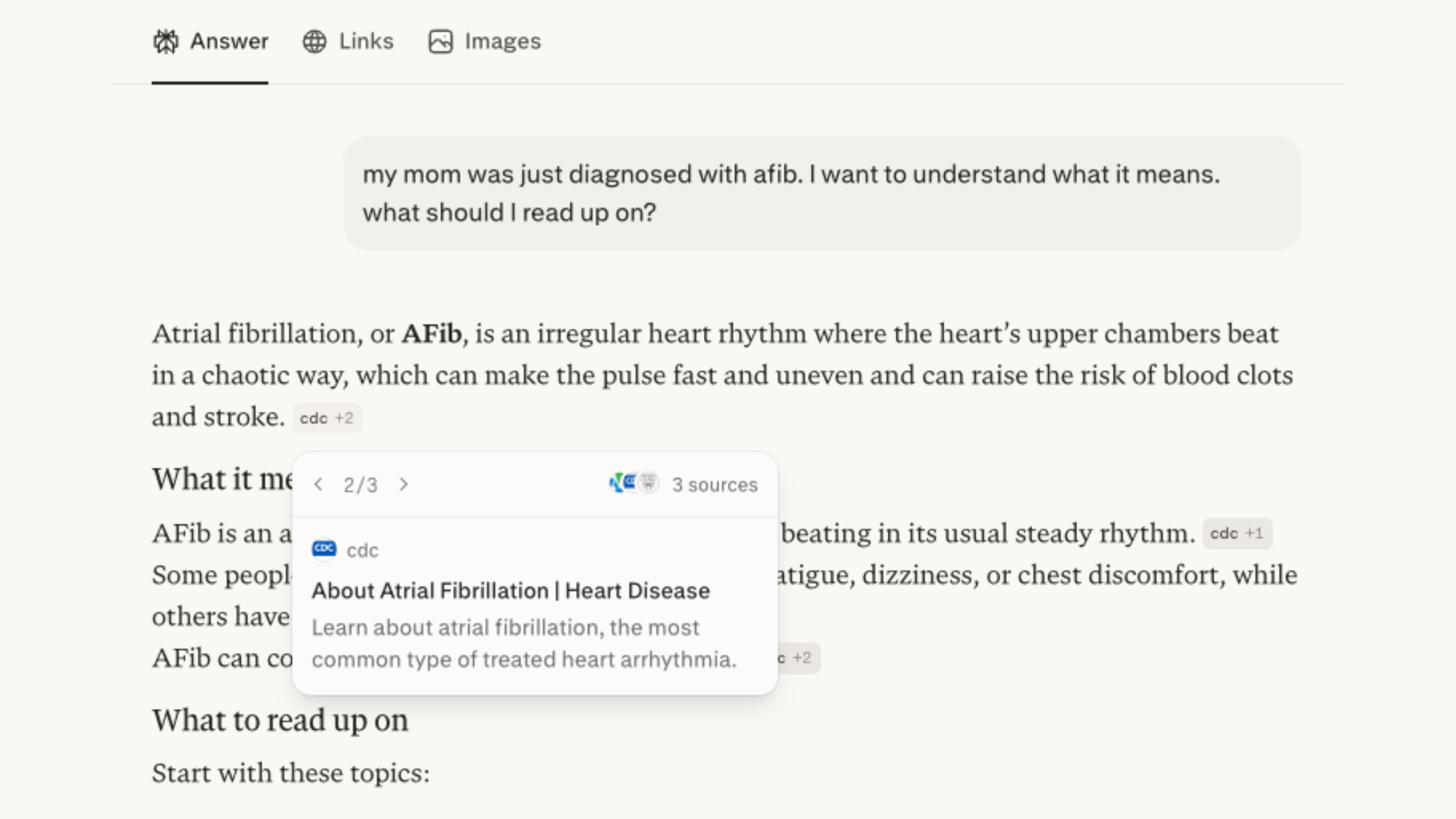
What AI citation looks like in practice. An LLM response surfacing a credentialed healthcare source, with the citation link patients can follow back to the brand.
How do you monitor brand visibility in AI search?
Tracking share-of-voice and monitoring brand visibility in AI search is now a baseline marketing operations capability. Specialized tools have emerged for this purpose:
- Profound. AI search monitoring across major LLMs, brand mention tracking, and competitive benchmarking.
- SE Ranking. Integrated AI tracking alongside traditional rank monitoring.
- SEOmonitor. Agency-focused reporting that connects classic Google rankings with AI Overviews, ChatGPT, and Gemini visibility.
- Manual prompting. For emerging tools and use cases, structured manual prompting against your priority queries remains essential.
What are the compliance and brand risks of AI-generated healthcare content?
AI-generated healthcare content is a real brand risk, not a hypothetical one. Hallucinated medical claims, misattributed citations, and outdated treatment recommendations all create reputational and, in some cases, regulatory exposure.
Google’s position is consistent with its overall stance: AI-assisted content is fine if it’s helpful, accurate, and demonstrably reviewed by qualified humans. The real question for healthcare marketers is how to use AI without breaking the trust signals that make healthcare content rank.
Our recommendation on AI-generated content
AI for ideation, outlining, and first drafts. Credentialed humans for substantive writing, accuracy review, and final approval. The combination of AI efficiency and human medical expertise is faster than purely-human production and safer than purely-AI production.
Why is the AI citation opportunity widening for healthcare brands?
AI tools cite credentialed sources less defensively than they used to. The citation opportunity for healthcare brands is wider, but so is the risk that AI-surfaced content will be misinterpreted by patients without disclaimers attached. Brands that publish credentialed, structured, primary-source-backed content benefit from both sides of that shift.
The Patient Journey
What does the healthcare patient journey look like in search?
The healthcare patient journey moves through three stages in search: informational research (symptoms and conditions), commercial comparison (treatments and providers), and transactional booking (appointments and locations). Search behavior, content needs, and conversion drivers shift sharply at each stage.
That’s also why healthcare SEO doesn’t have one playbook. The strategy that works for a national hospital system fails for a specialty clinic, and a tactic that drives MQLs for a medical device manufacturer will look very different from what works for a research nonprofit. Search intent, content type, and compliance considerations all shift across audience types, and across stages of the journey.
How does search intent change across the patient journey?
A patient researching symptoms is in a fundamentally different mindset than one comparing providers or one ready to book. Effective healthcare SEO maps content to journey stages.
Research
Symptom & condition research
Informational, high-volume, often dominated by WebMD and Mayo Clinic. Compete here through E-E-A-T signals, depth, and unique data, not by chasing head terms.
Compare
Treatment & provider comparison
Commercial intent, mid-funnel, where most healthcare brands have the strongest realistic ranking opportunity.
Convert
Booking & conversion
Transactional, often local, where Local SEO and on-site UX/CRO matter more than content.
Who are the main audience segments in healthcare SEO?
Large healthcare providers (HCPs)
Large hospital systems have the highest-volume opportunities to rank for service-matched terms, but face fierce competition from peer systems and aggregators. Strategy here typically centers on local SEO at scale, service-line content depth, and personalization across geographic markets. Patients rarely care what services are offered outside their own region, so brand-level content tends to underperform localized content for these providers.
MedTech and pharmaceutical brands
Medical device and pharma companies rarely win head-term battles against WebMD or major HCPs. The opportunity lies in long-tail informational content, condition-specific FAQs, and brand-query optimization integrated with digital PR. Compliance constraints are tighter: regulated claims language, FDA disclosure requirements, and region-specific advertising rules (Germany, for example, prohibits marketing certain medical devices to children under 14).
Specialized HCPs and independent practices
Smaller, specialized providers usually have a narrow but real opportunity in non-brand search. Diagnosis and execution must both be precise: identifying where the practice can realistically compete, building demonstrable E-E-A-T signals around key practitioners, and executing local SEO without resorting to grey-hat tactics that don’t hold up.
Research organizations and nonprofits
Medical research organizations and health nonprofits often hold the strongest natural E-E-A-T position of any category. They’re primary sources for the data and expertise that other healthcare content cites. The challenge is usually strategic rather than tactical: defining CTAs, conversion goals, and KPIs in a way that connects organic performance to organizational priorities.
What Top Programs Do
How should SEO support the patient journey?
SEO supports the patient journey best when ranking, landing experience, and booking flow are designed as one continuous system, rather than handed off across siloed SEO, UX, and operations teams. The highest-ROI healthcare SEO programs we’ve worked with all share that integration as a baseline.
What do the highest-performing healthcare SEO programs focus on?
Healthcare SEO investments rarely pay off when treated as a pure acquisition channel. The clients we’ve seen drive the highest ROI from organic search treat it as connected to user experience, conversion, and clinical operations, not separated from them.
- Aligning navigation and content with patient vocabularies, not internal taxonomies. Patients search for “knee replacement surgery,” not “Arthroplasty Services.”
- Adding logical internal links that reinforce content relevance for Google and give users with different qualification needs the next click they’re looking for.
- Testing CTA phrasing, placement, and sequencing, especially on high-intent landing pages.
- Optimizing booking and provider-search interfaces as part of SEO performance, not separately. The appointment-booking flow is an SEO conversion asset.
- Designing organic landing pages to address downstream questions, not just the primary query. A page about “signs of a heart attack” should also surface “what to do next” and “how to find a cardiologist.”
Keyword Research
How do you do keyword research for healthcare?
Healthcare keyword research starts with first-party data (your own paid search query reports and Google Search Console performance), then layers in third-party tools to fill the gaps. Google deliberately withholds keyword data for sensitive health verticals to protect user privacy, so Keyword Planner alone is insufficient.
How do you use first-party data for healthcare keyword research?
Successful healthcare SEO strategies usually begin with first-party data, a more precise and future-proofed starting point than third-party tools, especially in privacy-first industries where Google withholds keyword data more aggressively. Two first-party data sources matter most for healthcare SEO teams: paid search data and Google Search Console.
Paid search data
Your Google Ads search query report is one of the most valuable keyword research sources you have. It shows what terms you bid on, what you spend, what traffic and conversions each drove, and your conversion rate by keyword. That last data point lets you prioritize organic targets based on terms that have already proven valuable on your site, and calculate what you’ll save by earning that traffic organically. At Wheelhouse DMG, we run our clients’ paid search data through Lighthouse, our proprietary healthcare search intelligence platform, to surface high-converting keywords for organic targeting at a scale other tools can’t match.
Google Search Console
Google Search Console is the best place to find “striking distance keywords,” meaning terms you already rank for but could optimize further. Looking beyond your top traffic-drivers, the real opportunity often lies with keywords ranking too low to drive meaningful traffic but already adjacent enough to push higher with focused optimization. Lighthouse helps us identify and prioritize these opportunities at scale across our healthcare clients, including projecting the traffic and revenue impact of pursuing each.
What third-party tools work best for healthcare keyword research?
Third-party tools fill in gaps in first-party data, but in healthcare you should expect more friction than in other categories. Google deliberately withholds keyword data for sensitive verticals like health and finance to protect user privacy, and Keyword Planner often filters out terms tied to protected health conditions. Workarounds matter here.
- Ahrefs Keyword Explorer. Competitive analysis and keyword gap insights, including for keywords Google filters.
- Google Keyword Planner. Strong for location-specific volume; weakest for sensitive medical queries.
- SEMrush. Strong topic clustering through Keyword Magic Tool; competitor keyword discovery.
- SEOmonitor. Forecasting, business-impact modeling, and AI Overview tracking.
- Google Trends. Seasonality and emerging health topics; useful for timely content planning.
- AlsoAsked + SERP trackers. Uncovering question-based intent and SERP feature opportunities.
The Healthcare Standard
What is E-E-A-T, and why does it matter most in healthcare?
E-E-A-T is a constellation of structural, content, and off-site indicators that, together, tell Google your content can be trusted on health topics, rather than a single ranking signal. Healthcare marketers should focus on four categories of signal.

Read this one twice
Google’s E-E-A-T (Experience, Expertise, Authoritativeness, Trustworthiness) framework applies with unusual rigor to YMYL content, and healthcare is the most YMYL category there is. Google’s 2022 Helpful Content Update reinforced this further. Sites without clear expertise signals saw outsized organic losses, and ungated medical content from non-credentialed sources was hit hardest.
Author credentials & bylines
Every piece of medical content should have a named, credentialed author. Author bios should appear on the page, link to a full author page, and clearly state credentials, affiliations, and areas of expertise. “Medically reviewed by Dr. Jane Doe, MD, Cardiology,” with a link to Dr. Doe’s author page, is the kind of signal Google’s quality raters explicitly look for.
Clinical review & update disclosures
Date stamps matter. So does separating the writer from the medical reviewer. Best practice: list both author and medical reviewer, the original publish date, and the most recent review date. For evergreen medical content, schedule formal annual reviews and reflect them on-page. “Last medically reviewed: April 2026” builds trust signals that Google rewards.
Citation practices
Medical content should cite primary sources, such as peer-reviewed journals, government health agencies (CDC, NIH, WHO), and major medical institutions. Inline citations with hyperlinks signal rigor. Avoid citing other health content marketers, since it weakens the chain of authority and replicates whatever errors exist upstream.
Demonstrating expertise vs. building authority
Expertise lives on your site: the content itself, the bylines, the medical review, the depth. Authority lives off your site: backlinks from medical journals, mentions in news coverage of health topics, citations by other credentialed sources. The two reinforce each other. Stronger on-site expertise signals make off-site authority easier to earn, and earned authority lifts the perceived expertise of everything you publish. There are no shortcuts.
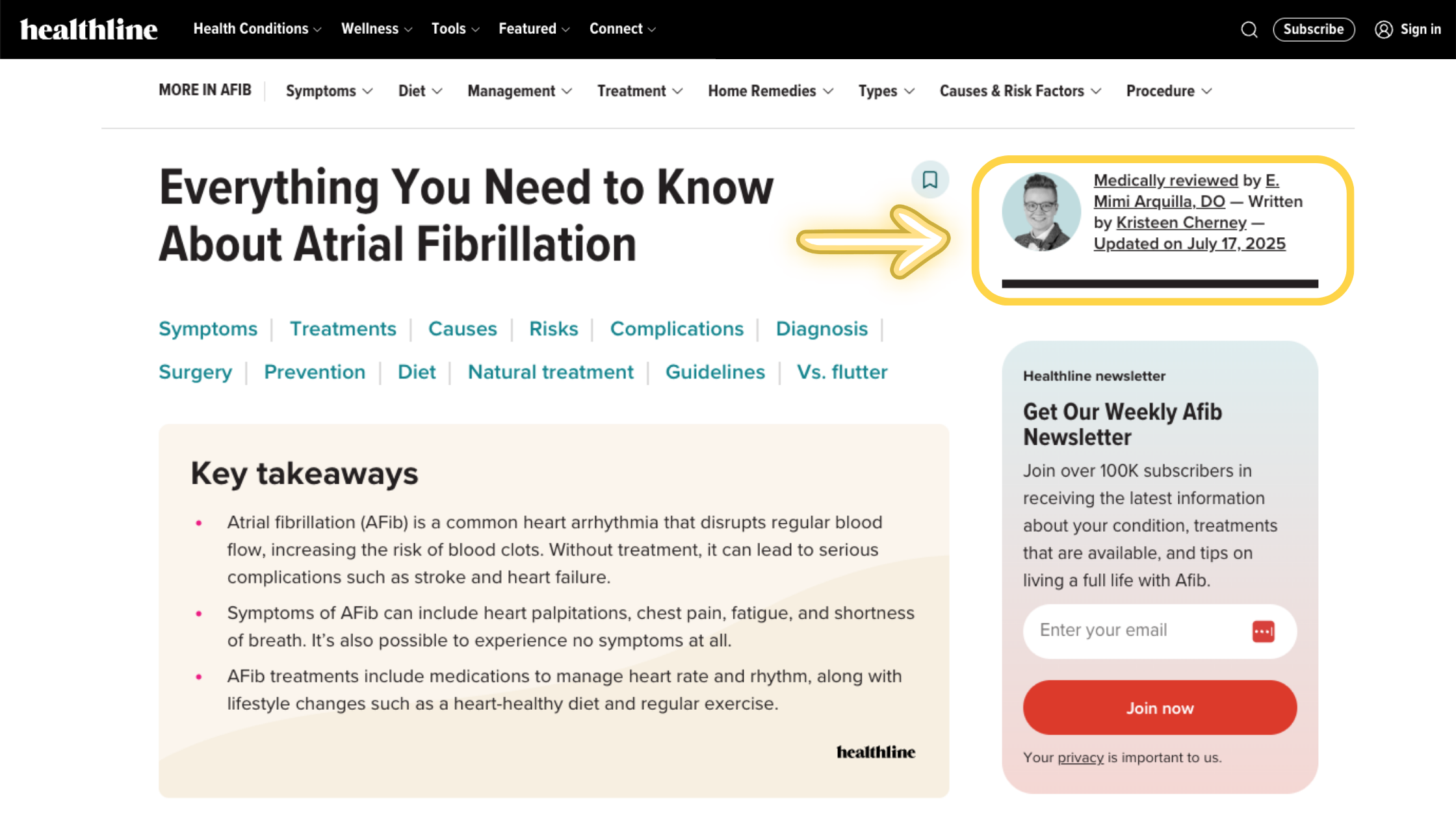
E-E-A-T signals on the page. Named author, separate medical reviewer, credentials, and a visible “last medically reviewed” date — the structural cues Google’s quality raters explicitly look for.
UX & CRO Integration
How do you integrate SEO with UX and CRO in healthcare?
You integrate SEO with UX and CRO in healthcare by treating ranking, landing experience, and booking flow as one connected system, then optimizing across all three together. The conversion funnel here is longer and more trust-dependent than almost any other category, which means siloed SEO leaves measurable revenue on the table.
Why does siloed SEO underdeliver in healthcare?
Healthcare SEO underdelivers most often when it’s siloed from UX and CRO. Patients don’t convert because of rankings. They convert because of what happens after they land. The brands seeing the strongest SEO ROI treat ranking, landing experience, and booking flow as one continuous system.
In most categories, an SEO program can move the rankings needle without ever touching the conversion path. In healthcare, that gap is where most of the opportunity lives. A high-ranking provider page that buries the appointment booking flow under three navigation clicks has spent organic traffic without earning patient acquisition.
The conversion funnel for healthcare is longer, more cautious, and more trust-dependent than almost any other category, which means SEO without CRO leaves measurable revenue on the table.
How should organic landing pages align with provider booking flows?
The first organic landing page a patient sees should anticipate the next three actions they’re likely to take: verifying provider credentials, checking insurance acceptance, finding the nearest location, and booking. Designing landing pages around that sequence (rather than around topical content density alone) is one of the highest-ROI integrations of SEO and UX in healthcare.
How do you A/B test CTAs without violating HIPAA?
Standard A/B testing platforms create real HIPAA exposure when applied to healthcare sites. They collect, store, and process visitor data in ways that often violate compliance requirements. VWO is HIPAA-compliant and will sign a BAA, which makes it our default recommendation for healthcare CTA testing. Combined with Compass, Wheelhouse’s HIPAA-compliant marketing data warehouse, healthcare marketers can run rigorous CRO programs without compromising on compliance.
Why is the appointment booking interface an SEO asset?
Provider search and appointment booking interfaces are usually treated as engineering or operations problems, but they function as SEO conversion assets too. Speed, mobile usability, accessibility, and clarity of available appointment slots all influence whether organic traffic converts. SEO leads who pay attention to these interfaces, and who advocate for fixing the painful ones, typically see the largest gains in revenue per organic visit.
On-Page
What does on-page SEO look like for healthcare websites?
Healthcare on-page SEO comes down to three priorities: metadata that’s specific and differentiated by page type, header structure that delivers full topical coverage against the questions patients actually ask, and long-form formatting designed for both accessibility and skimmability. Each one compounds harder in a YMYL category than in general SEO.
How should you write meta titles and descriptions for healthcare pages?
Metadata still drives meaningful CTR gains when done well. The framework that holds up:
- Specificity. Each page type’s metadata clearly distinguishes its purpose.
- Differentiation. Similar pages don’t share interchangeable titles and descriptions.
- Competition. Metadata is benchmarked against pages currently outranking yours. What’s pulling clicks in the SERP that you’re missing?
How should you structure content and headers for healthcare SEO?
The single highest-leverage on-page tactic we see consistently work: audit your H1–H3 coverage against your target topic and the pages outranking you. If a competitor’s outline reads as more thorough, more specific, or more aligned with how patients actually ask questions, you have a concrete optimization target. The goal is full topical coverage: whether your page addresses the subtopics a search engine and a patient would expect to find.
How do you format long-form healthcare content for readability and SEO?
Long-form healthcare content can drown its own SEO value if it’s a wall of text. Practical formatting moves:
- Add a table of contents with jump links on long pages.
- Use expandable sections for FAQs and dense subtopics.
- Test layouts across devices, including older browsers and assistive tech.
- Run accessibility reviews. Healthcare audiences skew older and more disability-inclusive than most.
- Use pull quotes and callouts to draw attention to key statistics and takeaways.
Technical SEO
What technical SEO matters most for healthcare sites?
Healthcare technical SEO concerns cluster around three areas: structured data (especially healthcare-specific schema), indexation control (protecting patient portals and compliance-sensitive paths), and accessibility (WCAG 2.1 AA compliance for an older, more disability-inclusive audience). Mobile-first indexing is the baseline beyond that.
What schema markup should healthcare websites use?
Schema markup is one of the few technical SEO investments where healthcare-specific opportunity is meaningful and well-supported. Recommended schema types by content:
Hospital
Describing hospitals and their services
Physician
Individual healthcare professionals like doctors
MedicalClinic
Clinics or outpatient services
Medical
Broad category for healthcare-related orgs
Medical
Describing medical conditions
Medical
Symptoms associated with conditions
Medical
Medical or diagnostic procedures
Surgical
Specific surgeries
Medical
Therapies or treatments
Drug
Pharmaceuticals and medications
MedicalTest
Medical tests and diagnostics
Medical
Clinical guidelines
Medical
Scholarly articles in medicine
Medical
Medical studies or clinical trials
How should healthcare sites manage indexation with sitemaps and robots.txt?
Healthcare sites often have complex structures: service pages, provider profiles, patient resources, portals, intranets. XML sitemaps ensure all important content is discoverable; robots.txt ensures the wrong content isn’t indexed. The healthcare-specific concerns:
- Use robots.txt to protect patient-facing portal paths from indexation.
- Block administrative and compliance-sensitive areas from crawling, not because robots.txt is a security measure (it isn’t), but to avoid surface-area accidents in indexed search results.
- Reference your sitemap in robots.txt to make discovery efficient.
- Audit indexed pages quarterly via Google Search Console. Healthcare sites accumulate orphaned and accidentally-indexed pages faster than most.
Why is accessibility a healthcare SEO ranking factor?
Healthcare audiences include disproportionately more elderly users and users with disabilities. Beyond ADA compliance, accessibility is also a usability requirement and a Google ranking factor through Core Web Vitals and overall UX signals. Build to WCAG 2.1 AA as a minimum standard, and treat accessibility audits as a recurring engineering practice rather than a one-time launch checklist.
Local SEO
How do healthcare providers win at local SEO?
Healthcare providers win at local SEO through accurate Google Business Profile management at every location, healthcare-specific directory citations (Healthgrades, Zocdoc, Vitals), NAP consistency across all listings, and HIPAA-compliant review management. It’s where healthcare providers most often see fastest organic ROI, and where errors carry unusual stakes. A wrong phone number on Google Business Profile doesn’t just lose a lead; for a clinic with limited evening hours, it can mean a patient driving to a closed building during a medical concern. Healthcare local SEO needs to be tight.
What should be on a healthcare Google Business Profile checklist?
-
Claim and verify the listing for every location.
-
Maintain accurate NAP (name, address, phone) and hours, including holidays and service categories.
-
Upload current photos of facilities, staff, and exterior signage.
-
Use GBP posts for new providers, service launches, and operational updates.
-
Respond to every review (see Reputation Management below for HIPAA considerations).
How do you do local keyword research for healthcare providers?
Local keyword research overlaps with the keyword research approach above but layers in geographic modifiers (“dentist in [City],” “urgent care near [Neighborhood]”) and local intent signals. Google Keyword Planner’s location filter is helpful here. Apply local terms across page content, metadata, and Google Business Profile categories.
Which directories and citations matter for healthcare local SEO?
Healthcare-specific directories matter (Healthgrades, Zocdoc, Vitals) alongside major general directories (Yelp, Yellow Pages). NAP consistency across all listings is the single most important hygiene factor; even small inconsistencies degrade local rankings. Implement Local Business schema on location pages to reinforce signals to search engines.
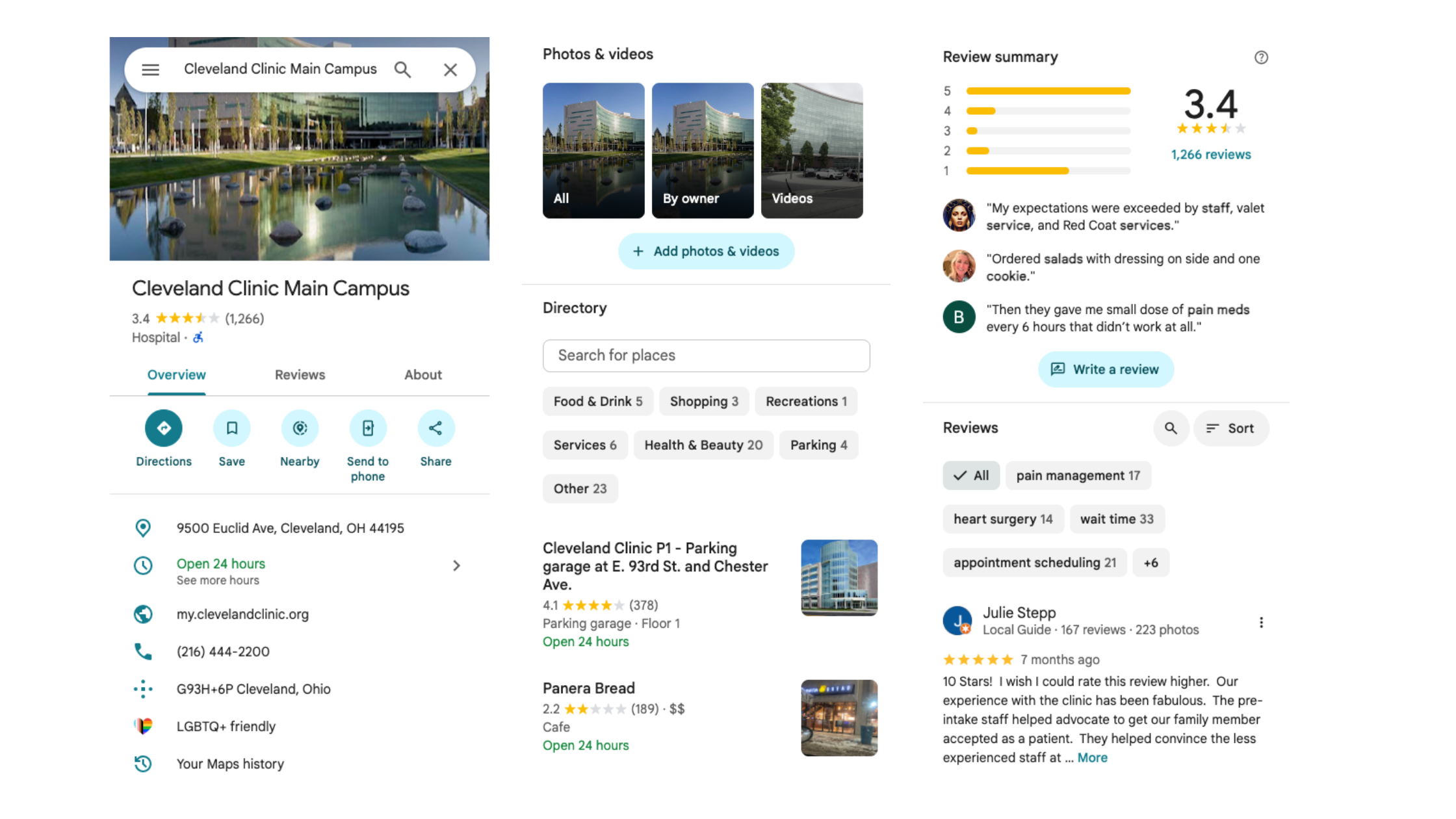
A complete healthcare Google Business Profile. Accurate NAP, current photos, service categories, and active review responses are the foundation of local SEO performance.
How important are online reviews for healthcare SEO?
Patients read reviews before choosing healthcare providers more than in almost any other category. According to recent industry data, 94% of healthcare patients use online reviews to evaluate providers, and nearly half are willing to go out-of-network for a provider with strong reviews. Reviews are simultaneously a local ranking signal, a trust signal, and, in healthcare, a compliance minefield.
The trust factor is hard to overstate. For most service categories, reviews are validation. In healthcare, they’re often the deciding factor between two clinically similar providers, especially for high-anxiety services like surgery, oncology, and mental health.
How do you respond to patient reviews without violating HIPAA?
The complication: responding to a review confirms the reviewer is a patient, which is itself protected information. Some best practices:
- Never confirm or deny that a reviewer is a patient.
- Don’t reference any specific clinical details, even to correct the reviewer.
- Use generic acknowledgment language. Templates below.
- Train front-desk and marketing staff together. Inconsistent responses across staff create the highest compliance risk.
- Encourage reviews proactively, but never offer incentives. Both Google and HHS treat that as policy violations.
Positive Review · Template
“Thank you for taking the time to share your feedback. We’re committed to providing exceptional care to everyone who walks through our doors and appreciate hearing from our community.”
Negative Review · Template
“We take all feedback seriously and strive to provide the highest quality care. Please contact our patient relations team directly so we can better understand your concerns.”
For more on healthcare-specific local SEO tactics, see our SEO Healthcare Study.
International
What does international SEO look like for multinational healthcare brands?
International healthcare SEO is built on two fundamentals: a clear global website structure (country-specific domains or subdirectories) and properly implemented hreflang tags that route the right version of your site to the right audience. Hreflang lives in the HTML head, the HTTP header, or the XML sitemap depending on the page type. Multinational healthcare brands also face localized content, keyword, and compliance challenges that don’t exist for domestic-only competitors.
The choice between the two patterns is a real architectural decision. Each carries trade-offs that compound over time:
ccTLD Pattern
example.fr
example.de
example.com.au
Pros
- Strongest possible geographic targeting signal to Google and AI search.
- Builds clear local trust with regional patients and HCPs.
- Easier alignment with country-specific data residency and advertising rules.
Cons
- Each domain starts at zero authority. No SEO equity transfers between TLDs.
- Higher operational overhead (registrations, hosting, certificates, governance).
- Slower and more expensive to scale into new markets.
Subdirectory Pattern
example.com/fr/
example.com/de/
example.com/en-au/
Pros
- Inherits authority from the root domain. New markets launch with SEO equity already in place.
- Lowest cost and fastest path to launching additional markets.
- Single ops, content, and analytics stack to maintain.
Cons
- Weaker geographic targeting signal than ccTLDs.
- Shared root-domain risk: penalties, downtime, or compliance issues affect all markets at once.
- May feel less locally trustworthy to users who prefer in-country domains.
For most multinational healthcare brands, the subdirectory pattern is the right starting point. The exception is regulated markets where ccTLDs provide a meaningful trust or compliance advantage, or where a market is large enough to warrant its own dedicated authority profile.
Why does content localization matter more in healthcare?
Direct translation rarely lands, because patient vocabularies, cultural attitudes toward medical authority, and trust signals all vary by region. First-party data from each market and user research with culturally distinct audiences are the best inputs. International keyword research tools that filter by region give you real local search volume rather than translated approximations.
How does compliance stack up across international healthcare markets?
HIPAA in the US, GDPR in the EU, and regional advertising restrictions (Germany’s rules on marketing medical devices to minors, for example) all layer their own rules on top of standard SEO practice. Ensuring compliance across all targeted markets needs to be top-of-mind from the start of any international expansion, not added on after the fact.
Content Strategy
What does an effective healthcare content strategy include?
The most effective healthcare content strategies combine SEO opportunity with broader marketing goals. It’s content that ranks but also fuels email, social, sales enablement, and PR. The starting point is always patient understanding.
“Audiences increasingly stay inside the channels and AI tools where they first encounter content, rather than crossing over to a brand’s website.”
David Patton · Sr. Director of Content Strategy, Fred Hutchinson Cancer Center
For content strategists, that shifts the first question from where you want patients to land to where and how they’re already consuming information, and how you tell one story across the formats and platforms they actually use.
What types of healthcare content drive the most SEO value?
- FAQs. The most repurposable content type. They translate into voice search optimization, AI search visibility, social posts, and sales enablement.
- Patient-focused service detail. “What to expect” and “how to prepare” content consistently outperforms generic service pages in organic search.
- Timely data and thought leadership. Original research, technology trends, and emerging treatment information are strong for both rankings and earned media.
- Consideration and qualification content. Provider-comparison and facility-differentiation content for patients in active research mode.
- Credibility content. Testimonials, awards, certifications, and partnerships reinforce E-E-A-T off the page.
How should large healthcare providers personalize and localize content?
As Kevin Madden, Assistant VP of Web Experience at Providence, pointed out on the Digital Clinic podcast, universal healthcare brand content is “a very efficient way to build a website, but it’s not the most productive way to build a website from a patient’s experience.” Patients usually don’t care what services exist outside their state or which insurances are accepted in markets they don’t live in. Geographically-distributed providers should invest in personalization and localization in parallel with universal content efforts.
What multimedia content performs best for healthcare SEO?
Video is the highest-leverage multimedia investment for most healthcare brands when it meets these criteria:
- Distinctive visual style that won’t look dated in two years.
- Topics and transcripts that map to SEO opportunities.
- Discoverability potential on YouTube as a secondary channel.
- Repurposability into clips for short-form social and paid creative.
- Evergreen subject matter that doesn’t require frequent updates.
Infographics are still useful for complex medical content where a visual concise summary outperforms text. Diagrams and flow charts work well for procedure explanations, treatment pathways, and condition timelines.
How do you optimize healthcare video content for search?
-
Use descriptive, intent-aligned titles. “How to Effectively Manage Diabetes” outperforms “Winning the Glucose Game.”
-
Include full transcripts and closed captions. For both accessibility and to give search engines crawlable content.
-
Apply VideoObject schema. Pair with healthcare-specific schema (MedicalCondition, MedicalProcedure) where relevant.
-
Place videos prominently. Embed them on relevant pages, not buried in a video library.
-
Use custom thumbnails. Professional, on-topic imagery, not auto-generated stills.
How do you build content briefs and calendars for healthcare?
Healthcare content creation is almost always a collaboration between marketers, designers, and clinical SMEs. Without a structured intake (detailed content briefs and a coordinated content calendar), these collaborations fragment quickly. We partner with clients to build healthcare content strategy programs around governing documents that keep marketing, design, and clinical review aligned, so production scales and a higher percentage of content actually performs.
Link Building
How do you build links for healthcare websites?
You build healthcare links through original research and proprietary data, expert collaborations with credentialed practitioners, healthcare-specific directories, community and PR-driven coverage, and long-horizon medical journal and health-organization partnerships. Volume tactics don’t hold up here: the competitive set includes some of the most authoritative domains on the open web (WebMD, Mayo Clinic, the NIH, major hospital systems, and credentialed medical journals), and domain authority gaps are real.
Which link building approaches hold up in healthcare?
Original research and data
Studies, patient-outcome data, and proprietary research are the strongest natural link magnets in healthcare. Other publishers cite primary sources, so give them one.
Expert collaborations
Interviews, podcasts, and roundups featuring credentialed practitioners. The combination of credentialed sourcing and unique perspective makes this content link-worthy.
Healthcare-specific directories
Healthgrades, Zocdoc, Vitals. They build links and patient visibility simultaneously.
Community and PR-driven coverage
Local health events, sponsorships, and partnerships with research foundations are all routes to legitimate news coverage that yields high-authority backlinks.
Medical journal citations and health-organization partnerships
The highest-value link sources in healthcare and the hardest to earn. Worth investing in over multi-year horizons.
Measurement
How do you measure healthcare SEO success?
You measure healthcare SEO success using a tiered KPI hierarchy: business outcomes first (appointments booked, MQLs, revenue per organic visit), search visibility second (AI search citations, AI Overview visibility, SERP features), and engagement and technical signals third (organic traffic, Core Web Vitals, backlink quality). Measurement has changed materially in the last two years; click-based metrics like organic traffic still matter, but the rise of AI Overviews and zero-click search means the relationship between rankings and traffic has decoupled.
Tier 01
Appointments booked, MQLs, and consultations. The metrics SEO is ultimately accountable for. If your measurement infrastructure can’t connect organic traffic to these outcomes, that gap is the most important investment to make, typically through a HIPAA-compliant marketing data warehouse like Compass.
Revenue per organic visit. The metric that captures whether SEO is acquiring valuable traffic, not just any traffic.
Tier 02
AI search citations and mentions: how often your brand and content surface in ChatGPT, Gemini, Claude, Perplexity, and Copilot responses.
Google AI Overview visibility: appearance in AI-generated SERP summaries.
SERP feature visibility: featured snippets, People Also Ask, local pack, knowledge panel.
Tier 03
Organic click traffic: still useful, but interpret in context. Falling traffic with rising rankings often means AI Overviews are absorbing clicks.
Bounce rate (compared like-for-like): compare similar page types only; bounce rates vary drastically by intent.
Core Web Vitals: table-stakes UX signal, especially given healthcare’s older and accessibility-needs-heavy audience.
Backlink quality: authority of linking domains, not link count. Medical journals and major health organizations carry disproportionate weight.
What’s the recommended healthcare SEO measurement stack?
- GA4 + Google Search Console. Traffic, click data, and search performance. Free, robust, and widely supported.
- Ahrefs (or comparable). Competitive analysis, backlink monitoring, and keyword research.
- A rank tracker. SEOmonitor, SEMrush, or similar. Ideally one that includes AI Overview tracking.
- An AI search monitoring tool. Profound, SE Ranking AI Visibility, or equivalent.
How do you make analytics HIPAA-compliant?
Standard GA4 deployments can create real HIPAA exposure on healthcare sites. The Department of Health and Human Services has been increasingly active in enforcement, and many providers are unknowingly non-compliant. Configuring GA4 (and any other tracking) to avoid collecting PHI requires care.
What’s Next
What’s next for healthcare SEO?
Four forces will shape healthcare SEO over the next few years: tightening HIPAA enforcement, LLM-driven search fragmentation, a clarifying division of labor between AI and credentialed humans, and the constant tempo of algorithm change. Build for them now.
HIPAA enforcement will keep tightening
HHS scrutiny on digital marketing tools and analytics platforms has accelerated, and the regulatory environment is unlikely to loosen. Healthcare brands relying on standard analytics or advertising configurations should expect to revisit their compliance posture annually, and to invest in HIPAA-compliant analytics alternatives where standard tools create exposure.
LLM search will reshape the channel
In August 2024, a federal judge ruled that Google holds an illegal monopoly in search. Combined with the rapid rise of LLM-based search behavior, the next several years are likely to see more fragmentation across discovery platforms than the channel has experienced in two decades. Healthcare marketers should expect to maintain visibility across more platforms simultaneously.
AI will reshape workflows, not expertise
The boundaries are clarifying. AI accelerates research, ideation, and drafting. Credentialed humans own accuracy, ethical judgment, and final approval. Healthcare brands that institutionalize human-in-the-loop AI, and resist the pressure to hand more authority to AI than is responsible, will produce content that holds up under both Google’s quality standards and patient trust.
Staying current will remain essential
Algorithm updates and AI search behavior are moving faster than any single team can track passively. We recommend a small set of standing inputs: Search Engine Journal, Search Engine Land, the Google Search Status Dashboard, and Search Engine Roundtable. A useful trick: pipe the Google Search Status Dashboard RSS into Slack via Zapier so updates surface in your team’s daily workflow.
Quick Answers
Healthcare SEO: frequently asked questions.
How should healthcare brands use AI for content creation?
AI for ideation, outlining, and first drafts. Credentialed humans for substantive writing, accuracy review, and final approval. The combination of AI efficiency and human medical expertise is faster than purely-human production and safer than purely-AI production. Google's position: AI-assisted content is fine if it's helpful, accurate, and demonstrably reviewed by qualified humans.
How do you measure healthcare SEO success in a HIPAA-compliant way?
Use a tiered KPI hierarchy:
- Tier 1, business outcomes: appointments booked, MQLs, revenue per organic visit.
- Tier 2, search visibility: AI search citations, AI Overview visibility, SERP feature visibility.
- Tier 3, engagement and technical: organic traffic, bounce rate, Core Web Vitals, backlink quality.
Standard GA4 deployments can create real HIPAA exposure; configure analytics to avoid collecting PHI, and use a HIPAA-compliant marketing data warehouse like Compass to connect organic activity to outcomes.
What schema markup should healthcare websites use?
Healthcare-specific schema types include Hospital, Physician, MedicalClinic, MedicalOrganization, MedicalCondition, MedicalSymptom, MedicalProcedure, SurgicalProcedure, MedicalTherapy, Drug, MedicalTest, MedicalGuideline, MedicalScholarlyArticle, and MedicalStudy. Implementation reinforces topical relevance and increases the chance of rich results in SERPs.
Can you respond to patient reviews without violating HIPAA?
Yes, but carefully. Never confirm or deny that a reviewer is a patient. Responding can itself confirm the patient relationship. Don't reference any specific clinical details, even to correct the reviewer. Use generic acknowledgment language. Train front-desk and marketing staff together. Encourage reviews proactively but never offer incentives, since both Google and HHS treat that as policy violations.
What makes healthcare keyword research different?
Google deliberately withholds keyword data for sensitive verticals like health and finance to protect user privacy, and Keyword Planner often filters out terms tied to protected health conditions. First-party sources, like your Google Ads search query report and Google Search Console, are the most precise and future-proofed starting point. Third-party tools like Ahrefs, SEMrush, and SEOmonitor fill the gaps.
Which audience segments need different healthcare SEO strategies?
Four segments need different playbooks: large healthcare providers (local SEO at scale, service-line depth, geographic personalization); MedTech and pharmaceutical brands (long-tail informational content, brand-query optimization, tight compliance); specialized HCPs and independent practices (precise diagnosis of where they can compete, demonstrable E-E-A-T around key practitioners); and research organizations and nonprofits (surfacing original research, defining business-aligned KPIs).
Legal Disclaimer: The information contained in this communication should not be construed as legal advice on any matter. Wheelhouse DMG is not providing any legal opinions regarding the compliance of any solution with HIPAA or other laws and regulations. Any determination as to whether a particular solution meets applicable compliance requirements is the sole responsibility of the client and should be made after consulting with their own legal counsel.
Work with us
Healthcare SEO is a specialty.
It’s a discipline shaped by E-E-A-T scrutiny, YMYL standards, HIPAA constraints, longer trust-driven conversion cycles, and a competitive set that includes some of the most authoritative domains on the open web. Not general SEO with a few extra rules.
Wheelhouse DMG has spent more than a decade partnering with healthcare and MedTech organizations across hospital systems, medical device companies, pharmaceutical brands, and research nonprofits. If you’re building or scaling a healthcare SEO program and want a partner who treats this as a specialty rather than a generalist line of work, we’d love to talk.
This site is protected by reCAPTCHA and the Google Privacy Policy and Terms of Service apply.